
We read your photo as:
A ball is kicked with an initial velocity of 25 s at an angle of 35° to the ground. Calculate: (a) The maximum height reached. (b) The time of flight. (c) The range.
Physics
ScanSolve AI Answer
Step-by-step solution
19 stepshere are the solutions for all the questions from the image.
Part 5· 6 steps
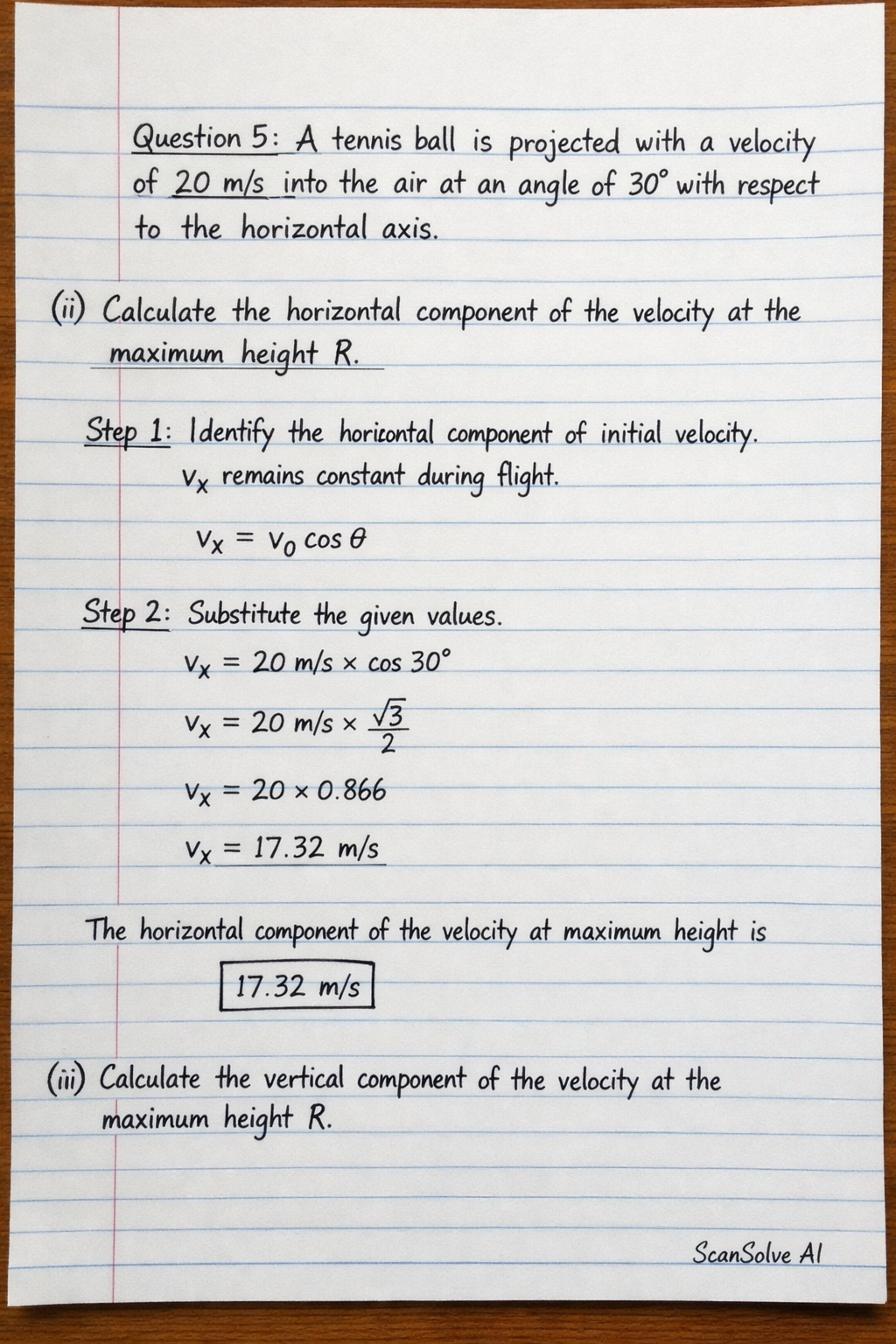
A tennis ball is projected with a velocity of into the air at an angle of with respect to the horizontal axis.
- (i) Calculate the horizontal component of the velocity at the maximum height R.
Identify the horizontal component of initial velocity.
The horizontal component of velocity ($v_x$) remains constant throughout the projectile's flight, assuming no air resistance. $$ v_x = v_0 \cos \theta $$Substitute the given values.
$$ v_x = 20 \text{ m/s} \times \cos 30^\circ $$ $$ v_x = 20 \text{ m/s} \times \frac{\sqrt{3}}{2} $$ $$ v_x \approx 17.32 \text{ m/s} $$ The horizontal component of the velocity at maximum height is $\boxed{\text{17.32 m/s}}$.- (ii) Calculate the vertical component of the velocity at the maximum height R.
Understand velocity at maximum height.
At the maximum height of a projectile's trajectory, the vertical component of its velocity momentarily becomes zero. The vertical component of the velocity at maximum height is $\boxed{\text{0 m/s}}$.- (iii) If the maximum horizontal distance reached is 50 m, calculate the time of flight.
Identify given values and the formula.
Given: Maximum horizontal distance (Range), $R = 50 \text{ m}$. Initial velocity, $v_0 = 20 \text{ m/s}$. Launch angle, $\theta = 30^\circ$. The horizontal component of velocity is constant: $v_x = v_0 \cos \theta$. The time of flight ($T$) is related to the range by $R = v_x T$.Calculate the horizontal component of velocity.
$$ v_x = v_0 \cos \theta = 20 \text{ m/s} \times \cos 30^\circ $$ $$ v_x = 20 \text{ m/s} \times 0.866 $$ $$ v_x = 17.32 \text{ m/s} $$Calculate the time of flight.
$$
T = \frac{R}{v_x}
$$
$$
T = \frac{50 \text{ m}}{17.32 \text{ m/s}}
$$
$$
T \approx 2.89 \text{ s}
$$
The time of flight is $\boxed{\text{2.89 s}}$.
Part 6· 7 steps
A tennis ball rolls off a 1.5 m high table at an initial horizontal velocity of 2 m/s.
- (a) How long does it take for the ball to reach the floor?
Use the vertical motion equation.
The vertical displacement is $h = 1.5 \text{ m}$. The initial vertical velocity $v_{0y} = 0 \text{ m/s}$. $$ h = v_{0y}t + \frac{1}{2}gt^2 $$Substitute the values.
$$ 1.5 \text{ m} = (0 \text{ m/s})t + \frac{1}{2}(9.8 \text{ m/s}^2)t^2 $$ $$ 1.5 = 4.9t^2 $$Solve for .
$$ t^2 = \frac{1.5}{4.9} $$ $$ t = \sqrt{\frac{1.5}{4.9}} $$ $$ t \approx 0.553 \text{ s} $$ The time taken to reach the floor is $\boxed{\text{0.55 s}}$.- (b) How far does the ball land from the table?
Use the horizontal motion equation.
The horizontal distance ($R$) is given by $R = v_{0x}t$.Substitute the values.
Using the time $t \approx 0.553 \text{ s}$ from part (a) and $v_{0x} = 2 \text{ m/s}$. $$ R = 2 \text{ m/s} \times 0.553 \text{ s} $$ $$ R \approx 1.11 \text{ m} $$ The ball lands approximately $\boxed{\text{1.11 m}}$ from the table.- (c) What is the impact velocity of the ball?
Calculate the horizontal and vertical components of the impact velocity.
The horizontal velocity ($v_x$) remains constant: $$ v_x = v_{0x} = 2 \text{ m/s} $$ The vertical velocity ($v_y$) at impact is: $$ v_y = v_{0y} + gt $$ $$ v_y = 0 \text{ m/s} + (9.8 \text{ m/s}^2)(0.553 \text{ s}) $$ $$ v_y \approx 5.42 \text{ m/s} $$Calculate the magnitude of the impact velocity.
The impact velocity ($v$) is the resultant of its horizontal and vertical components:
$$
v = \sqrt{v_x^2 + v_y^2}
$$
$$
v = \sqrt{(2 \text{ m/s})^2 + (5.42 \text{ m/s})^2}
$$
$$
v = \sqrt{4 + 29.38}
$$
$$
v = \sqrt{33.38}
$$
$$
v \approx 5.78 \text{ m/s}
$$
The impact velocity of the ball is approximately $\boxed{\text{5.78 m/s}}$.
Part 7· 6 steps
A ball is kicked with an initial velocity of at an angle of to the ground.
- (a) The maximum height reached.
Use the formula for maximum height ().
$$ H = \frac{v_0^2 \sin^2 \theta}{2g} $$Substitute the values.
Given $v_0 = 25 \text{ m/s}$, $\theta = 35^\circ$, $g = 9.8 \text{ m/s}^2$. $$ \sin 35^\circ \approx 0.5736 $$ $$ H = \frac{(25 \text{ m/s})^2 (0.5736)^2}{2 \times 9.8 \text{ m/s}^2} $$ $$ H = \frac{625 \times 0.3289}{19.6} $$ $$ H = \frac{205.5625}{19.6} $$ $$ H \approx 10.49 \text{ m} $$ The maximum height reached is $\boxed{\text{10.49 m}}$.- (b) The time of flight.
Use the formula for the time of flight ().
$$ T = \frac{2 v_0 \sin \theta}{g} $$Substitute the values.
$$ \sin 35^\circ \approx 0.5736 $$ $$ T = \frac{2 \times 25 \text{ m/s} \times 0.5736}{9.8 \text{ m/s}^2} $$ $$ T = \frac{50 \times 0.5736}{9.8} $$ $$ T = \frac{28.68}{9.8} $$ $$ T \approx 2.93 \text{ s} $$ The time of flight is $\boxed{\text{2.93 s}}$.- (c) The range.
Use the formula for the range ().
$$ R = \frac{v_0^2 \sin(2\theta)}{g} $$Substitute the values.
$$
2\theta = 2 \times 35^\circ = 70^\circ
$$
$$
\sin 70^\circ \approx 0.9397
$$
$$
R = \frac{(25 \text{ m/s})^2 \sin(70^\circ)}{9.8 \text{ m/s}^2}
$$
$$
R = \frac{625 \times 0.9397}{9.8}
$$
$$
R = \frac{587.3125}{9.8}
$$
$$
R \approx 59.93 \text{ m}
$$
The range is $\boxed{\text{59.93 m}}$.
Was this helpful?
Still stuck on this one?
Ask a follow-up, and the answer starts from this question.
Got a different question?Ask your own question
More Physics Questions
QA particle is projected with a velocity of 196m/s at an angle of 30 to the horizontal. Calculate…QA projectile is launched with an initial horizontal velocity of 50 m/s and an initial vertical…QA projectile is launched from ground level at an angle of 35° above the horizontal. It passes…QA football player hits a ball at a speed of 8 meters per second with an angle of 30° from the…QIn the diagram above, a ball placed on top of a tower 150 m high is kicked with a velocity of 20 m…
Browse by topic:Mechanics
Handwritten Step-by-Step Solution
Get this as a handwritten image on WhatsApp — like a tutor wrote it for you.
Try on WhatsApp