
We read your photo as:
A ball is whirled in a horizontal circle by a string. If the string breaks, what path does the ball follow?
ScanSolve AI Answer
Answer
Step-by-step solution
4 stepsWhen a ball moves in uniform circular motion, its velocity at any instant is tangent to the circle at its current position. When the string breaks, the centripetal force that keeps the ball in circular motion is removed. According to Newton's First Law of Motion, the ball will then continue to move in a straight line at a constant velocity, in the direction it was moving at the exact moment the string broke.
Identify the direction of circular motion.
The problem states the ball moves in a counterclockwise horizontal circle.
Determine the instantaneous velocity at the point of breakage.
At the point where the string breaks (bottom right of the circle in the diagram), the ball's instantaneous velocity will be tangent to the circle and pointing in the counterclockwise direction. This means the velocity vector will be directed upwards and to the right.
Apply Newton's First Law.
Once the string breaks, there is no longer a centripetal force pulling the ball towards the center. The ball will therefore continue in a straight line along its instantaneous velocity vector.
Match the predicted path with the given curves.
Curve B is the only path that is tangent to the circle at the point of breakage and points in the direction of the counterclockwise motion (upwards and to the right).
The correct option is C.
The final answer is .
Try one yourself
A new problem that tests the same skill.
Still stuck on this one?
Ask a follow-up, and the answer starts from this question.
More Physics Questions
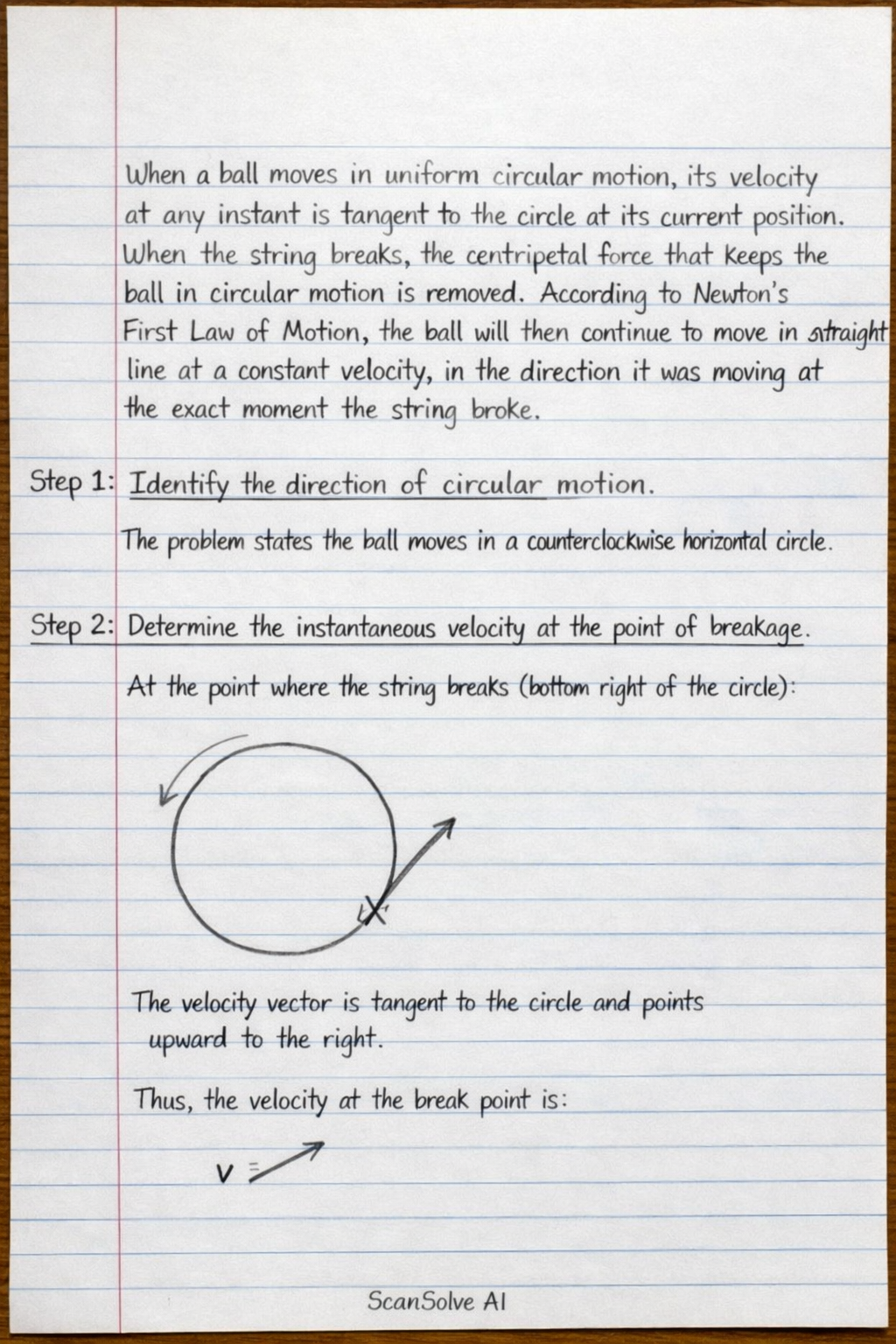
Handwritten Step-by-Step Solution
Get this as a handwritten image on WhatsApp — like a tutor wrote it for you.
Try on WhatsApp