
We read your photo as:
A ball of mass A moving with velocity V, collides with another B of the same mass at rest. If the coefficient of restriction between the balls is e, the ratio of final and initial velocity of A is
ScanSolve AI Answer
Answer
Step-by-step solution
6 stepsHere are the solutions to the collision problems.
:
A ball of mass A moving with velocity V, collides with another B of the same mass at rest. If the coefficient of restriction between the balls is e, the ratio of final and initial velocity of A is
-
Given:
- Mass of ball A:
- Initial velocity of ball A:
- Mass of ball B: (same mass as A)
- Initial velocity of ball B: (at rest)
- Coefficient of restitution:
-
To find: The ratio
Apply the principle of conservation of momentum.
Substitute the given values:
Apply the definition of the coefficient of restitution.
Substitute the given values:
Solve the system of equations for .
We have:
Subtract Equation 2 from Equation 1:
Calculate the ratio .
The ratio of final and initial velocity of A is .
:
A block of mass m moving with a speed v collides with another object of mass 2m at rest. The lighter block comes to rest after the collision. The coefficient of restitution is-
Given:
- Mass of lighter block (A):
- Initial speed of lighter block (A):
- Mass of heavier block (B):
- Initial speed of heavier block (B): (at rest)
- Final speed of lighter block (A): (comes to rest)
-
To find: The coefficient of restitution,
-
Apply the principle of conservation of momentum.
Substitute the given values:
Apply the definition of the coefficient of restitution.
Substitute the known values:
The coefficient of restitution is .
Try one yourself
A new problem that tests the same skill.
Still stuck on this one?
Ask a follow-up, and the answer starts from this question.
More Physics Questions
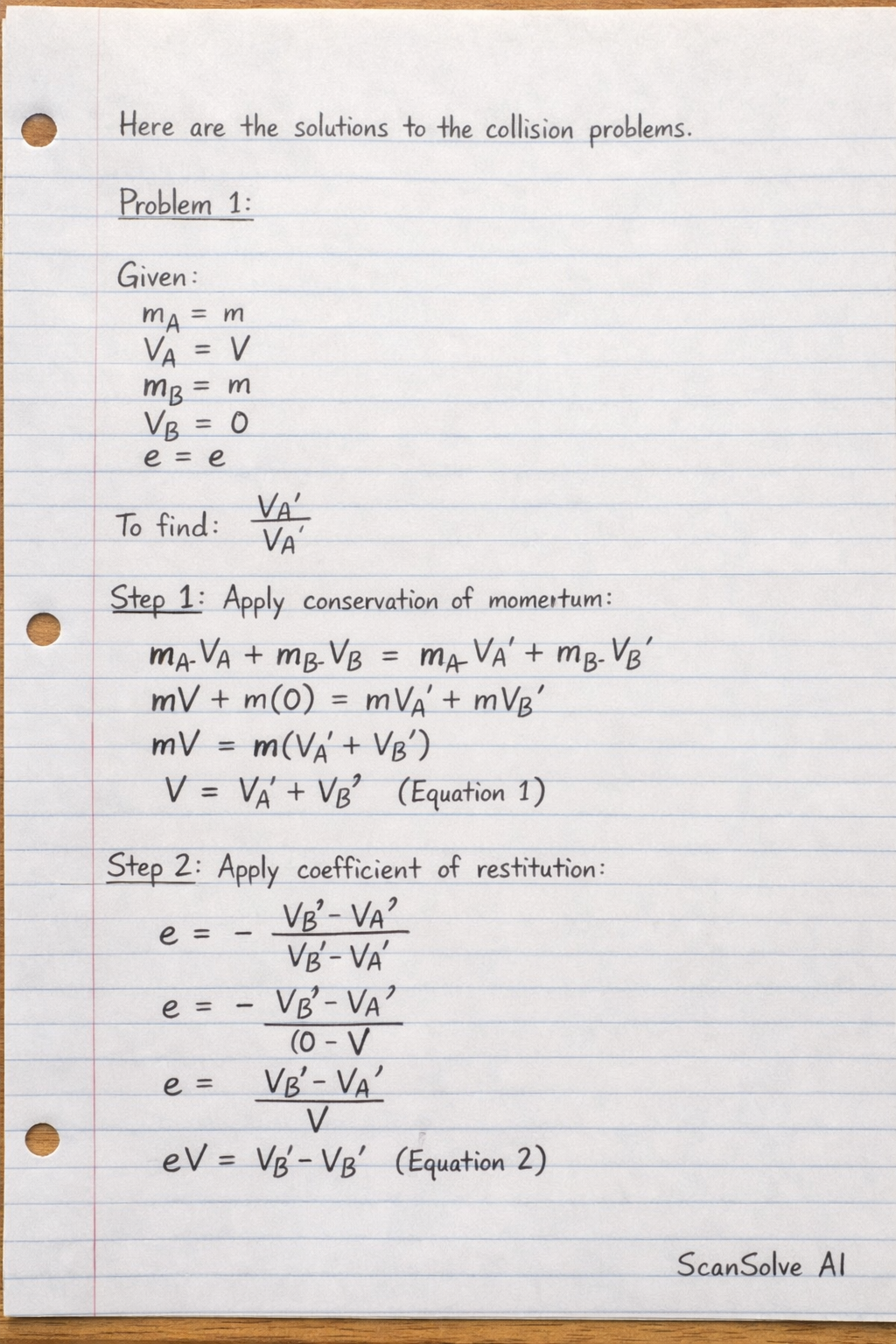
Handwritten Step-by-Step Solution
Get this as a handwritten image on WhatsApp — like a tutor wrote it for you.
Try on WhatsApp