
We read your photo as:
A battery discharge follows the formula v = V0 * e^(-t/RC). Given V0 = 12V, R = 0.50 Ohms, C = 100F, determine the time t when the voltage drops to 11.0V and transpose the formula to make R the subjec
ScanSolve AI Answer
Step-by-step solution
15 stepsTask 1, Part A:
A.1: Determine the time () when the battery voltage drops to .
Write down the given formula and values.
The formula for battery discharge is:
Given values are , , . We want to find when .
Substitute the known values into the formula.
Isolate the exponential term.
Take the natural logarithm () of both sides to solve for .
The time when the battery voltage drops to is .
A.2: Transpose the formula to make the subject.
Start with the original formula.
Divide both sides by .
Take the natural logarithm of both sides.
Multiply both sides by .
Divide both sides by to isolate .
The formula transposed for is .
Task 1, Part B:
B.i: Determine the power will be supplied by a deep-cycle battery.
Use the formula for electrical power .
Given voltage and current .
The power supplied by the battery is .
B.ii: Determine the total electrical energy (in Watt-hours) consumed by the pump during its daily 2-hour operation.
Use the formula for energy .
From B.i, power . The pump operates for hours.
The total electrical energy consumed is .
B.iii: Calculate the percentage of its stored energy will be used by the pump's daily operation.
Calculate the percentage using the consumed energy and total stored energy.
Energy consumed (from B.ii).
Total usable energy .The percentage of stored energy used is
\boxed{\text{10%}}.B.iv: Calculate the power dissipated as heat inside the battery while it is supplying the 5A current to the pump.
Use the formula for power dissipated as heat .
Given current and internal resistance .
The power dissipated as heat is .
B.v: Calculate the total charge (in Coulombs) delivered to the battery during this time.
Use the formula for charge .
Given charging current and time hours.
Convert time from hours to seconds:Calculate the total charge.
The total charge delivered to the battery is .
B.vi: Draw a circuit diagram showing how to connect the four panels to achieve 48V output.
To achieve a 48V output from four solar panels, assuming each panel has a nominal voltage of 12V (a common rating for solar panels in 12V systems), the panels must be connected in series.
A circuit diagram would show:
- Four solar panel symbols connected in a chain.
- The positive terminal of the first panel connects to the negative terminal of the second panel.
- The positive terminal of the second panel connects to the negative terminal of the third panel.
- The positive terminal of the third panel connects to the negative terminal of the fourth panel.
- The overall output would be taken from the negative terminal of the first panel and the positive terminal of the fourth panel. This series connection adds the voltages of individual panels: .
Still stuck on this one?
Ask a follow-up, and the answer starts from this question.
More Physics Questions
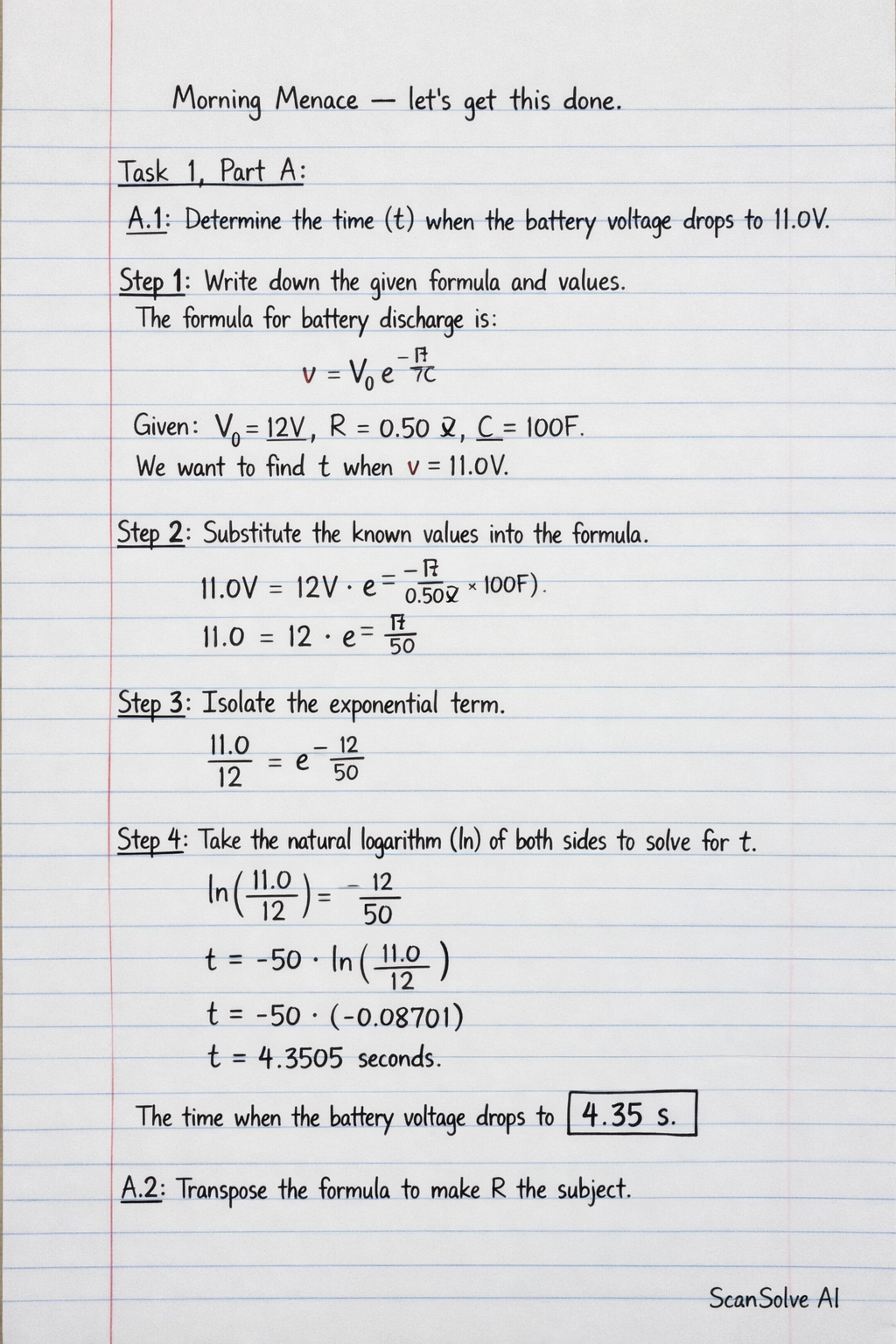
Handwritten Step-by-Step Solution
Get this as a handwritten image on WhatsApp — like a tutor wrote it for you.
Try on WhatsApp