
We read your photo as:
A body of mass 2.5 kg is suspended by two strings XP and YP. If the angle between XP and the vertical is 40 degrees and the angle between YP and the vertical is 50 degrees, find the tensions in the st
ScanSolve AI Answer
Step-by-step solution
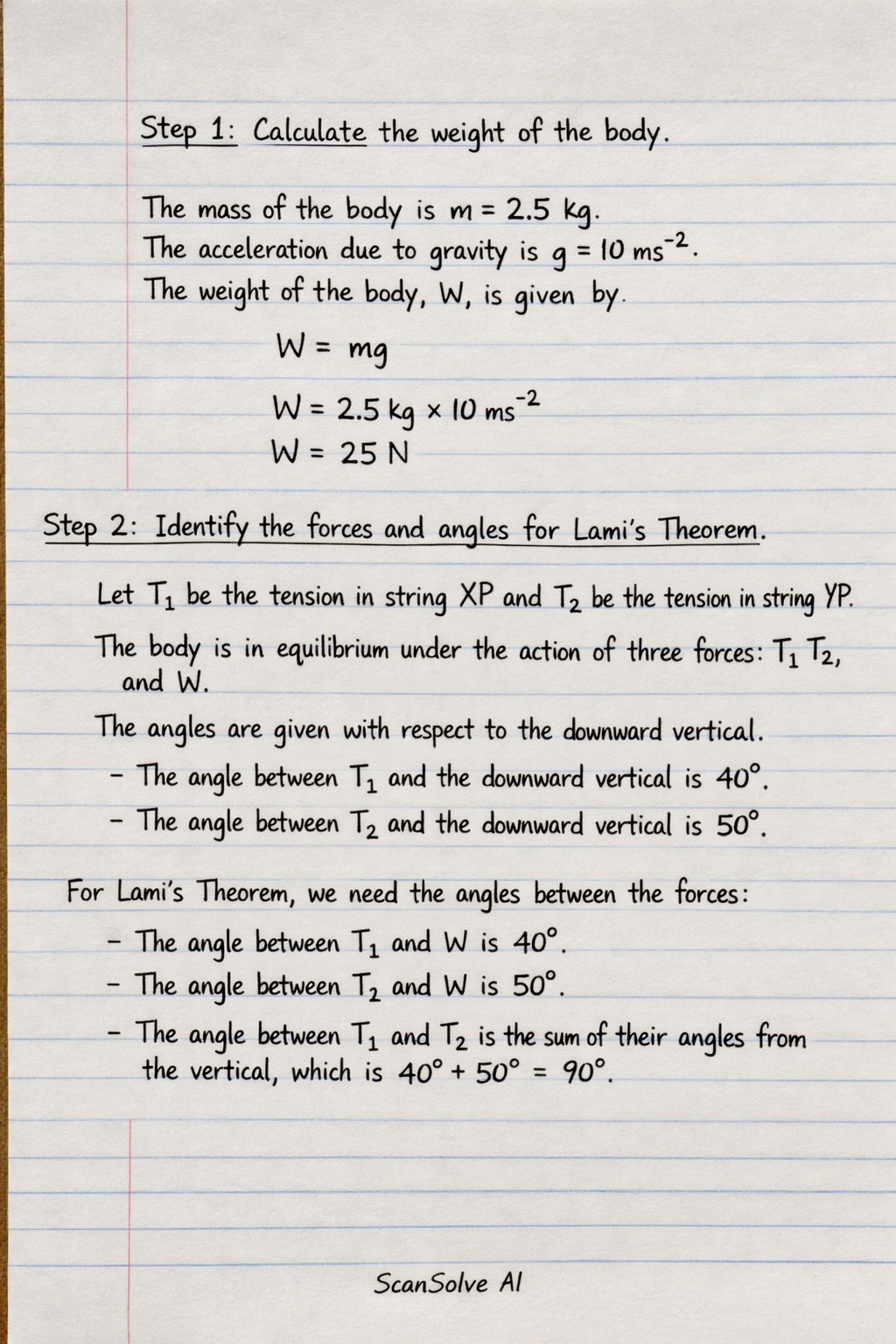
4 stepsCalculate the weight of the body.
The mass of the body is .
The acceleration due to gravity is .
The weight of the body, , is given by .Identify the forces and angles for Lami's Theorem.
Let be the tension in string and be the tension in string .
The body is in equilibrium under the action of three forces: , , and its weight .
The angles are given with respect to the downward vertical.- The angle between and the downward vertical is .
- The angle between and the downward vertical is .
For Lami's Theorem, we need the angles between the forces.
- The angle between and is .
- The angle between and is .
- The angle between and is the sum of their angles from the vertical, which is .
Apply Lami's Theorem.
Lami's Theorem states that for three forces in equilibrium, each force is proportional to the sine of the angle between the other two forces.
Substituting the values:
Since :
Solve for the tensions and .
From the equations:
Using approximate values for sine: and .
Rounding to three significant figures:
The tensions in the strings are:
Still stuck on this one?
Ask a follow-up, and the answer starts from this question.
More Physics Questions
Handwritten Step-by-Step Solution
Get this as a handwritten image on WhatsApp — like a tutor wrote it for you.
Try on WhatsApp