
We read your photo as:
A body of mass 5 kg is placed in a lift. Find the reaction between the floor of the lift and the body when the lift moves upward: i) at constant velocity ii) with an acceleration of 2.5 m s⁻² (take g
ScanSolve AI Answer
Answers
2 partsStep-by-step solution
6 stepsHere are the solutions to the problems.
:
A body of mass is placed in a lift. Find the reaction between the floor of the lift and the body when the lift moves upward:
Part i
at constant velocity
Part ii
with an acceleration of (take )
The general formula for the reaction force when a lift moves upward with acceleration is .
Part a
When the lift moves upward at constant velocity
Identify the given values.
The mass of the body is .
The acceleration due to gravity is .
Since the velocity is constant, the acceleration of the lift is .Substitute the values into the formula.
The reaction force is .
Part b
When the lift moves upward with an acceleration of
Identify the given values.
The mass of the body is .
The acceleration due to gravity is .
The acceleration of the lift is .Substitute the values into the formula.
The reaction force is .
:
A body of mass is placed in a lift. If the lift moves upward with a retardation of , find the reaction between the floor of the lift and the body (take ).When a lift moves upward with retardation (deceleration), the effective acceleration is downwards. The formula for the reaction force becomes , where is the magnitude of the retardation.
Identify the given values.
The mass of the body is .
The acceleration due to gravity is .
The retardation of the lift is .Substitute the values into the formula.
The reaction force is .
Try one yourself
A new problem that tests the same skill.
Still stuck on this one?
Ask a follow-up, and the answer starts from this question.
More Physics Questions
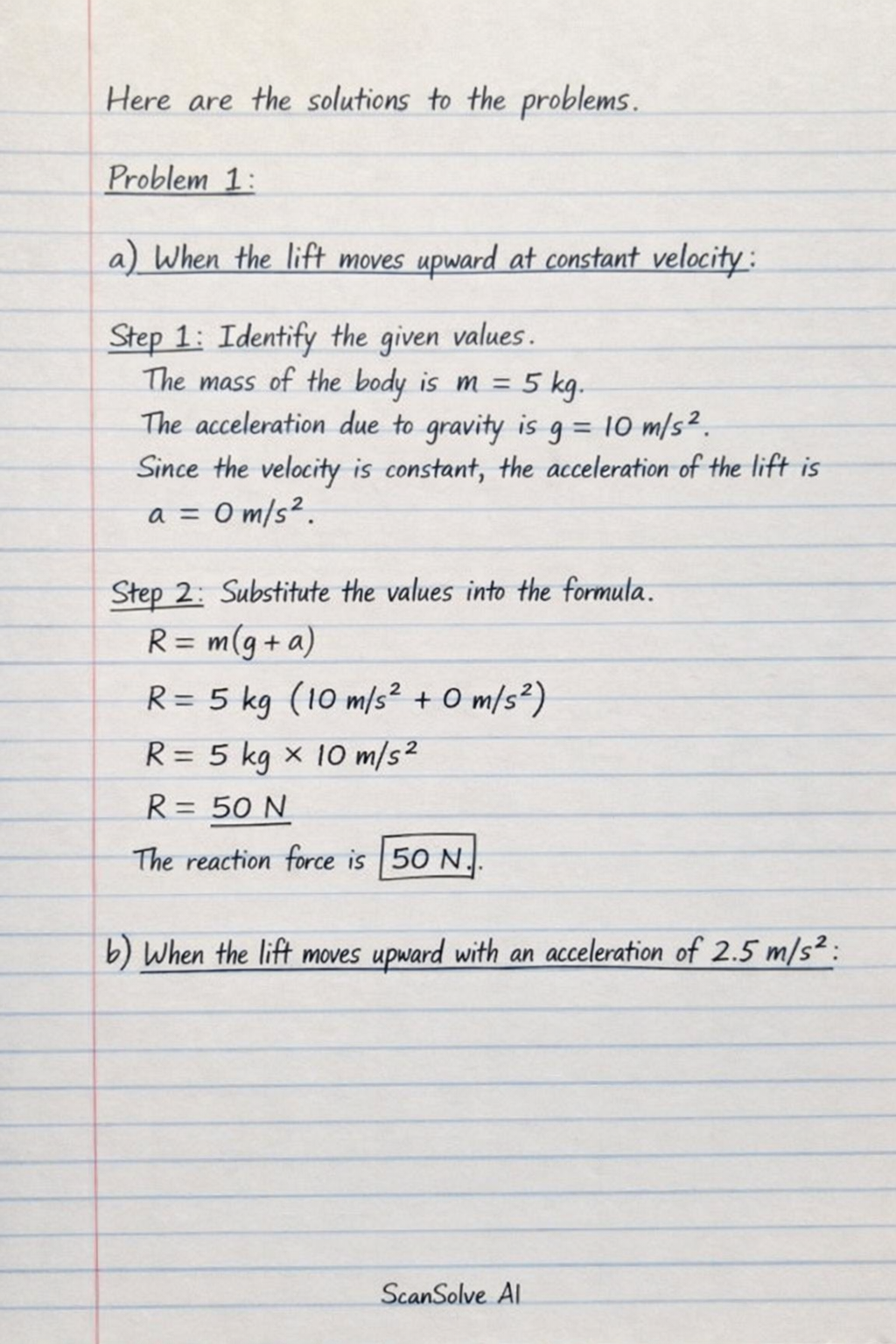
Handwritten Step-by-Step Solution
Get this as a handwritten image on WhatsApp — like a tutor wrote it for you.
Try on WhatsApp