
We read your photo as:
A bodybuilder pulls a 60 kg tyre with a force of 250 N at an angle of 20 degrees to the horizontal. If he pulls for 25 m, calculate the work done by the bodybuilder and the work done against friction,
ScanSolve AI Answer
Answers
4 partsStep-by-step solution
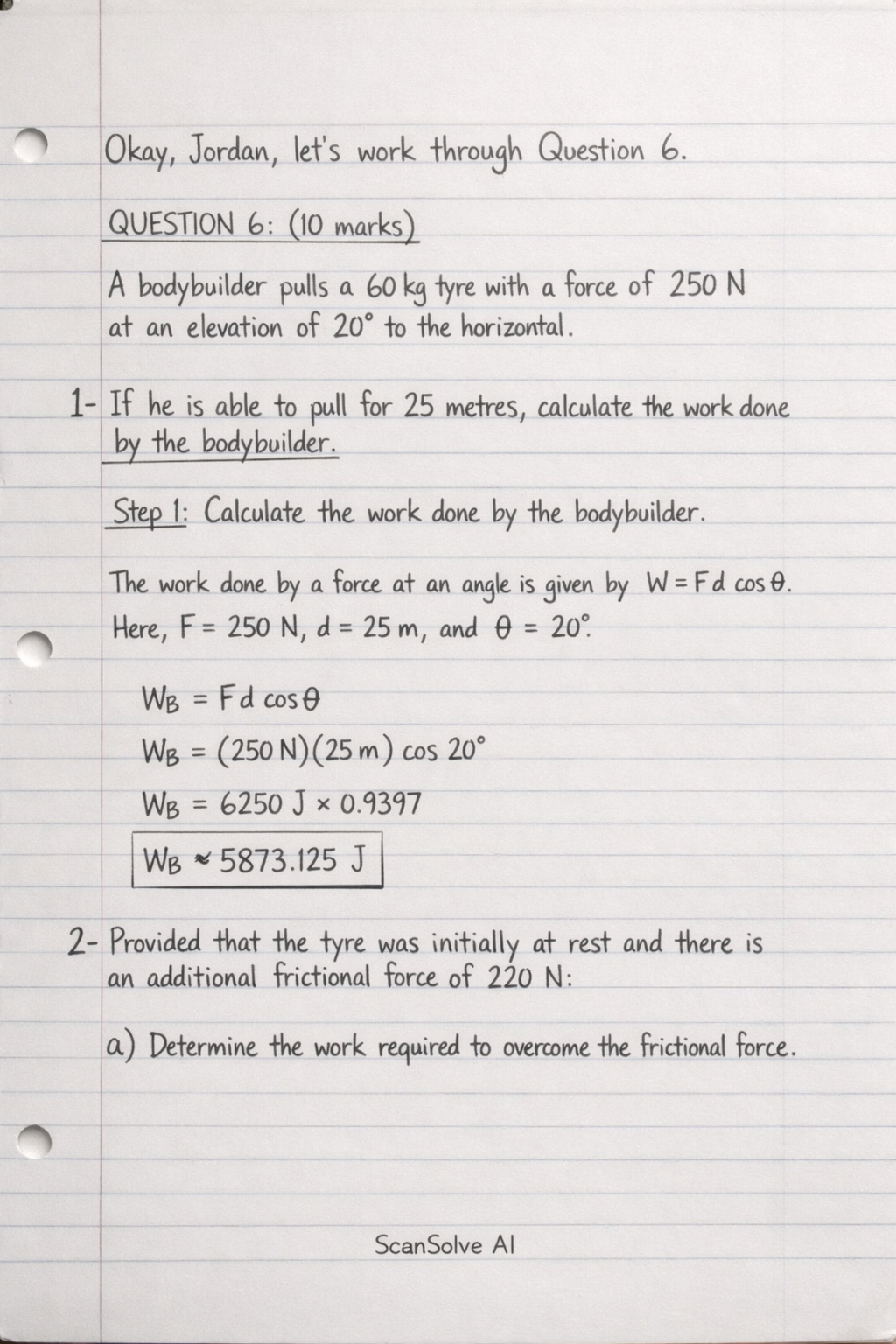
4 stepsOkay, Jordan, let's work through Question 6.
Part 6· 1 step
(10 marks)
A bodybuilder pulls a tyre with a force of at an elevation of to the horizontal.
1- If he is able to pull for 25 metres, calculate the work done by the bodybuilder.
Calculate the work done by the bodybuilder.
The work done by a force at an angle is given by .
Here, , , and .2- Provided that the tyre was initially at rest and there is an additional frictional force of :
Part a
Determine the work required to overcome the frictional force.
Calculate the work done against friction.
The work done against friction is .
Here, and .
Part b
Using the kinetic energy theorem, deduce the kinetic energy the bodybuilder provides the tyre.
Apply the Work-Energy Theorem to find the kinetic energy.
The net work done on the tyre is the work done by the bodybuilder minus the work done against friction. This net work equals the change in kinetic energy (). Since the tyre starts from rest, the initial kinetic energy is 0.
So, the kinetic energy provided to the tyre is:
Part c
Calculate the tyre's velocity. Take .
Calculate the velocity using the kinetic energy formula.
The kinetic energy is given by . We are given and .
Try one yourself
A new problem that tests the same skill.
Still stuck on this one?
Ask a follow-up, and the answer starts from this question.
More Physics Questions
Handwritten Step-by-Step Solution
Get this as a handwritten image on WhatsApp — like a tutor wrote it for you.
Try on WhatsApp