
We read your photo as:
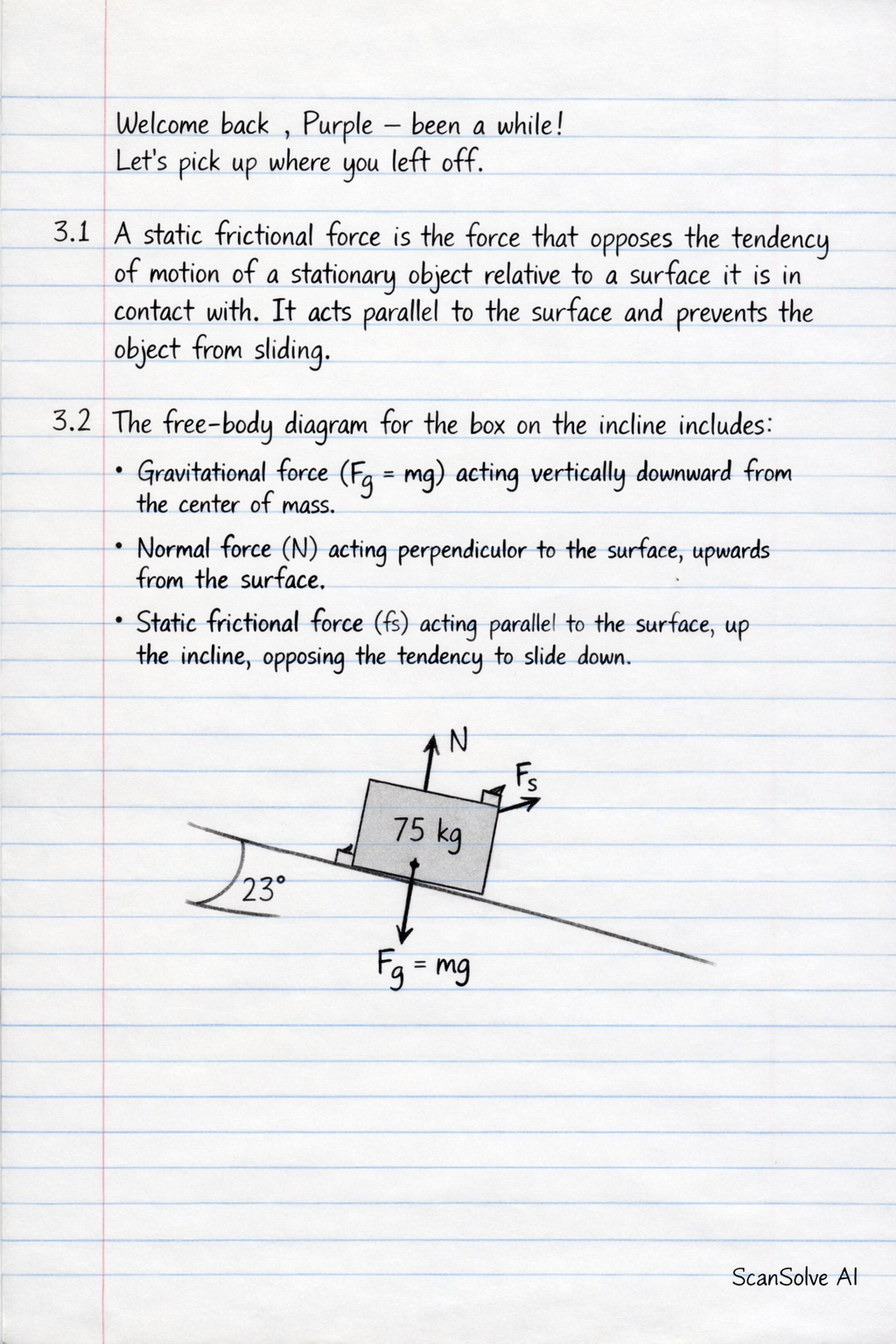
A box of mass 75 kg lies on a rough surface inclined at an angle of 23° to the horizontal. The box is stationary on the incline as shown in the diagram below.
ScanSolve AI Answer
Answer
Step-by-step solution
6 steps3.1 A static frictional force is the force that opposes the tendency of motion of a stationary object relative to a surface it is in contact with. It acts parallel to the surface and prevents the object from sliding.
3.2
The free-body diagram for the box on the incline includes:
- Gravitational force ( or ) acting vertically downwards from the center of mass.
- Normal force () acting perpendicular to the surface, upwards from the surface.
- Static frictional force () acting parallel to the surface, up the incline, opposing the tendency to slide down.
\begin{tikzpicture}[scale=0.8]
    % Incline
    \draw (0,0) -- (6,2.4); % Angle is atan(2.4/6) = 21.8 degrees, close enough to 23
    \draw (0,0) -- (2,0);
    \draw (1.5,0) arc (0:23:1.5);
    \node at (1.8,0.3) {$23^\circ$};

    % Box
    \draw[fill=lightgray] (2.5,1) rectangle (4.5,2);
    \node at (3.5,1.5) {75 kg};

    % Forces
    % Gravity
    \draw[->, thick] (3.5,1.5) -- (3.5,0) node[below] {$F_g = mg$};
    % Normal
    \draw[->, thick] (3.5,1.5) -- ({3.5 - 0.5*sin(23)}, {1.5 + 0.5*cos(23)}) node[above right] {$N$};
    % Friction
    \draw[->, thick] (3.5,1.5) -- ({3.5 - 0.5*cos(23)}, {1.5 - 0.5*sin(23)}) node[below left] {$f_s$};
\end{tikzpicture}
3.3.1
Identify the forces acting parallel to the incline.
Since the box is stationary, the net force parallel to the incline is zero. The component of gravity acting down the incline is , and the static frictional force acts up the incline.
Substitute the given values (, , ).
Calculate the magnitude of the static frictional force.
The magnitude of the static frictional force is .
3.3.2
The coefficient of static friction is related to the maximum static frictional force and the normal force by .
For the box to be stationary, the actual static friction must be less than or equal to . If we assume the box is at the verge of slipping or we are calculating the minimum coefficient required to keep it stationary at this angle, then .
Calculate the normal force .
The normal force balances the component of gravity perpendicular to the incline.
Calculate the coefficient of static friction using .
The coefficient of static friction is .
3.4
The static frictional force required to keep the box stationary is .
When the angle is tilted to , the new static frictional force will be .
Since , the new static frictional force will be less than the value calculated in question 3.3.1.The correct choice is LESS THAN.
Try one yourself
A new problem that tests the same skill.
Still stuck on this one?
Ask a follow-up, and the answer starts from this question.
More Physics Questions
Handwritten Step-by-Step Solution
Get this as a handwritten image on WhatsApp — like a tutor wrote it for you.
Try on WhatsApp