
We read your photo as:
A boy swims 1 km upstream and returns downstream. Compare his total swimming time in still water versus water with a steady speed of 0.5 m/s.
Physics
ScanSolve AI Answer
Step-by-step solution
7 stepsGiven:
Boy's speed in still water,
Distance to swim upstream (one way),
1. When the water is still
Determine the total distance.
The boy swims upstream and returns downstream.
Total distance .Calculate the total time.
When the water is still, the boy's speed is simply his speed in still water.
The total time when the water is still is .
2. When the water has a steady speed of
Given water speed, .Calculate the speed when swimming upstream.
When swimming upstream, the water current opposes the boy's motion.
Calculate the time taken to swim upstream.
Calculate the speed when swimming downstream.
When swimming downstream, the water current aids the boy's motion.
Calculate the time taken to swim downstream.
Calculate the total time.
The total time when the water has a steady speed of is .
Was this helpful?
Still stuck on this one?
Ask a follow-up, and the answer starts from this question.
Got a different question?Ask your own question
More Physics Questions
QA swimmer heads out to swim across a river. The river flows at 0.54 m/s to the left. The swimmer…QA man rows a boat across a river at his best speed in still water. The river flows at 4 km/hr, and…QA fisherman who can paddle at 4 km/h in still water, heads a canoe due north. The water is moving at…QConvert 300 litres of water into 500ml bottles. Also, calculate the time taken for a 1500m race with…QA boat crosses a river due East at 30km/h while the river flows due South at 40km/h. The resultant…
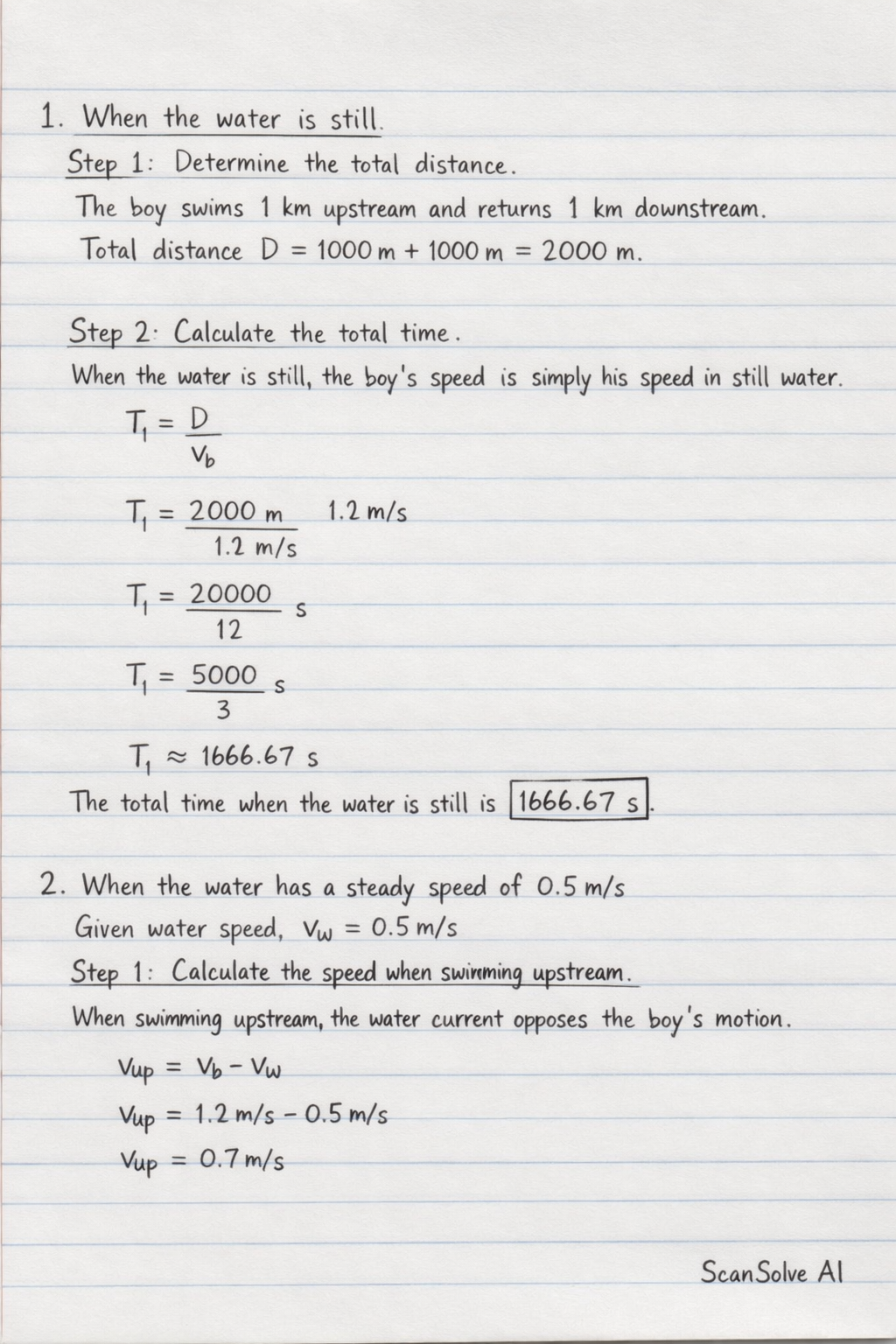
Handwritten Step-by-Step Solution
Get this as a handwritten image on WhatsApp — like a tutor wrote it for you.
Try on WhatsApp