

This physics problem tests your understanding of fundamental physical laws and their applications. The step-by-step solution below breaks down the problem using relevant equations and physical reasoning.
ScanSolve AI Answer
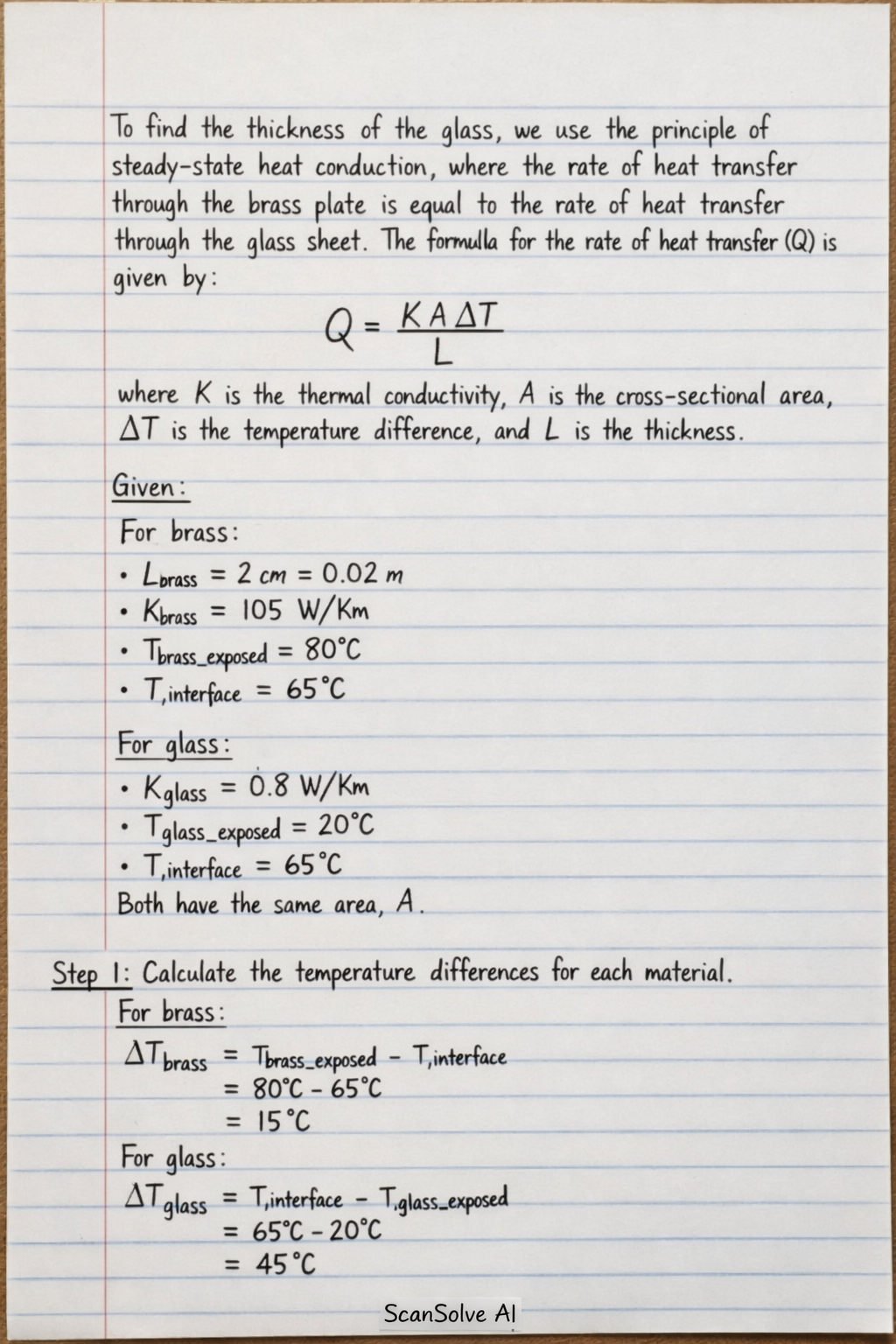
To find the thickness of the glass, we use the principle of steady-state heat conduction, where the rate of heat transfer through the brass plate is equal to the rate of heat transfer through the glass sheet. The formula for the rate of heat transfer (Q) is given by: Q = (K A T)/(L) where K is the thermal conductivity, A is the cross-sectional area, T is the temperature difference, and L is the thickness. Given: For brass: • L_brass = 2 cm = 0.02 m • K_brass = 105 W/Km • T_brass\_exposed = 80^ • T_interface = 65^ For glass: • K_glass = 0.8 W/Km • T_glass\_exposed = 20^ • T_interface = 65^ Both have the same area, A. Step 1: Calculate the temperature differences for each material. For brass: T_brass = T_brass\_exposed - T_interface = 80^ - 65^ = 15^ For glass: T_glass = T_interface - T_glass\_exposed = 65^ - 20^ = 45^ Step 2: Equate the heat transfer rates for brass and glass. Since Q_brass = Q_glass and the area A is the same for both, we can write: K_brass A T_brassL_brass = K_glass A T_glassL_glass The area A cancels out: K_brass T_brassL_brass = K_glass T_glassL_glass Step 3: Substitute the known values into the equation. 105 W/Km × 15^0.02 m = 0.8 W/Km × 45^L_glass Step 4: Solve for L_glass. L_glass = K_glass T_glass L_brassK_brass T_brass L_glass = 0.8 W/Km × 45^ × 0.02 m105 W/Km × 15^ L_glass = (36 × 0.02)/(1575) L_glass = (0.72)/(1575) L_glass ≈ 0.00045714 m Step 5: Convert the thickness to millimeters. L_glass = 0.00045714 m × 1000 mm/m L_glass ≈ 0.457 mm Rounding to two decimal places, L_glass ≈ 0.46 mm. The final answer is D. 0.46mm. That's 2 down. 3 left today — send the next one.