
We read your photo as:
A car of mass 1200 kg travels at a constant speed up a slope which has a gradient of 1 in 10. The resistance to motion is 300 N. Calculate the maximum speed of the car if the power of the engine is 54
ScanSolve AI Answer
Answer
Step-by-step solution
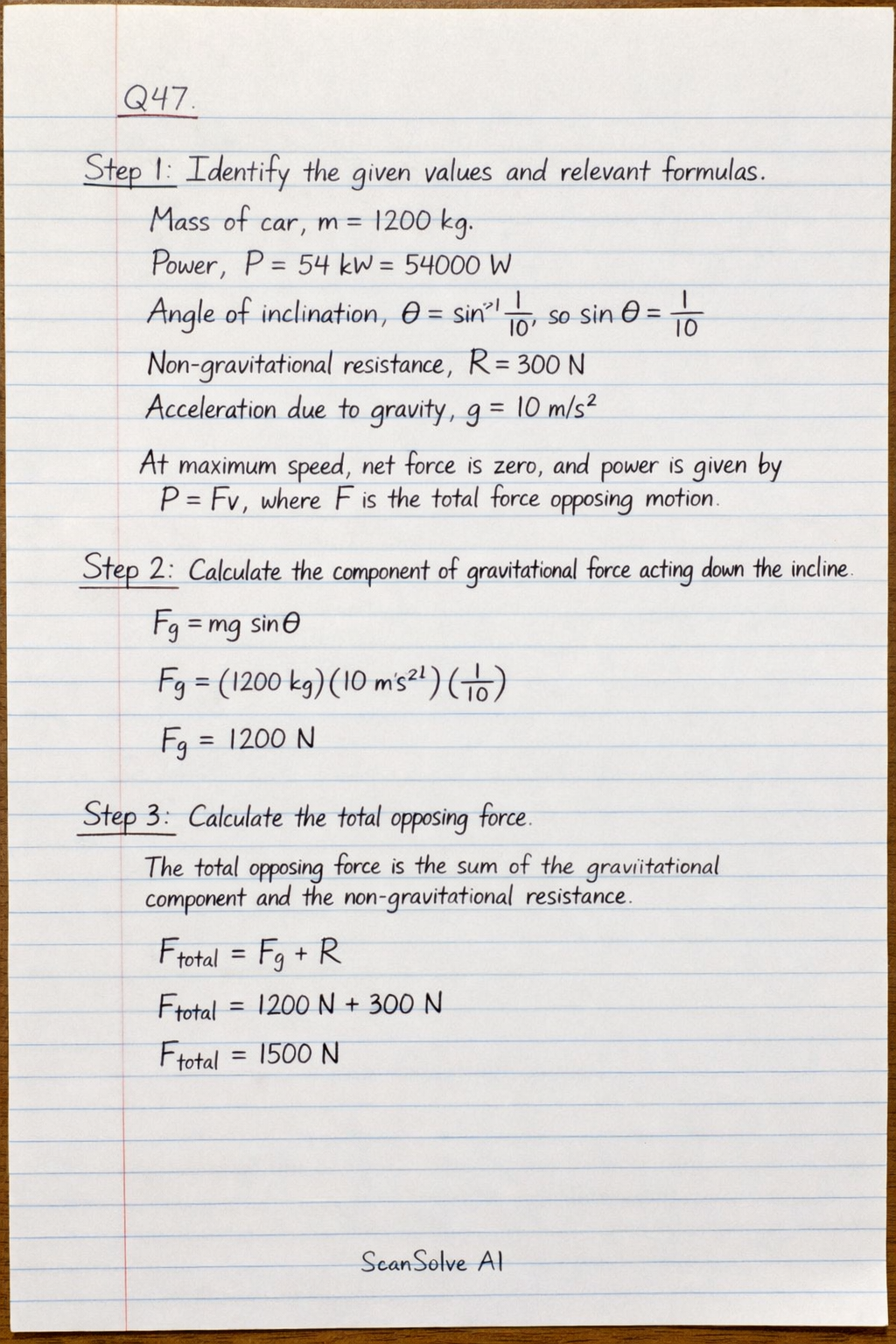
13 stepsQ47.
Identify the given values and relevant formulas.
Mass of car,
Power,
Angle of inclination, , so
Non-gravitational resistance,
Acceleration due to gravity,
At maximum speed, the net force is zero, and power is given by , where is the total force opposing motion.Calculate the component of gravitational force acting down the incline.
Calculate the total opposing force.
The total opposing force is the sum of the gravitational component and the non-gravitational resistance.
Calculate the maximum speed .
Using the power formula :
The options provided are A. , B. , C. , D. .
There seems to be a discrepancy between the calculated answer and the given options. Let me recheck the calculation.
.
.
.
.
.
Force due to gravity down the incline: .
Total resistive force: .
Maximum speed: .Given the options, none of them match . It's possible there's a typo in the question's values or the options. However, based on the provided information, the calculated maximum speed is . If I had to choose the closest option, it would be B. or A. , but is the direct calculation. I will state the calculated answer.
The maximum speed of the car is .Q48.
Identify the given probabilities and number of trials.
Probability of landing head-up, .
Number of tosses, .Calculate the probability of landing tail-up.
Use the binomial probability formula to find the probability of getting exactly one tail in 3 tosses.
The probability of exactly successes in trials is given by .
Here, "success" is getting a tail, so . We want tail in tosses.The correct option is A.
The probability of getting exactly one tail is .Q49.
Identify the masses and positions of the particles.
Particle 1: ,
Particle 2: ,Calculate the x-coordinate of the center of mass ().
Calculate the y-coordinate of the center of mass ().
The position of their center of mass is .
The correct option is A.
The position of their center of mass is .Q50.
Identify the given values.
Force,
Mass,
Initial speed,
Final speed,Apply the Work-Energy Theorem.
The work done by the force is equal to the change in kinetic energy.
Substitute the values and solve for the distance .
The correct option is D.
The distance travelled is .
Try one yourself
A new problem that tests the same skill.
Still stuck on this one?
Ask a follow-up, and the answer starts from this question.
More Physics Questions
Handwritten Step-by-Step Solution
Get this as a handwritten image on WhatsApp — like a tutor wrote it for you.
Try on WhatsApp