

This physics problem tests your understanding of fundamental physical laws and their applications. The step-by-step solution below breaks down the problem using relevant equations and physical reasoning.
ScanSolve AI Answer
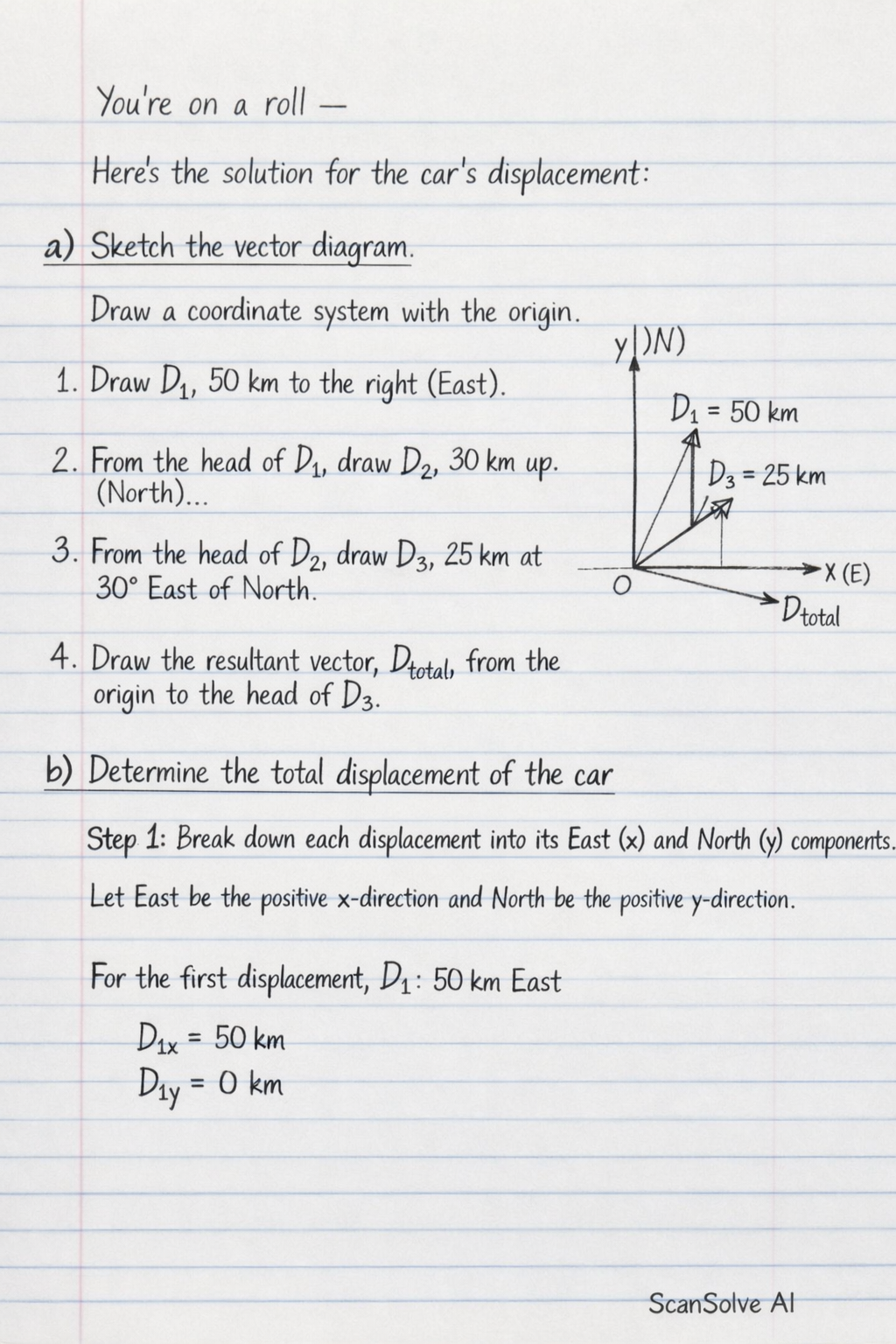
You're on a roll — Here's the solution for the car's displacement: a) Sketch the vector diagram To sketch the vector diagram, draw a coordinate system with the origin as the starting point. 1. Draw the first vector, D_1, 50 km long, pointing horizontally to the right (East). 2. From the head of D_1, draw the second vector, D_2, 30 km long, pointing vertically upwards (North). 3. From the head of D_2, draw the third vector, D_3, 25 km long, at an angle of 30^ East of North. This means the vector is 30^ away from the North axis towards the East. 4. Draw the resultant displacement vector, D_total, from the origin (tail of D_1) to the head of D_3. b) Determine the total displacement of the car Step 1: Break down each displacement into its East (x) and North (y) components. Let East be the positive x-direction and North be the positive y-direction. For the first displacement, D_1: 50 km East D_1x = 50 km D_1y = 0 km For the second displacement, D_2: 30 km North D_2x = 0 km D_2y = 30 km For the third displacement, D_3: 25 km at 30^ East of North. This angle is measured from the North axis. To find the x-component (East), we use (30^), and for the y-component (North), we use (30^). D_3x = 25 (30^) = 25 × 0.5 = 12.5 km D_3y = 25 (30^) = 25 × sqrt(3)2 ≈ 25 × 0.8660 = 21.65 km Step 2: Sum the x-components and y-components to find the total displacement components. Total East displacement (D_x): D_x = D_1x + D_2x + D_3x = 50 + 0 + 12.5 = 62.5 km Total North displacement (D_y): D_y = D_1y + D_2y + D_3y = 0 + 30 + 21.65 = 51.65 km Step 3: Calculate the magnitude of the total displacement. The magnitude of the total displacement, D_total, is found using the Pythagorean theorem: D_total = sqrt(D_x^2 + D_y^2) D_total = sqrt((62.5)^2 + (51.65)^2) D_total = sqrt(3906.25 + 2667.7225) D_total = sqrt(6573.9725) D_total ≈ 81.08 km Step 4: Calculate the direction of the total displacement. The direction is found using the arctangent function: = ((D_y)/(D_x)) = ((51.65)/(62.5)) = (0.8264) ≈ 39.56^ Since both D_x and D_y are positive, the direction is North of East. The total displacement of the car is 81.08 km at 39.56^ North of East. What's next?