

This physics problem tests your understanding of fundamental physical laws and their applications. The step-by-step solution below breaks down the problem using relevant equations and physical reasoning.
ScanSolve AI Answer
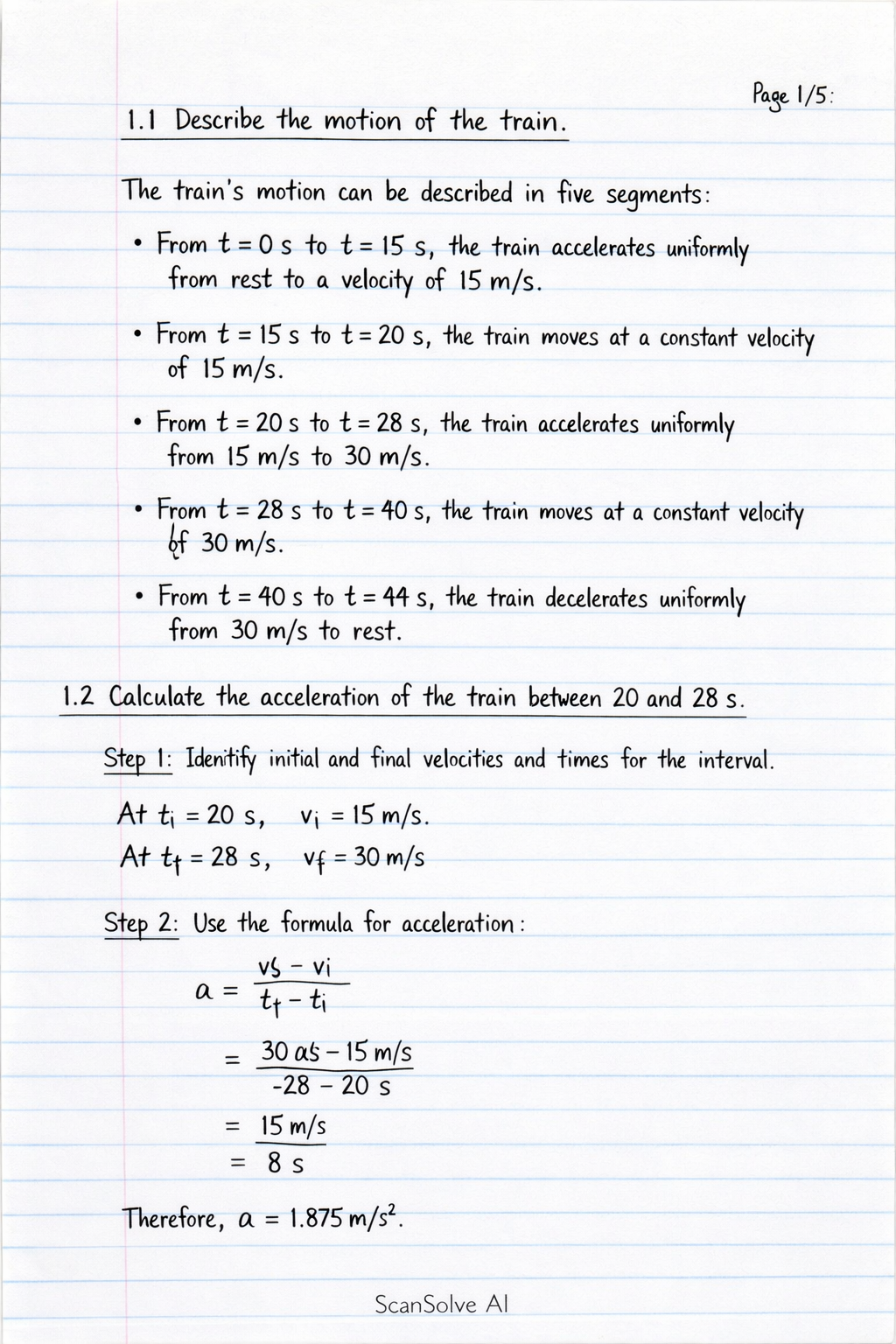
1.1 Describe the motion of the train. The train's motion can be described in five segments: • From t = 0 s to t = 15 s, the train accelerates uniformly from rest to a velocity of 15 m/s. • From t = 15 s to t = 20 s, the train moves at a constant velocity of 15 m/s. • From t = 20 s to t = 28 s, the train accelerates uniformly from 15 m/s to 30 m/s. • From t = 28 s to t = 40 s, the train moves at a constant velocity of 30 m/s. • From t = 40 s to t = 44 s, the train decelerates uniformly from 30 m/s to rest. 1.2 Calculate the acceleration of the train between 20 and 28 s. Step 1: Identify initial and final velocities and times for the interval. At t_i = 20 s, v_i = 15 m/s. At t_f = 28 s, v_f = 30 m/s. Step 2: Use the acceleration formula. a = (v_f - v_i)/(t_f - t_i) a = 30 m/s - 15 m/s28 s - 20 s a = 15 m/s8 s a = 1.875 m/s^2 The acceleration of the train between 20 and 28 s is 1.875 m/s^2. 1.3 Calculate the distance travelled in the 44 s. The distance travelled is the total area under the velocity-time graph. Step 1: Calculate the area for each segment. • Segment 1 (0-15 s, triangle): A_1 = (1)/(2) × base × height = (1)/(2) × 15 s × 15 m/s = 112.5 m • Segment 2 (15-20 s, rectangle): A_2 = width × height = (20 s - 15 s) × 15 m/s = 5 s × 15 m/s = 75 m • Segment 3 (20-28 s, trapezium): A_3 = (1)/(2) × (sum of parallel sides) × height = (1)/(2) × (15 m/s + 30 m/s) × (28 s - 20 s) A_3 = (1)/(2) × 45 m/s × 8 s = 180 m • Segment 4 (28-40 s, rectangle): A_4 = width × height = (40 s - 28 s) × 30 m/s = 12 s × 30 m/s = 360 m • Segment 5 (40-44 s, triangle): A_5 = (1)/(2) × base × height = (1)/(2) × (44 s - 40 s) × 30 m/s = (1)/(2) × 4 s × 30 m/s = 60 m Step 2: Sum all the areas to find the total distance. Total Distance = A_1 + A_2 + A_3 + A_4 + A_5 Total Distance = 112.5 m + 75 m + 180 m + 360 m + 60 m Total Distance = 787.5 m The total distance travelled in 44 s is 787.5 m. 1.4 Draw an acceleration-time graph from this velocity-time graph. To draw the acceleration-time graph, we calculate the acceleration for each segment: • From t = 0 s to t = 15 s: a = 15 m/s - 0 m/s15 s - 0 s = 1 m/s^2. • From t = 15 s to t = 20 s: a = 15 m/s - 15 m/s20 s - 15 s = 0 m/s^2. • From t = 20 s to t = 28 s: a = 30 m/s - 15 m/s28 s - 20 s = 15 m/s8 s = 1.875 m/s^2. • From t = 28 s to t = 40 s: a = 30 m/s - 30 m/s40 s - 28 s = 0 m/s^2. • From t = 40 s to t = 44 s: a = 0 m/s - 30 m/s44 s - 40 s = -30 m/s4 s = -7.5 m/s^2. The acceleration-time graph would consist of horizontal line segments: • A horizontal line at a = 1 m/s^2 from t = 0 s to t = 15 s. • A horizontal line at a = 0 m/s^2 from t = 15 s to t = 20 s. • A horizontal line at a = 1.875 m/s^2 from t = 20 s to t = 28 s. • A horizontal line at a = 0 m/s^2 from t = 28 s to t = 40 s. • A horizontal line at a = -7.5 m/s^2 from t = 40 s to t = 44 s. 2.1 Identify the car with the greatest velocity. Step 1: Understand that velocity on a position-time graph is represented by the gradient (slope) of the line. Step 2: Visually compare the slopes of lines K and L. Line L is steeper than line K. Car L has a greater gradient, indicating a greater velocity. The car with the greatest velocity is Car L. 2.2 How far apart are the two cars at t = 0 s? Step 1: Read the initial position of each car at t = 0 s from the graph. • Car K starts at x = 16 m. • Car L starts at x = 0 m. Step 2: Calculate the difference in their positions. Distance apart = |x_K - x_L| = |16 m - 0 m| = 16 m The two cars are 16 m apart at t = 0 s. 3.1 Draw an accurate displacement-time graph to represent the motion of the car. To draw the graph, plot the given points (Time (s), Displacement (m)) and connect them with straight lines: • (0, 0) • (2, 14) • (4, 28) • (6, 28) • (8, 20) • (10, 12) The graph would show: • A line segment from (0,0) to (2,14). • A line segment from (2,14) to (4,28). • A horizontal line segment from (4,28) to (6,28). • A line segment from (6,28) to (8,20). • A line segment from (8,20) to (10,12). 3.2 Use the graph to determine the velocity of the car after 3 seconds. Step 1: Identify the time interval that includes t = 3 s. This is the interval from t = 2 s to t = 4 s. Step 2: Calculate the gradient (velocity) for this segment using the points (2 s, 14 m) and (4 s, 28 m). v = ( x)/( t) = 28 m - 14 m4 s - 2 s v = 14 m2 s v = 7 m/s The velocity of the car after 3 seconds is 7 m/s. 3.3 What was the car's velocity after 5 seconds? Justify your answer. Step 1: Identify the time interval that includes t = 5 s. This is the interval from t = 4 s to t = 6 s. Step 2: Calculate the gradient (velocity) for this segment using the points (4 s, 28 m) and (6 s, 28 m). v = ( x)/( t) = 28 m - 28 m6 s - 4 s v = 0 m2 s v = 0 m/s The car's velocity after 5 seconds was 0 m/s. This is because the displacement remained constant at 28 m between t = 4 s and t = 6 s, indicating the car was stationary. 3.4 Use the graph to determine the car's velocity after 9 seconds. Step 1: Identify the time interval that includes t = 9 s. This is the interval from t = 8 s to t = 10 s. Step 2: Calculate the gradient (velocity) for this segment using the points (8 s, 20 m) and (10 s, 12 m). v = ( x)/( t) = 12 m - 20 m10 s - 8 s v = -8 m2 s v = -4 m/s The car's velocity after 9 seconds is -4 m/s. 3.5 In words, describe the motion of the car during the 10 seconds. The car starts from rest at the origin and moves in a northerly direction, increasing its speed initially. From t = 0 s to t = 4 s, its displacement increases from 0 m to 28 m. Between t = 4 s and t = 6 s, the car stops and remains stationary at 28 m displacement. From t = 6 s to t = 10 s, the car moves back towards its starting point (in the southerly direction), with its displacement decreasing from 28 m to 12 m. Send me the next one 📸