
We read your photo as:
Calculate the following: The indicated power in kilowatts, The induced volume per second, The swept volume and atmospheric volume, both in m³/s
ScanSolve AI Answer
This answer stops before the end.
It was cut off when it was first written. Ask ScanSolve this question again for the full working.
The user wants me to solve a physics problem from an image. I need to address Question 2 and Question 3.
Question 2.1: Determine what FAD stands for.
Step 1: Identify the acronym.
FAD stands for Free Air Delivered.
Question 2.2: Calculate the following for a reciprocating compressor.
Given data:
Suction pressure,
Suction temperature,
Delivery pressure,
Polytropic index,
Volumetric efficiency,
Mass flow rate,
Characteristic gas constant,
Atmospheric pressure,
Atmospheric temperature,
2.2.1 The indicated power in kilowatts
The indicated power for a polytropic compression process in a reciprocating compressor is given by:
Step 1: Calculate the exponent .
Step 2: Calculate the pressure ratio term.
Step 3: Substitute the values into the indicated power formula.
The indicated power is .
2.2.2 The induced volume per second
The induced volume per second () is the volume of air drawn into the cylinder per second at suction conditions. It can be calculated using the ideal gas law: .
Step 1: Rearrange the ideal gas law to solve for .
Step 2: Substitute the given values.
The induced volume per second is .
2.2.3 The swept volume and atmospheric volume, both in m/s
The volumetric efficiency () relates the induced volume to the swept volume: .
Step 1: Calculate the swept volume per second ().
The atmospheric volume per second () is the volume of the mass flow rate of air if it were at atmospheric conditions (, ). Use the ideal gas law: .
Step 2: Rearrange the ideal gas law to solve for .
Step 3: Substitute the given values.
The swept volume per second is and the atmospheric volume per second is .
Question 3.1: Explain the following in the context of steam plants.
3.1.1 Saturation temperature
Saturation temperature is the temperature at which a pure substance, like water, changes phase (boils or condenses) at a given pressure. For a steam plant, it's the temperature at which water turns into steam or steam turns into water at the boiler's operating pressure.
3.1.2 Function of the economiser
An economiser is a heat exchanger in a steam plant that preheats the boiler feed water using the hot exhaust gases from the boiler. This recovers waste heat, increasing the overall thermal efficiency of the plant and reducing fuel consumption.
3.1.3 Control rods
Control rods are used in nuclear steam plants to regulate the rate of fission reactions in the nuclear reactor core. They are typically made of neutron-absorbing materials like cadmium or boron and are inserted or withdrawn to control the power output and temperature of the reactor.
Question 3.2: Calculate the following for a boiler.
Given data:
Steam quality,
Steam pressure,
Steam mass flow rate,
Calorific value of oil,
Oil mass flow rate,
Feed water temperature,
We need steam table values for (0.76 MPa).
From steam tables at :
Saturation temperature,
Specific enthalpy of saturated liquid,
Specific enthalpy of evaporation,
Specific enthalpy of saturated vapor,
For feed water at :
Specific enthalpy of feed water, at .
From steam tables at :
(using specific heat capacity of water )
More precisely from steam tables, at is approximately . Let's use .
3.2.1 The steam produced per kilogram of oil burnt
This is the steam-to-fuel ratio, .
Step 1: Calculate the ratio using the given mass flow rates.
The steam produced per kilogram of oil burnt is .
3.2.2 The specific enthalpy at the boiler inlet and outlet
Boiler inlet specific enthalpy () is the specific enthalpy of the feed water.
Boiler outlet specific enthalpy () is the specific enthalpy of the wet steam.
Step 1: Determine .
at .
From steam tables, at .
Step 2: Determine .
For wet steam, at .
Using values from steam tables at : and .
The specific enthalpy at the boiler inlet is and at the outlet is .
3.2.3 The enthalpy produced per hour
The enthalpy produced per hour is the total heat absorbed by the steam per hour.
The mass flow rate of steam needs to be in kg/hour.
.
Step 1: Calculate the enthalpy difference.
Step 2: Calculate the total enthalpy produced per hour.
The enthalpy produced per hour is .
3.2.4 The boiler thermal efficiency
Boiler thermal efficiency () is the ratio of the heat absorbed by the steam to the heat supplied by the fuel.
Step 1: Calculate the heat supplied by the fuel per hour.
.
Heat supplied
Heat supplied
Step 2: Calculate the boiler thermal efficiency.
The boiler thermal efficiency is .
That's 2 down. 3 left today — send the next one.### 2.1 Determine what FAD stands for.
FAD stands for Free Air Delivered.
2.2 Calculate the following for a reciprocating compressor.
Given data:
Suction pressure,
Suction temperature,
Delivery pressure,
Polytropic index,
Volumetric efficiency,
Mass flow rate,
Characteristic gas constant,
Atmospheric pressure,
Atmospheric temperature,
2.2.1 The indicated power in kilowatts
The indicated power for a polytropic compression process is given by:
Step 1: Calculate the exponent .
Step 2: Calculate the pressure ratio term.
Step 3: Substitute the values into the indicated power formula.
Still stuck on this one?
Ask a follow-up, and the answer starts from this question.
More Physics Questions
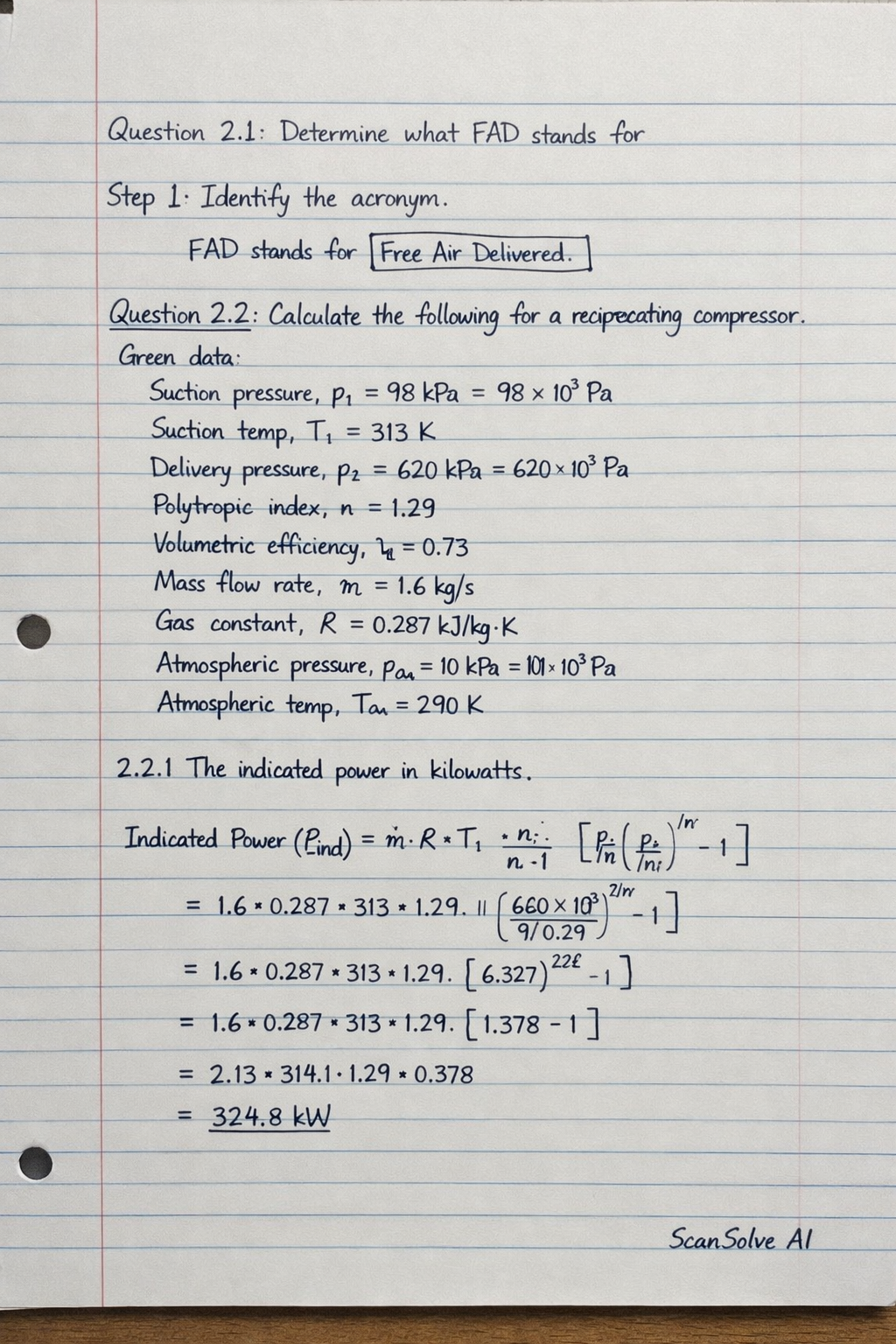
Handwritten Step-by-Step Solution
Get this as a handwritten image on WhatsApp — like a tutor wrote it for you.
Try on WhatsApp