
We read your photo as:
Calculate the swept volume, bore, and total cylinder volume of an engine given combustion chamber volume and compression ratio.
ScanSolve AI Answer
Answers
6 partsStep-by-step solution
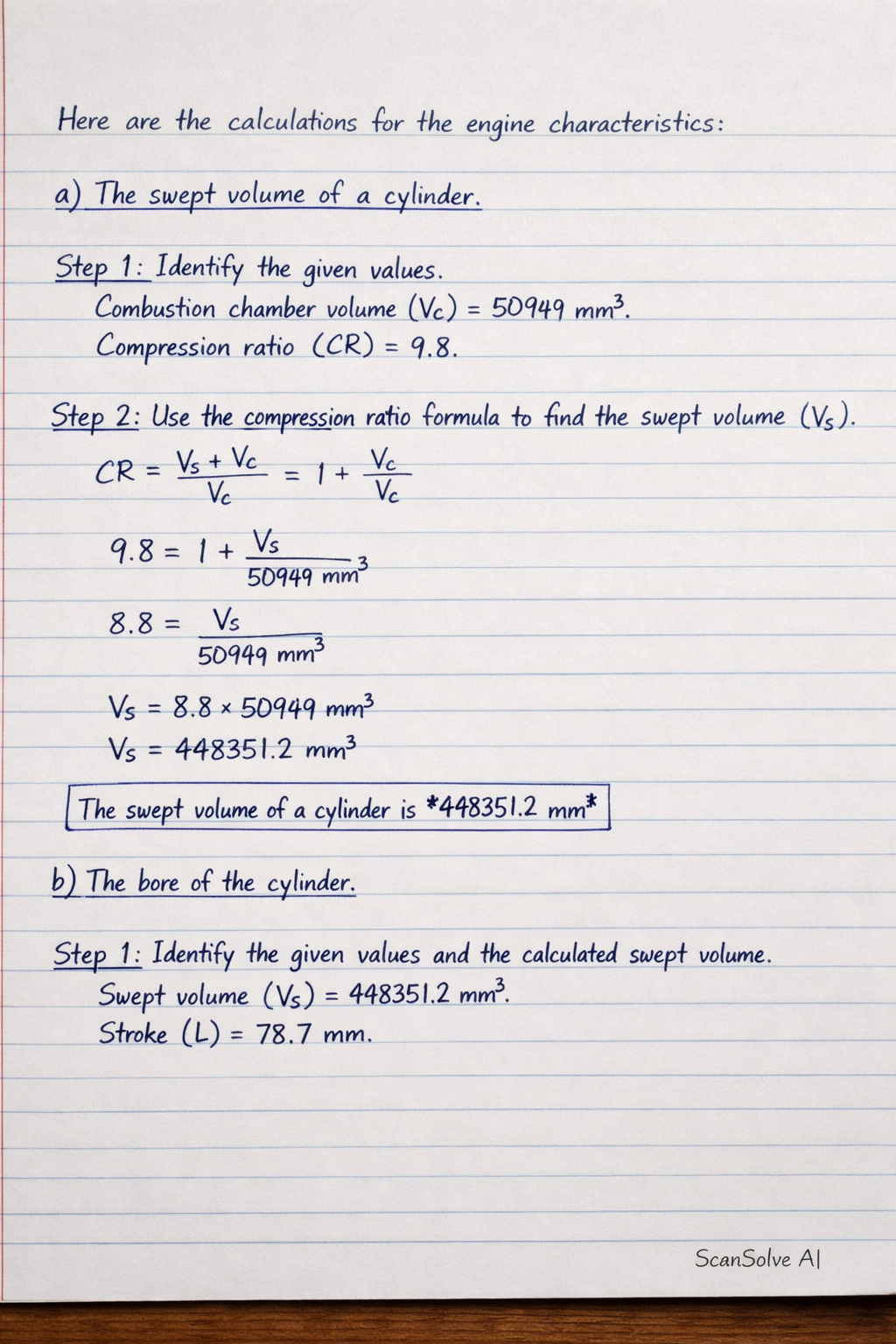
15 stepsHere are the calculations for the engine characteristics:
Part a· 2 steps
The swept volume of a cylinder.
Identify the given values.
Combustion chamber volume () .
Compression ratio () .Use the compression ratio formula to find the swept volume ().
The swept volume of a cylinder is .
Part b
The bore of the cylinder.
Identify the given values and the calculated swept volume.
Swept volume () .
Stroke () .Use the swept volume formula for a cylinder to find the bore ().
The bore of the cylinder is approximately .
Part c
Total cylinder volume.
Identify the swept volume and combustion chamber volume.
Swept volume () .
Combustion chamber volume () .Calculate the total cylinder volume ().
The total cylinder volume is .
Part d
Total engine capacity.
Identify the swept volume per cylinder and the number of cylinders.
Swept volume per cylinder () .
Number of cylinders .Calculate the total engine capacity.
This can also be expressed as or .
The total engine capacity is .
Part e
The force acting on the piston if the pressure (P) is .
Identify the given pressure and the calculated bore.
Pressure () .
Bore () .Convert the bore to meters.
Calculate the piston area ().
Calculate the force ().
The force acting on the piston is approximately .
Part f
Effective engine power.
Identify the given engine torque and rotational speed.
Engine torque () .
Rotational speed () .Convert the torque to Newton-meters (Nm).
Calculate the effective engine power ().
This can also be expressed as .
The effective engine power is approximately .
Part g
Briefly explain why cylinders are fitted with four valves instead of two?
Cylinders are fitted with four valves (typically two intake and two exhaust) instead of two to increase the total valve area. This larger area allows for more efficient and faster flow of gases into and out of the combustion chamber, improving the engine's *
Try one yourself
A new problem that tests the same skill.
Still stuck on this one?
Ask a follow-up, and the answer starts from this question.
More Physics Questions
Handwritten Step-by-Step Solution
Get this as a handwritten image on WhatsApp — like a tutor wrote it for you.
Try on WhatsApp