
We read your photo as:
At the end of compression stroke the Air is the Combustion space of a certain spark ignition engine develops a space of 50cm³. The pressure is 10³ N/m² (bar) and the temperature is 170°C. Calculate the mass & fuel ratio; m=14.7/1! Take R for air = 287 J/K. Calculate the barometric pressure to be.
ScanSolve AI Answer
Step-by-step solution
3 stepsHere are the solutions to the questions:
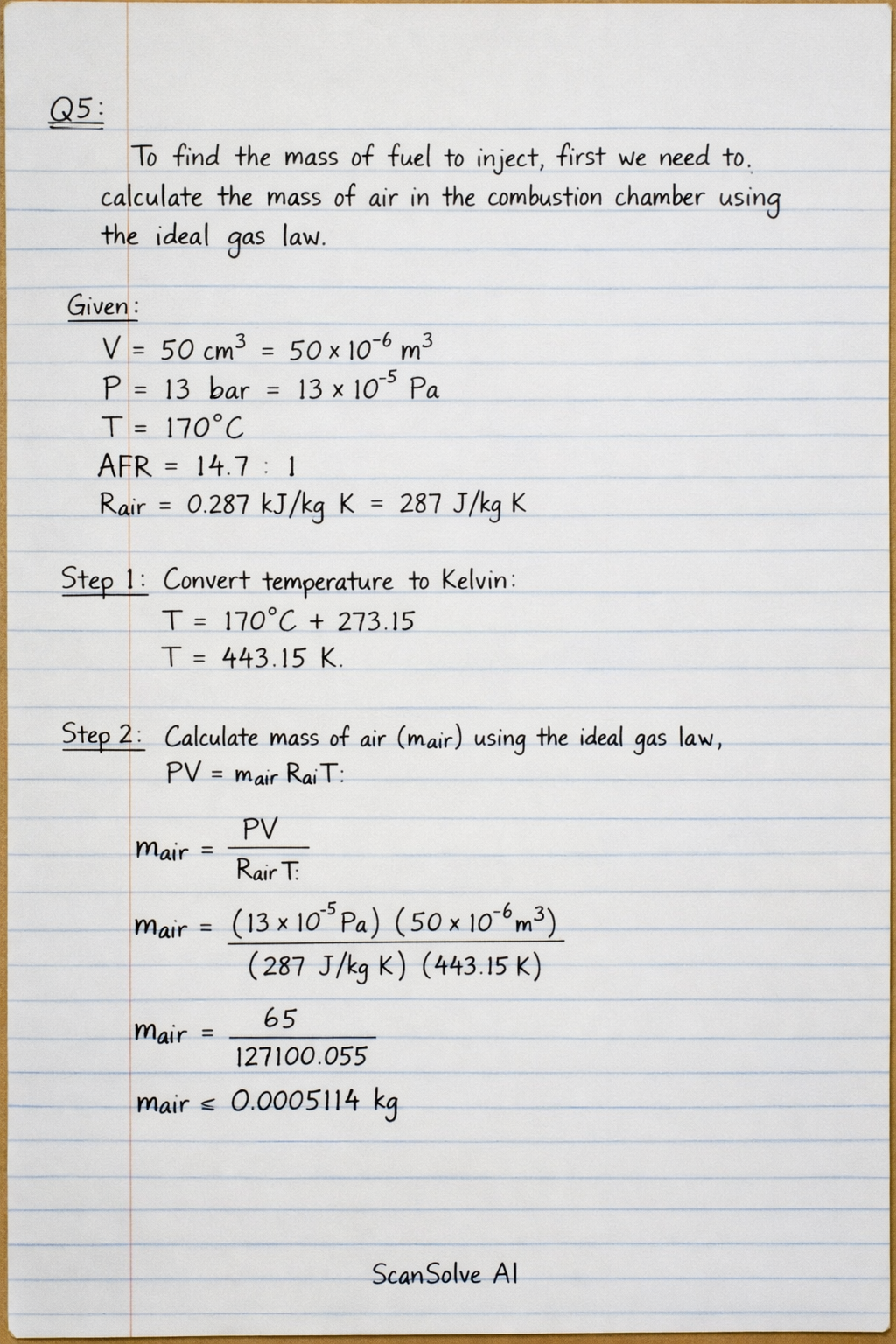
Q5:
To calculate the mass of fuel to be injected, we first need to find the mass of air in the combustion chamber using the ideal gas law, and then apply the air-fuel ratio.
Given values:
Volume of air () =
Pressure of air () =
Temperature of air () =
Air-fuel ratio (AFR) =
Gas constant for air () =
Convert temperature to Kelvin.
Calculate the mass of air () using the ideal gas law, .
Calculate the mass of fuel () using the air-fuel ratio.
The mass of fuel to be injected is .
Q6:
When safety is not observed in an Automobile Workshop, the following can result:- a) Distracted mindset on the job: This can lead to errors, accidents, and injuries due to lack of focus on the task at hand, especially when operating machinery or handling hazardous materials.
- b) Work when you are overtired: Fatigue impairs judgment and reaction time, significantly increasing the risk of accidents, mistakes, and serious injuries.
- c) Wear unclean overall: Unclean overalls, especially if soaked with oil, grease, or flammable liquids, pose a fire hazard and can cause skin irritation or infections.
- d) Not wearing safety boot: This exposes feet to hazards like falling objects, crushing injuries, punctures from sharp objects, and electrical shocks.
- e) Wear jewelry (ring, neck jewelry, neck chain): Jewelry can get caught in moving machinery, leading to severe injuries like degloving or amputation. It can also conduct electricity, causing electrical shocks or burns.
Q7:
a) Three categories of fire classifications in a workshop are: * Class A: Fires involving ordinary combustible materials such as wood, paper, cloth, rubber, and plastics. * Class B: Fires involving flammable liquids (e.g., gasoline, oil, paint) and flammable gases (e.g., propane, natural gas). * Class C: Fires involving energized electrical equipment.
b) Five important factors to be considered for preventing most explosions and fire spreading in a workshop are: * Proper Storage of Flammables: Store flammable liquids and gases in approved, clearly labeled containers and cabinets, away from ignition sources. * Good Housekeeping: Maintain a clean and organized workspace, regularly removing combustible waste, oily rags, and clutter that could fuel a fire. * Control of Ignition Sources: Eliminate or control sources of ignition such as open flames, sparks from welding or grinding, hot surfaces, and faulty electrical equipment. * Adequate Ventilation: Ensure proper ventilation to prevent the buildup of flammable vapors or dust, which can lead to explosions. * Emergency Preparedness and Training: Have functional fire extinguishers, alarms, and emergency exits. Regularly train staff on fire prevention, evacuation procedures, and the correct use of fire-fighting equipment.
Still stuck on this one?
Ask a follow-up, and the answer starts from this question.
More Physics Questions
Handwritten Step-by-Step Solution
Get this as a handwritten image on WhatsApp — like a tutor wrote it for you.
Try on WhatsApp