
We read your photo as:
Answers based on thermodynamics
ScanSolve AI Answer
Step-by-step solution
6 stepsHere are the answers to your thermodynamics questions.
Section A: Answer any three (3) questions
Question 1a: Define the following terms
- Thermodynamics: The branch of physics that studies the relationship between heat, work, temperature, and energy. It describes how thermal energy is converted to and from other forms of energy and how it affects matter.
- Thermodynamic state: The condition of a thermodynamic system as defined by its properties (e.g., pressure, temperature, volume, internal energy) at a specific instant.
- Thermodynamic system: A defined quantity of matter or a region in space chosen for study. It is separated from its surroundings by a boundary.
- Boundary: The real or imaginary surface that separates a thermodynamic system from its surroundings. It can be fixed or movable, and permeable or impermeable.
- Surrounding: Everything external to the thermodynamic system. Interactions (energy and mass transfer) between the system and surroundings occur across the boundary.
- Universe: The combination of the thermodynamic system and its surroundings.
- Sketch of thermodynamic system: Imagine a container (the system) with a distinct line around it (the boundary). Everything outside this line is the surroundings.
Question 1b: List the types of thermodynamic systems and explain any two with examples of each.
The main types of thermodynamic systems are:
- Open System: A system that can exchange both mass and energy with its surroundings.
- Example: A boiling pot of water without a lid. Water vapor (mass) escapes, and heat (energy) is transferred to the surroundings.
- Closed System: A system that can exchange energy but not mass with its surroundings.
- Example: A sealed can of soda being heated. Heat is transferred to the soda, but no soda escapes.
- Isolated System: A system that cannot exchange either mass or energy with its surroundings.
- Example: A perfectly insulated thermos flask containing hot coffee. Ideally, no heat or coffee mass leaves the flask.
Question 3a: The transformation of a thermodynamic system from one thermodynamic state to another is called a process. List all the various types of these processes and explain at least three (3) of them.
Various types of thermodynamic processes include:
- Isothermal Process: A process that occurs at a constant temperature (). For an ideal gas, the internal energy change is zero.
- Explanation: In an isothermal process, any heat added to the system is converted entirely into work done by the system, or vice versa, to maintain a constant temperature.
- Isobaric Process: A process that occurs at a constant pressure ().
- Explanation: In an isobaric process, the system expands or contracts, doing work against or by the constant external pressure. Heat transfer occurs to change the internal energy and perform work.
- Isochoric (or Isometric) Process: A process that occurs at a constant volume (). Since no change in volume occurs, no work is done by or on the system ().
- Explanation: In an isochoric process, all heat added to the system goes directly into increasing its internal energy and temperature, as no work is performed.
- Adiabatic Process: A process where no heat transfer occurs between the system and its surroundings ().
- Cyclic Process: A process where the system returns to its initial state after a series of changes.
- Reversible Process: A process that can be reversed without leaving any change in the surroundings.
- Irreversible Process: A process that cannot be reversed without leaving a change in the surroundings.
Question 3b: Define the following terms and give their mathematical relation:
- Enthalpy (): A thermodynamic property representing the total heat content of a system. It is the sum of the internal energy () and the product of pressure () and volume ().
- Mathematical relation:
- Internal energy (): The total energy contained within a thermodynamic system, excluding the kinetic and potential energy of the system as a whole.
- Mathematical relation: For a closed system, the change in internal energy is given by the First Law of Thermodynamics:
- Pressure (): The force exerted perpendicularly on a surface per unit area.
- Mathematical relation:
Question 5a: State the first law of Thermodynamics and represent it with an Equation.
- Statement: The First Law of Thermodynamics, also known as the Law of Conservation of Energy, states that energy cannot be created or destroyed in an isolated system; it can only be transformed from one form to another. In a thermodynamic system, the change in internal energy of a closed system is equal to the heat supplied to the system minus the work done by the system on its surroundings.
- Equation:
Where:
- is the change in internal energy of the system.
- is the net heat transferred to the system.
- is the net work done by the system.
Question 5b: Give two (2) significance of the first law.
- Energy Conservation: It establishes the fundamental principle that energy is conserved, meaning it can be converted but not created or destroyed.
- Defines Internal Energy: It provides a precise definition for internal energy and how it changes through heat and work interactions.
Question 5c: Give one application of the law above.
- Application: The design and analysis of heat engines and refrigerators. Engineers use the first law to calculate the efficiency of these devices by accounting for energy inputs, outputs, and work done.
Question 5d: Give two limitations of the first law.
- Direction of Process: The first law does not indicate the direction in which a process will occur spontaneously (e.g., heat flows from hot to cold, not the other way).
- Quality of Energy: It does not distinguish between different qualities of energy. It treats all forms of energy equally, even though some forms are more useful for doing work than others.
Section B: Answer any two (2) questions
Question 6d: A 2.5 m³ of gas at 8 bar pressure expand at constant temperature to a volume of 10 m³. Find the final pressure of gas.
This is an isothermal process, so Boyle's Law applies ().
Identify the given values.
- Initial volume,
- Initial pressure,
- Final volume,
- Final pressure,
Apply Boyle's Law formula.
Solve for .
Question 7a: Define the following laws of perfect gas and state their mathematical relation:
- Boyle's Law: States that for a fixed amount of gas at constant temperature, the pressure of the gas is inversely proportional to its volume.
- Mathematical relation:
- Charles's Law: States that for a fixed amount of gas at constant pressure, the volume of the gas is directly proportional to its absolute temperature.
- Mathematical relation:
- Avogadro's Law: States that equal volumes of all gases, at the same temperature and pressure, have the same number of molecules (or moles).
- Mathematical relation:
- Dalton's Law of Partial Pressure: States that in a mixture of non-reacting gases, the total pressure exerted is equal to the sum of the partial pressures of the individual gases.
- Mathematical relation:
- Gay-Lussac's Law (Pressure-Temperature Law): States that for a fixed amount of gas at constant volume, the pressure of the gas is directly proportional to its absolute temperature.
- Mathematical relation:
Question 7b: Find the volume occupied when a given quantity of gas exists at a temperature of 400°C, if the volume of this quantity of gas at 0°C is 0.57m³, the pressure being same at both temperature.
This is a constant pressure process, so Charles's Law applies ().
- Boyle's Law: States that for a fixed amount of gas at constant temperature, the pressure of the gas is inversely proportional to its volume.
Identify the given values and convert temperatures to Kelvin.
- Initial volume,
- Initial temperature,
- Final temperature,
- Final volume,
Apply Charles's Law formula.
Solve for .
The volume occupied at 400°C is (rounded to two decimal places).
Still stuck on this one?
Ask a follow-up, and the answer starts from this question.
More Physics Questions
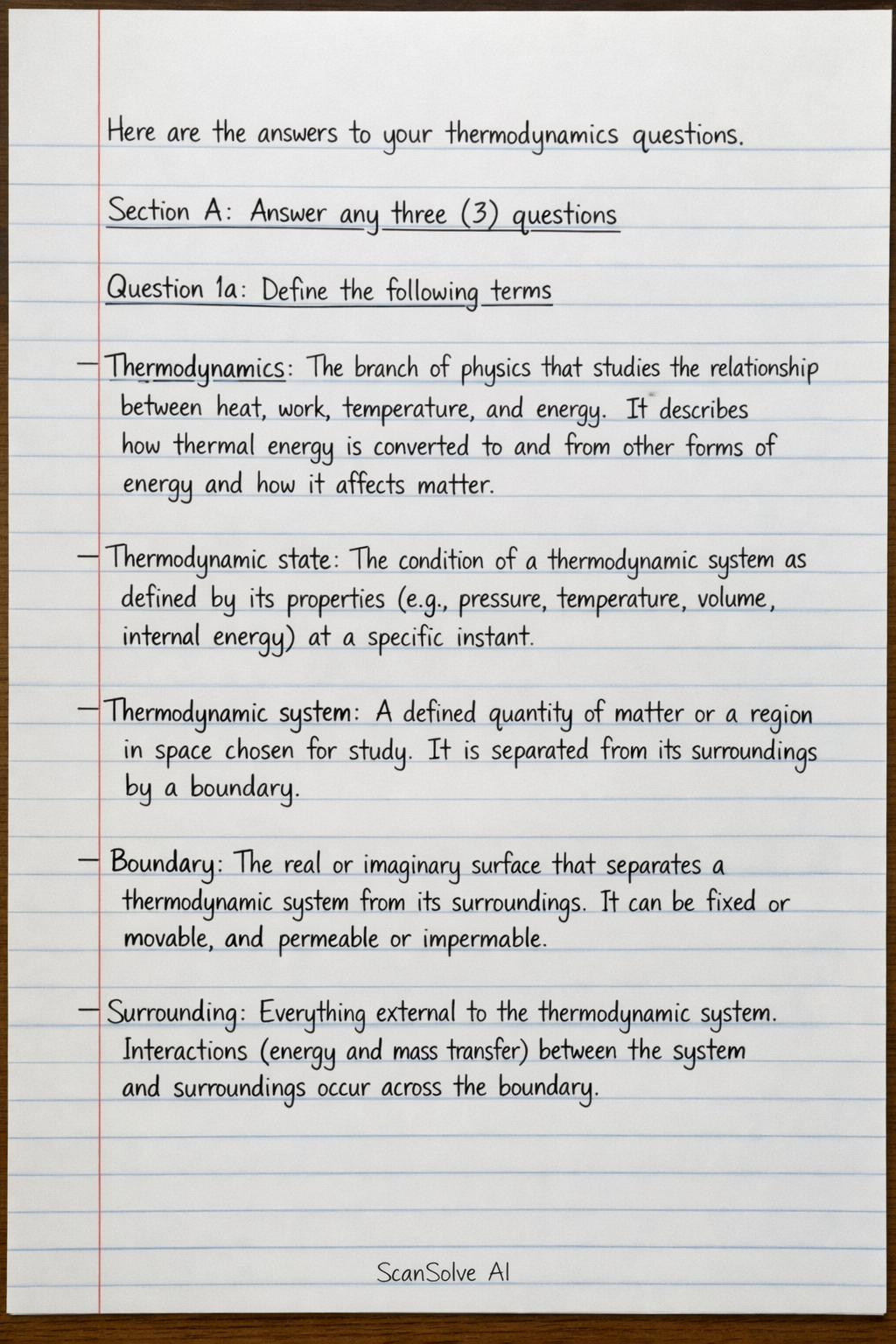
Handwritten Step-by-Step Solution
Get this as a handwritten image on WhatsApp — like a tutor wrote it for you.
Try on WhatsApp