
We read your photo as:
Define the following heat related terms: i. Sensible Heat ii. Latent Heat of Vaporization iii. Latent Heat of Fusion.
ScanSolve AI Answer
Step-by-step solution
5 stepsTo calculate the temperature of the air at the end of the compression stroke, we will use the adiabatic process relations for an ideal gas. We are given the initial temperature and pressure, and the final pressure.
Given values:
Initial temperature () =
Initial pressure () = (atmospheric pressure)
Gauge pressure at the end of compression () =
Compression ratio () = (This value is provided but not directly used in the chosen formula, as the final pressure is explicitly recorded, indicating a real process which may not be perfectly ideal adiabatic based on volume alone).
Adiabatic index for air () = 1.4
Convert the initial temperature to Kelvin and calculate the final absolute pressure.
The final absolute pressure () is the sum of the atmospheric pressure and the gauge pressure.
Use the adiabatic relation between temperature and pressure.
For an adiabatic process, the relationship between temperature and pressure is given by:
Substitute the given values into the formula.
Calculate the numerical value for in Kelvin.
Convert the final temperature back to Celsius.
The temperature of the air in the cylinder at the end of the compression stroke is .
Still stuck on this one?
Ask a follow-up, and the answer starts from this question.
More Physics Questions
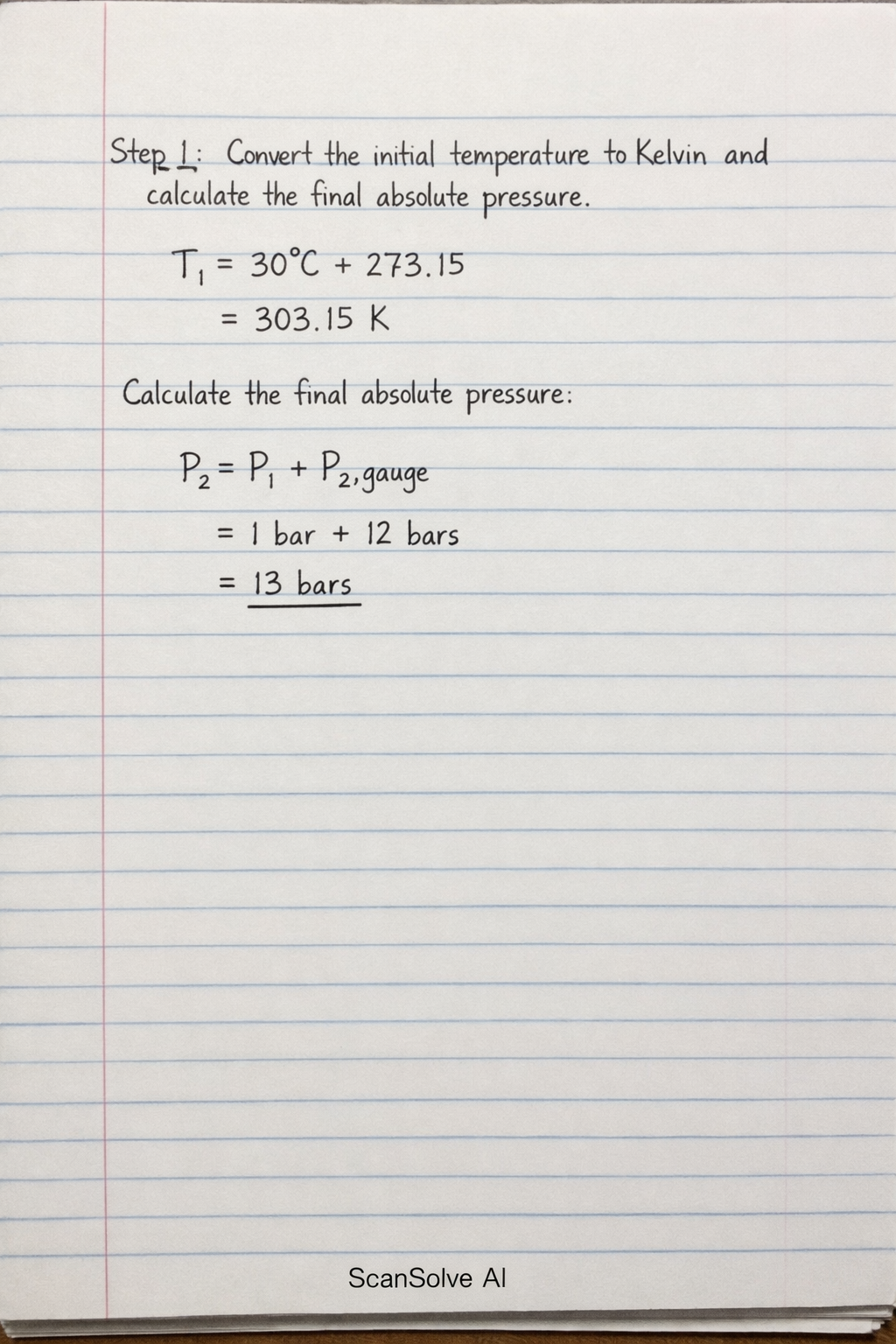
Handwritten Step-by-Step Solution
Get this as a handwritten image on WhatsApp — like a tutor wrote it for you.
Try on WhatsApp