
We read your photo as:
A car with mass 1300 kg is traveling at 13.3 m/s. If the frictional force is 7700 N, what is the stopping distance?
ScanSolve AI Answer
Answer
Step-by-step solution
5 stepsTo determine the stopping distance of the car, we will use the work-energy theorem, which states that the net work done on an object is equal to the change in its kinetic energy.
Given values:
- Mass of the car,
- Initial speed of the car,
- Final speed of the car (when it stops),
- Frictional force,
State the work-energy theorem.
Calculate the initial and final kinetic energies.
The formula for kinetic energy is .
Initial kinetic energy:Final kinetic energy:
Since the car stops, .
Calculate the work done by the frictional force.
The work done by friction is . Since the frictional force opposes the motion, the angle between the force and displacement is , so .
Apply the work-energy theorem to find the stopping distance .
Round the answer to two decimal places as instructed.
The stopping distance of the car is:
Just one more to go today! Send it over.
Try one yourself
A new problem that tests the same skill.
Still stuck on this one?
Ask a follow-up, and the answer starts from this question.
More Physics Questions
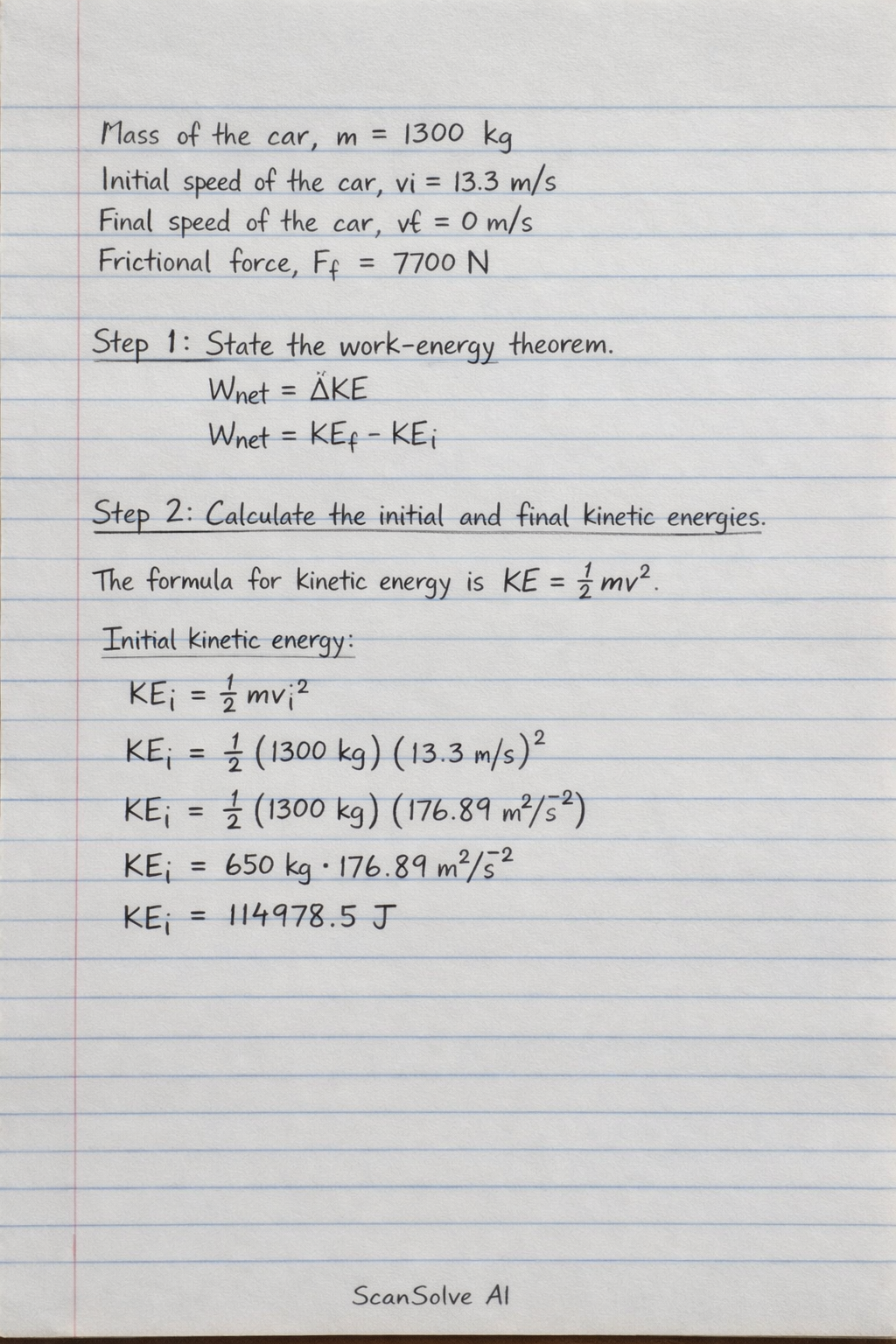
Handwritten Step-by-Step Solution
Get this as a handwritten image on WhatsApp — like a tutor wrote it for you.
Try on WhatsApp