
We read your photo as:
A charge of 13.0 C is moved through a potential difference of 40 V over a distance of 5.0 mm. Calculate the work done and the magnitude of the electric field.
Physics
ScanSolve AI Answer
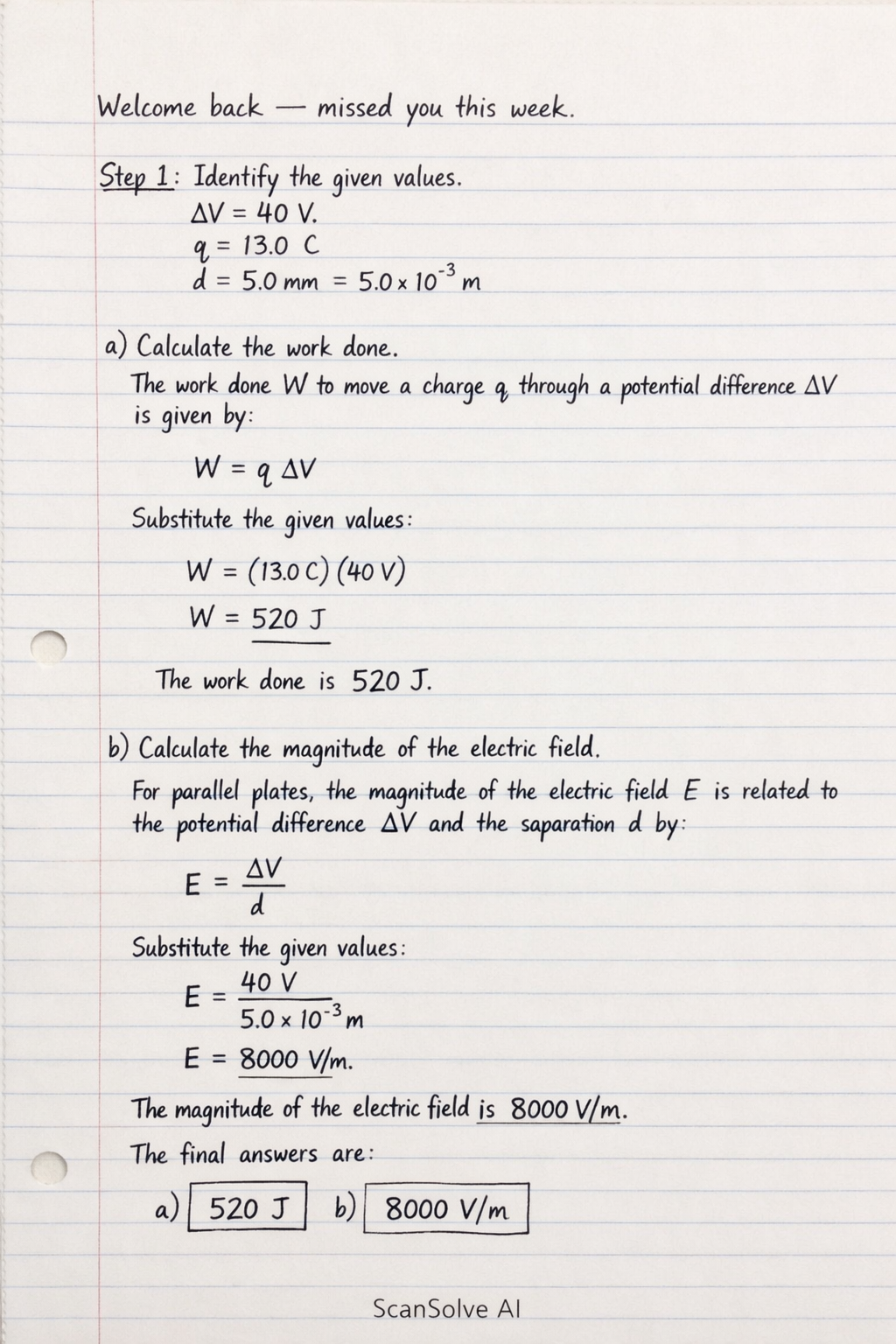
Step 1: Identify the given values.
Potential difference .
Charge .
Distance .
a) Calculate the work done.
The work done to move a charge through a potential difference is given by:
Substitute the given values:
The work done is 520 J.
b) Calculate the magnitude of the electric field.
For parallel plates, the magnitude of the electric field is related to the potential difference and the separation by:
Substitute the given values:
The magnitude of the electric field is 8000 V/m.
The final answers are:
a)
b)
Was this helpful?
Still stuck on this one?
Ask a follow-up, and the answer starts from this question.
Got a different question?Ask your own question
More Physics Questions
QA charge of +8.0 mC is moved through a uniform electric field of 20 V/m. The electric field lines…QCalculate the work done to move a charge of 0.05 microcoulomb from a distance of 10 cm to 50 cm from…QQ1. A uniform electric field E exists along positive x-axis. The work done in moving charge 0.5C…QPerpendicular to 85.0 × 10⁻⁵ T magnetic field E = BIV E = BW(5.00×10⁻⁵)(2.0×10⁴) 7.80 × 10³ m/s…QCalculate the work done by the electric force.
Handwritten Step-by-Step Solution
Get this as a handwritten image on WhatsApp — like a tutor wrote it for you.
Try on WhatsApp