
We read your photo as:
A child slides up a playground ramp with a speed of 4 m/s. How high up the ramp will the child go? (Assume no friction.)
ScanSolve AI Answer
Step-by-step solution
7 stepsHere are the solutions to the problems:
Question 3:
a) A child slides up a playground ramp with a speed of . How high up the ramp will the child go?
Identify the given values and the physical principle.
The initial speed (velocity) of the child is .
We need to find the maximum height .
The acceleration due to gravity is .
When the child slides up the ramp, their initial kinetic energy is converted into gravitational potential energy at the maximum height. We use the principle of conservation of mechanical energy:The mass of the child cancels out from both sides.
Rearrange the formula to solve for the height .
Substitute the given values into the formula and calculate the height.
The child will go high up the ramp.
Question 8:
a) A truck of mass moves up a hill at . Find the maximum height reached. Then state whether mass affects the height.
Identify the given values and the physical principle.
The mass of the truck is .
The initial speed (velocity) of the truck is .
We need to find the maximum height .
The acceleration due to gravity is .
Using the principle of conservation of mechanical energy:Again, the mass cancels out from both sides.
Rearrange the formula to solve for the height .
Substitute the given values into the formula and calculate the height.
The maximum height reached by the truck is .
State whether mass affects the height.
As seen in the formula , the mass is not present. This means that for a given initial velocity, the maximum height reached is independent of the mass of the object.
No, the mass does not affect the height reached.
Still stuck on this one?
Ask a follow-up, and the answer starts from this question.
More Physics Questions
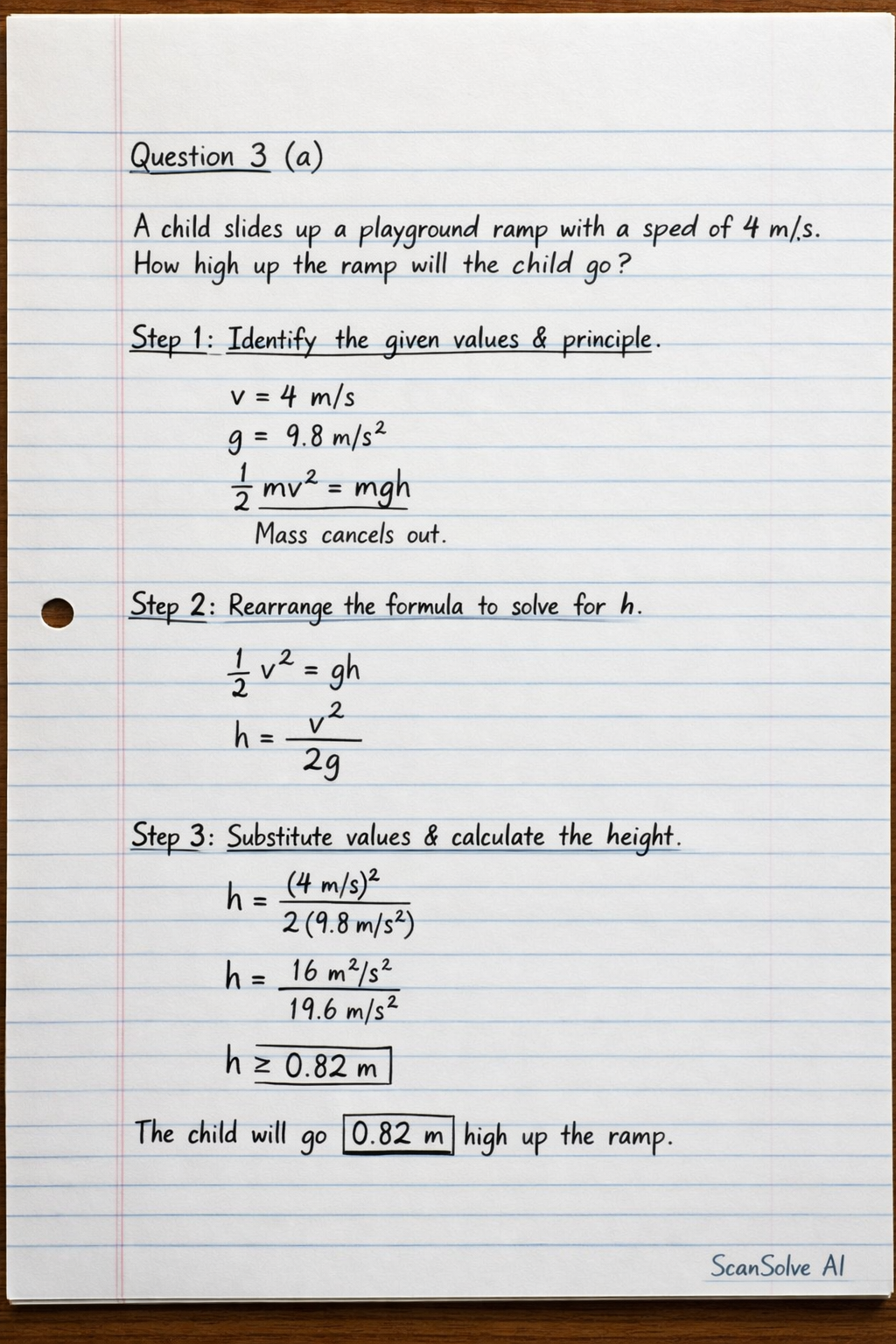
Handwritten Step-by-Step Solution
Get this as a handwritten image on WhatsApp — like a tutor wrote it for you.
Try on WhatsApp