
We read your photo as:
A concave mirror forms a real image that is 3 times the size of the object. If the screen is moved, the image size becomes 5 times the object size. Find the ratio of the distances of the screen from t
ScanSolve AI Answer
Step-by-step solution
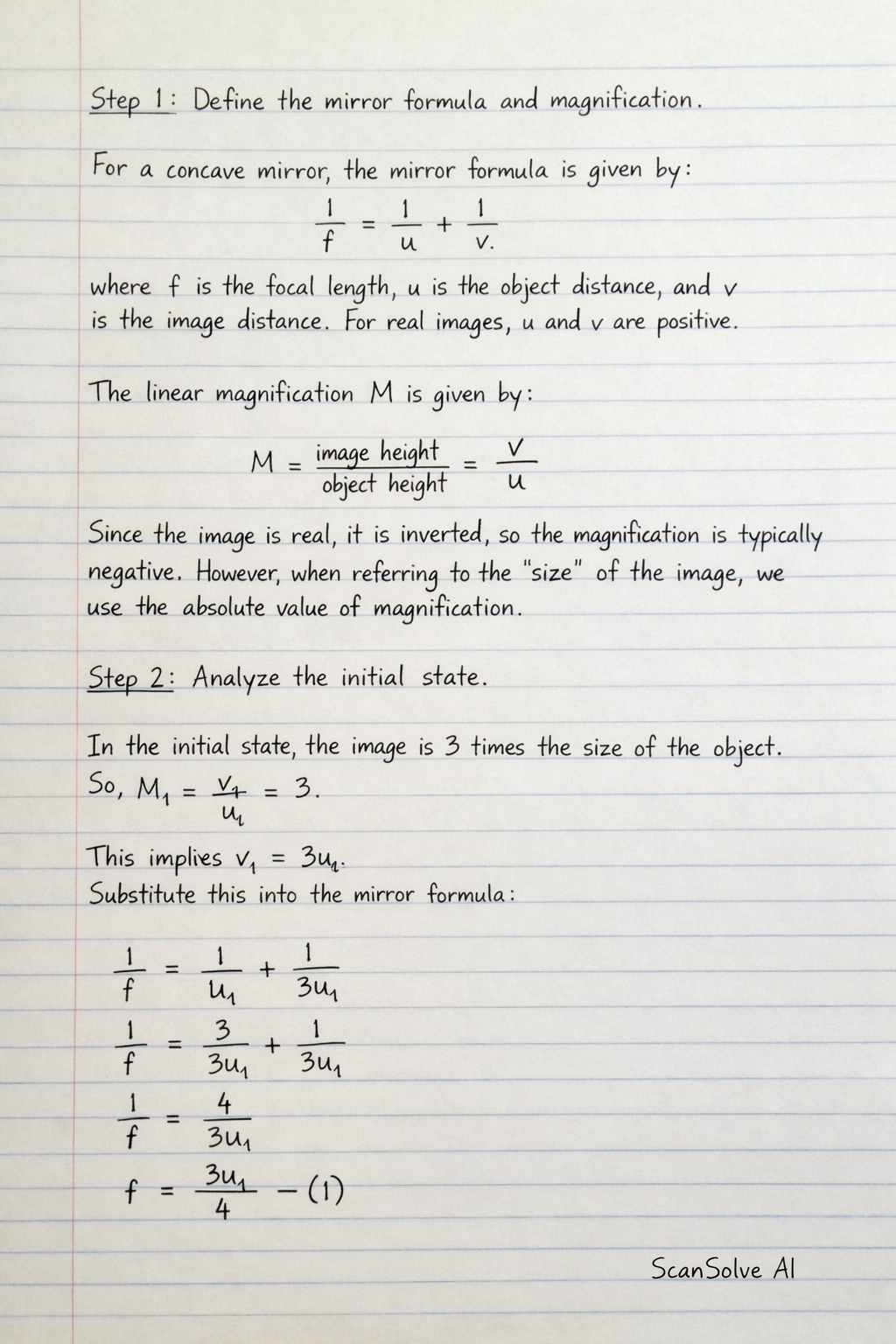
6 stepsDefine the mirror formula and magnification.
For a concave mirror, the mirror formula is given by:
where is the focal length, is the object distance, and is the image distance. For real images, and are positive.
The linear magnification is given by:Since the image is real, it is inverted, so the magnification is typically negative. However, when referring to the "size" of the image, we use the absolute value of magnification.
Analyze the initial state.
In the initial state, the image is 3 times the size of the object.
So, .
This implies .
Substitute this into the mirror formula:Analyze the final state.
In the final state, the image is 5 times the size of the object.
So, .
This implies .
Substitute this into the mirror formula:Relate the initial and final states using the screen shift.
Equate the expressions for from (1) and (2):
Multiply both sides by 12 to clear denominators:
Since the magnification increased from 3 to 5, the object must have moved closer to the mirror, and the image moved further away. Therefore, and .
The shift of the screen (image) is given as 30 cm:Substitute and :
Solve for and .
Substitute equation (3) into equation (4):
Now find using equation (3):
Calculate the focal length and the shift of the object.
Calculate the focal length using in equation (1):
The shift of the object is :
The focal length of the mirror is .
The shift of the object is .
Still stuck on this one?
Ask a follow-up, and the answer starts from this question.
More Physics Questions
Handwritten Step-by-Step Solution
Get this as a handwritten image on WhatsApp — like a tutor wrote it for you.
Try on WhatsApp