
We read your photo as:
A converging lens has a focal length of 6 cm. If an object is placed 8 cm from the lens, calculate the position of the image and give an application of this lens arrangement.
ScanSolve AI Answer
Answers
2 partsStep-by-step solution
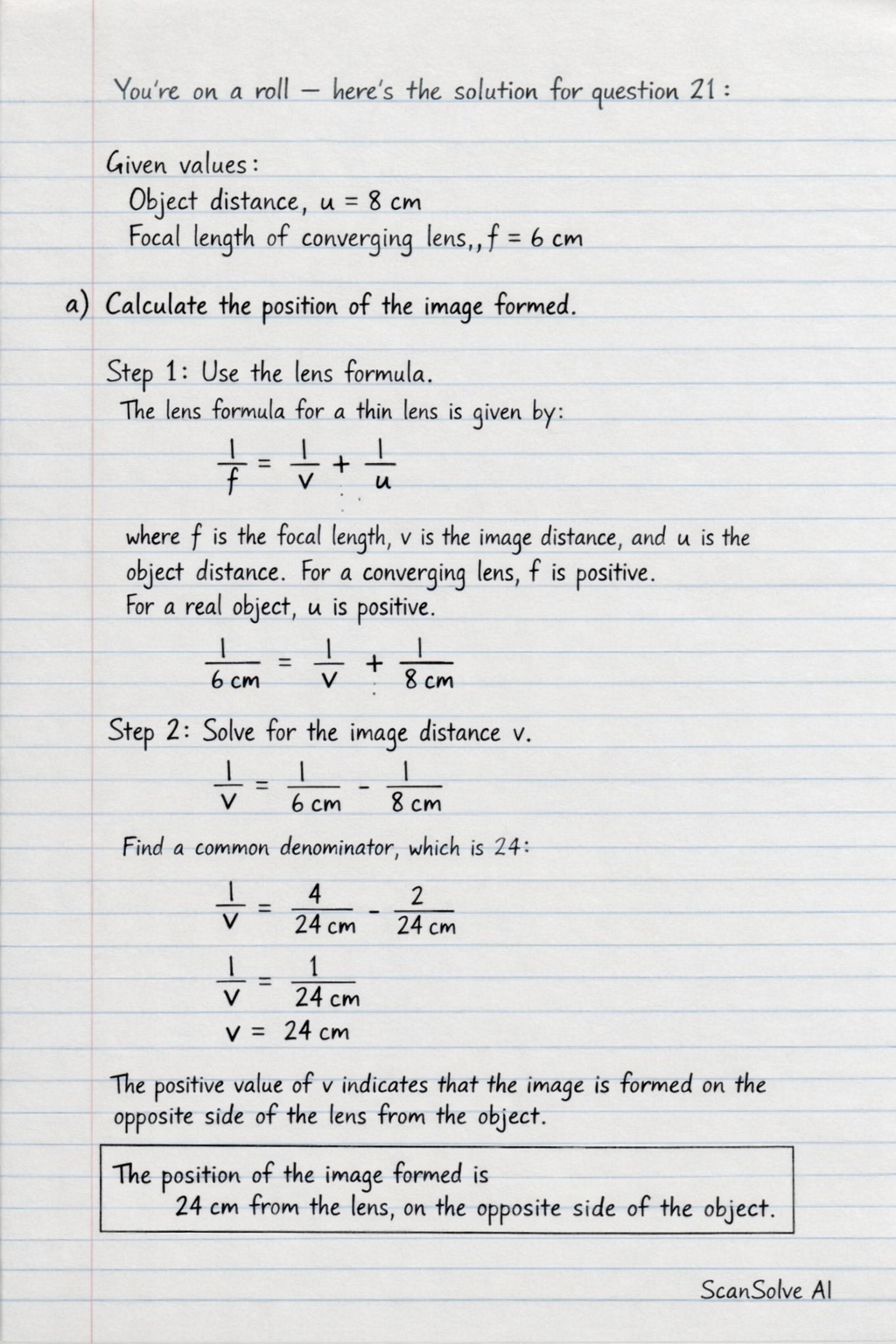
5 stepshere's the solution for question 21:
Given values:
Object distance,
Focal length of converging lens,
Part a· 2 steps
Calculate the position of the image formed.
Use the lens formula.
The lens formula for a thin lens is given by:
where is the focal length, is the image distance, and is the object distance. For a converging lens, is positive. For a real object, is positive.
Solve for the image distance .
Find a common denominator, which is 24:
The positive value of indicates that the image is formed on the opposite side of the lens from the object.
The position of the image formed is .
Part b
Give an application of this arrangement of a lens.
When an object is placed between the focal point () and twice the focal length () of a converging lens (here, , , and ), a real, inverted, and magnified image is formed. This arrangement is used in devices that require a magnified real image.
An application of this arrangement is a projector (e.g., slide projector or movie projector) or the objective lens of a compound microscope.
Part c
Describe the nature of the image formed.
Determine if the image is real or virtual.
Since the image distance is positive (), the image is formed by actual intersection of refracted rays, meaning it is a real image.
Determine if the image is upright or inverted.
For a real image formed by a single converging lens, the image is always inverted.
Determine if the image is magnified or diminished.
The magnification is given by .
The magnitude of magnification , which is greater than 1, indicating that the image is magnified.
The nature of the image formed is .
Try one yourself
A new problem that tests the same skill.
Still stuck on this one?
Ask a follow-up, and the answer starts from this question.
More Physics Questions
Handwritten Step-by-Step Solution
Get this as a handwritten image on WhatsApp — like a tutor wrote it for you.
Try on WhatsApp