
We read your photo as:
A. Define the term equilibrium b. The system shown in Figure Q1b below is in equilibrium. Calculate the values of the tensions in the strings A, B, C and D.
ScanSolve AI Answer
Step-by-step solution
5 stepsHere's the solution to the problem.
a) Equilibrium is a state where the net force and net torque acting on an object are both zero. This means the object is either at rest (static equilibrium) or moving with constant velocity (dynamic equilibrium).
b) To calculate the tensions in the strings, we will analyze the forces at point C. The system is in equilibrium, so the sum of forces in both the horizontal and vertical directions must be zero.
Let be the tension in the string segment from the left wall to point C, and be the tension in the string segment from the right wall to point C. The angles are given as with the horizontal for and with the horizontal for . The downward force is .
Resolve forces horizontally.
The sum of horizontal forces is zero.
Resolve forces vertically.
The sum of vertical forces is zero.
Substitute from Step 1 into the vertical force equation.
Calculate using the value of .
Substitute into equation :
Determine tensions in strings A and B.
String A is the vertical segment supporting the horizontal string B. String B is the horizontal segment connected to point C.
The tension in string B is equal to the horizontal component of .The tension in string A is equal to the tension in string B, as it is supporting the horizontal string B.
The tensions are:
Still stuck on this one?
Ask a follow-up, and the answer starts from this question.
More Physics Questions
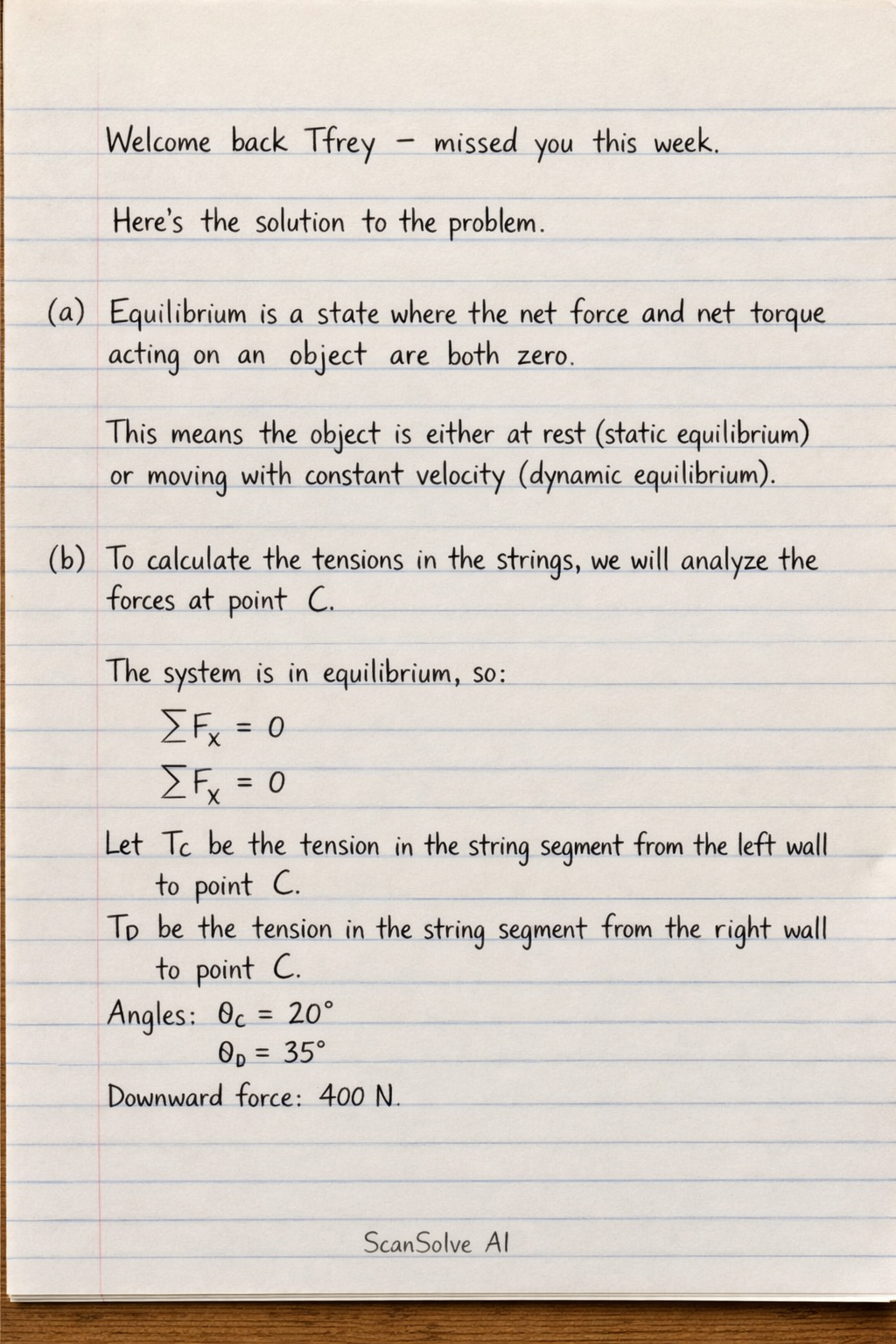
Handwritten Step-by-Step Solution
Get this as a handwritten image on WhatsApp — like a tutor wrote it for you.
Try on WhatsApp