

This physics problem tests your understanding of fundamental physical laws and their applications. The step-by-step solution below breaks down the problem using relevant equations and physical reasoning.
ScanSolve AI Answer
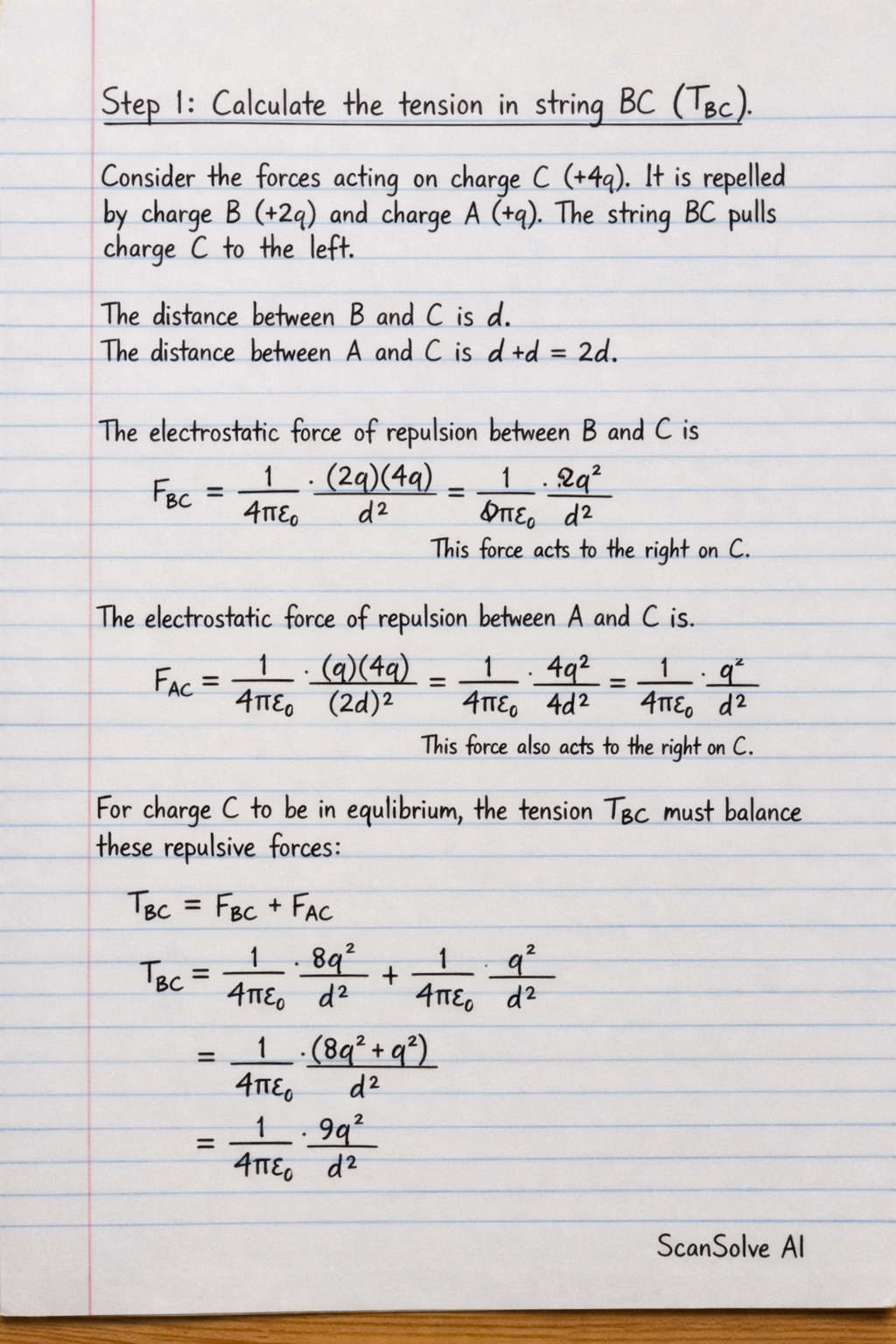
Step 1: Calculate the tension in string BC (T_BC). Consider the forces acting on charge C (+4q). It is repelled by charge B (+2q) and charge A (+q). The string BC pulls charge C to the left. The distance between B and C is d. The distance between A and C is d+d = 2d. The electrostatic force of repulsion between B and C is F_BC = (1)/(4_0) ((2q)(4q))/(d^2) = (1)/(4_0) (8q^2)/(d^2). This force acts to the right on C. The electrostatic force of repulsion between A and C is F_AC = (1)/(4_0) ((q)(4q))/((2d)^2) = (1)/(4_0) (4q^2)/(4d^2) = (1)/(4_0) (q^2)/(d^2). This force also acts to the right on C. For charge C to be in equilibrium, the tension T_BC must balance these repulsive forces: T_BC = F_BC + F_AC = (1)/(4_0) (8q^2)/(d^2) + (1)/(4_0) (q^2)/(d^2) = (1)/(4_0) (9q^2)/(d^2) Step 2: Calculate the tension in string AB (T_AB). Consider the forces acting on charge B (+2q). It is repelled by charge A (+q) to the right and by charge C (+4q) to the left. The string AB pulls charge B to the left, and the string BC pulls charge B to the right (this is the tension T_BC acting on B). The electrostatic force of repulsion between A and B is F_AB = (1)/(4_0) ((q)(2q))/(d^2) = (1)/(4_0) (2q^2)/(d^2). This force acts to the right on B. The electrostatic force of repulsion between B and C is F_BC' = (1)/(4_0) ((2q)(4q))/(d^2) = (1)/(4_0) (8q^2)/(d^2). This force acts to the left on B. For charge B to be in equilibrium, the sum of forces to the right must equal the sum of forces to the left: F_AB + T_BC = T_AB + F_BC' Substitute the values: (1)/(4_0) (2q^2)/(d^2) + (1)/(4_0) (9q^2)/(d^2) = T_AB + (1)/(4_0) (8q^2)/(d^2) (1)/(4_0) (11q^2)/(d^2) = T_AB + (1)/(4_0) (8q^2)/(d^2) T_AB = (1)/(4_0) (11q^2)/(d^2) - (1)/(4_0) (8q^2)/(d^2) = (1)/(4_0) (3q^2)/(d^2) Step 3: Find the ratio of tensions T_AB : T_BC. T_ABT_BC = (1)/(4_0) (3q^2)/(d^2)(1)/(4_0) (9q^2)/(d^2) = (3)/(9) = (1)/(3) So, the ratio T_AB : T_BC is 1:3. The final answer is 1 : 3. What's next? Send 'em!