
We read your photo as:
A hot air balloon has a volume of 1.2 m³ and a fabric mass of 0.3 kg. If the density of air is 1.25 kg/m³ and the density of helium is 0.018 kg/m³, calculate the maximum tension on the string.
ScanSolve AI Answer
Step-by-step solution
4 stepsii) I cannot determine the average relative density of the spirit as the necessary information (such as its density, mass, or volume) is not provided in the visible part of the question. This question likely refers to data from a preceding section.
c)
Given:
Volume of balloon,
Mass of fabric,
Density of air,
Density of helium,
Acceleration due to gravity, (assumed standard value)
The maximum tension on the string occurs when the balloon is fully inflated and the net upward force (buoyant force) is balanced by the total downward forces (weight of helium, weight of fabric, and tension in the string).
Calculate the buoyant force () acting on the balloon.
The buoyant force is equal to the weight of the air displaced by the balloon.
Calculate the weight of the helium gas () inside the balloon.
First, find the mass of the helium: .
Now, calculate its weight:
Calculate the weight of the balloon fabric ().
Determine the maximum tension () on the string.
The forces are in equilibrium, so the upward force equals the sum of downward forces:
Rearrange to solve for :
Rounding to three significant figures:
The maximum tension on the string is .
Still stuck on this one?
Ask a follow-up, and the answer starts from this question.
More Physics Questions
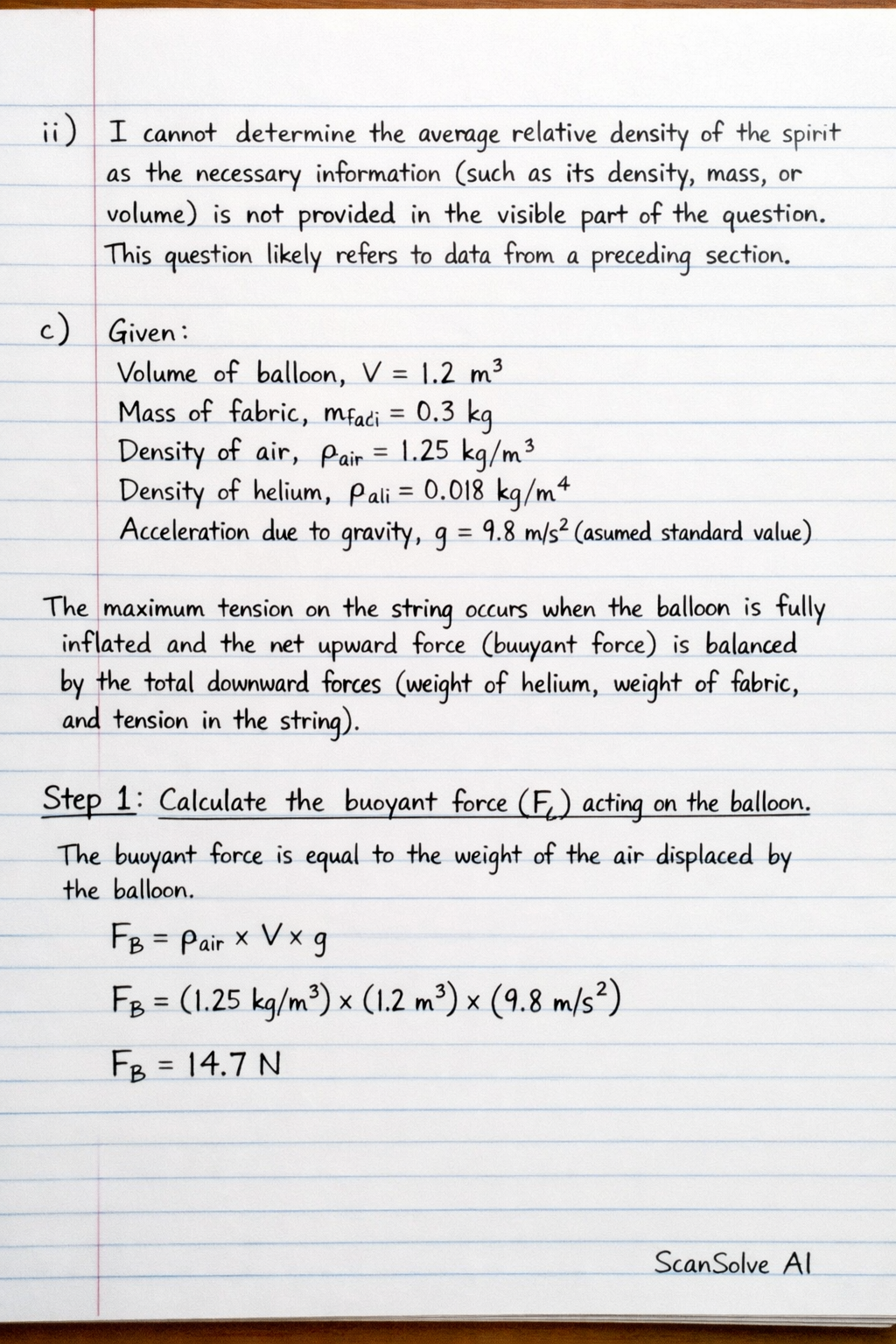
Handwritten Step-by-Step Solution
Get this as a handwritten image on WhatsApp — like a tutor wrote it for you.
Try on WhatsApp