

This physics problem tests your understanding of fundamental physical laws and their applications. The step-by-step solution below breaks down the problem using relevant equations and physical reasoning.
ScanSolve AI Answer
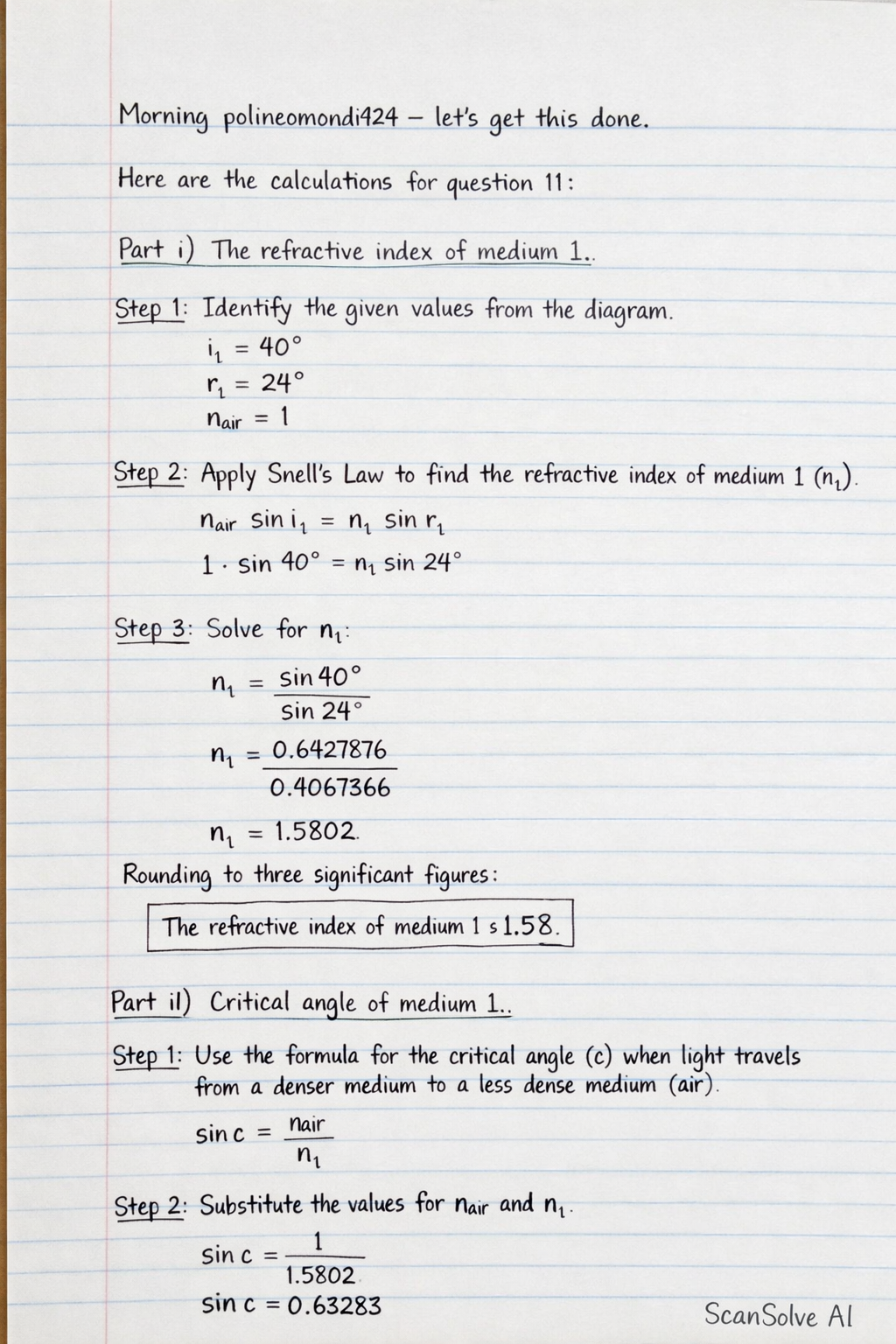
Morning polineomondi424 — let's get this done. Here are the calculations for question 11: Part i) The refractive index of medium 1. Step 1: Identify the given values from the diagram. The angle of incidence in air is i_1 = 40^. The angle of refraction in medium 1 is r_1 = 24^. The refractive index of air is n_air = 1. Step 2: Apply Snell's Law to find the refractive index of medium 1 (n_1). n_air (i_1) = n_1 (r_1) 1 · (40^) = n_1 (24^) Step 3: Solve for n_1. n_1 = ((40^))/((24^)) n_1 = (0.6427876)/(0.4067366) n_1 ≈ 1.5802 Rounding to three significant figures: The refractive index of medium 1 is 1.58 Part ii) Critical angle of medium 1. Step 1: Use the formula for the critical angle (c) when light travels from a denser medium (medium 1) to a less dense medium (air). (c) = n_airn_1 Step 2: Substitute the values for n_air and n_1. (c) = (1)/(1.5802) (c) ≈ 0.63283 Step 3: Calculate the critical angle c. c = (0.63283) c ≈ 39.25^ Rounding to one decimal place: The critical angle of medium 1 is 39.3^ Part iii) The refractive index of medium 2 relative to medium 1 (n_2). Step 1: Identify the angles for the interface between medium 1 and medium 2. The angle of incidence in medium 1 is i_2 = 24^. The angle of refraction in medium 2 is r_2 = 26^. Step 2: The refractive index of medium 2 relative to medium 1 is given by the ratio of the sines of the angles of incidence and refraction at that interface, or by the ratio of the absolute refractive indices. n_2/1 = (n_2)/(n_1) Using Snell's Law for the interface between medium 1 and medium 2: n_1 (i_2) = n_2 (r_2) Therefore, the relative refractive index n_2/1 can be expressed as: n_2/1 = (n_2)/(n_1) = ((i_2))/((r_2)) Step 3: Substitute the angles and calculate n_2/1. n_2/1 = ((24^))/((26^)) n_2/1 = 0.4067366