

This physics problem tests your understanding of fundamental physical laws and their applications. The step-by-step solution below breaks down the problem using relevant equations and physical reasoning.
ScanSolve AI Answer
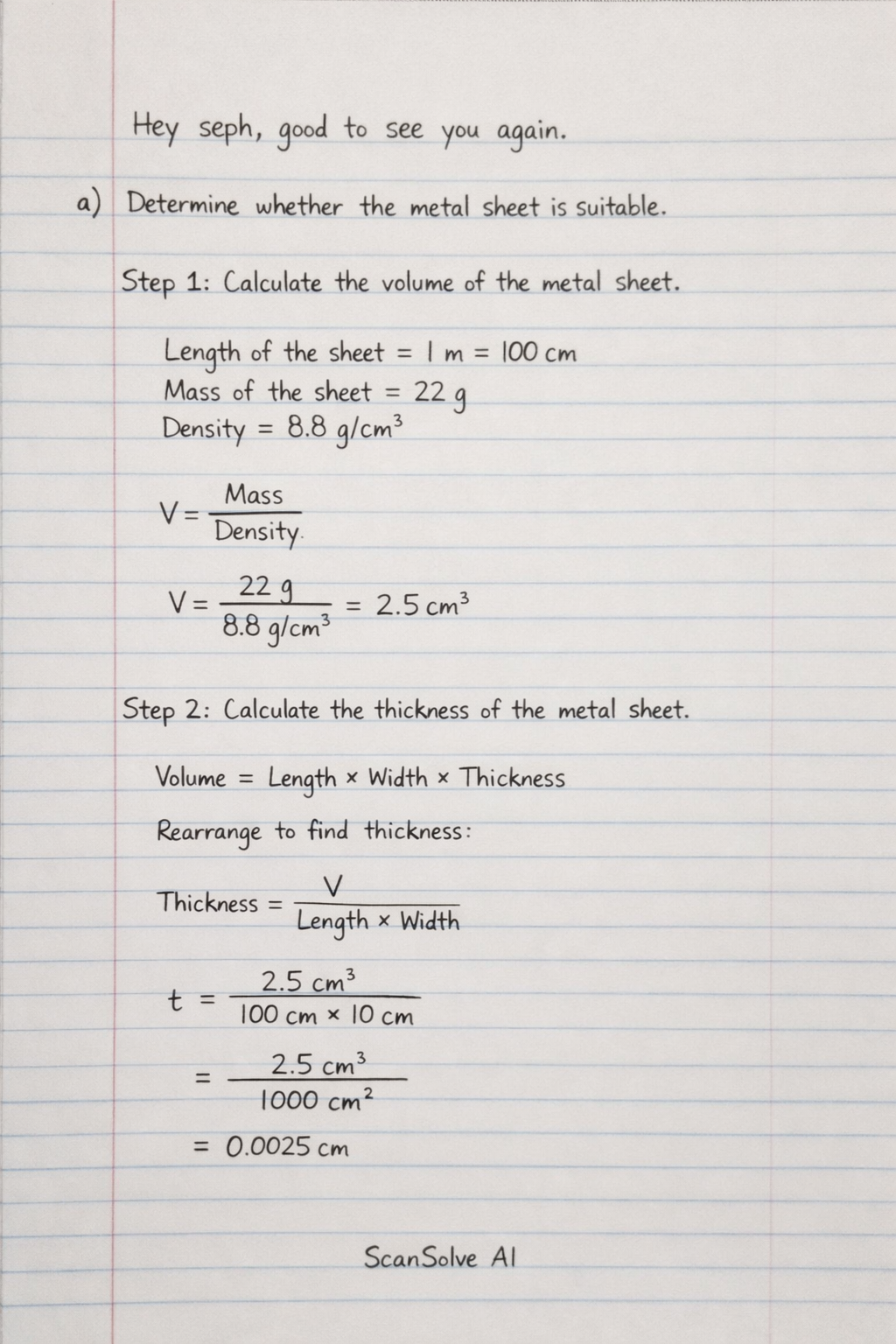
Hey seph, good to see you again. a) Determine whether the metal sheet is suitable. Step 1: Calculate the volume of the metal sheet. The length of the sheet is 1 m, which is 100 cm. The mass of the sheet is 22 g and its density is 8.8 gcm^-3. The formula for volume is V = MassDensity. V = 22 g8.8 gcm^-3 = 2.5 cm^3 Step 2: Calculate the thickness of the metal sheet. The volume of a rectangular sheet is V = Length × Width × Thickness. We can rearrange this to find the thickness: Thickness = (V)/(Length) × Width. t = 2.5 cm^3100 cm × 10 cm = 2.5 cm^31000 cm^2 = 0.0025 cm Step 3: Compare the calculated thickness with the suitability criterion. The hint states that for the metal sheet to be suitable, its thickness should be greater than 0.0022 cm. Since 0.0025 cm > 0.0022 cm, the metal sheet is suitable. The metal sheet is suitable. b) Determine whether the metal used by the student is pure. Step 1: Calculate the volume of the unknown metal block. The initial water level was 50 cm^3, and it rose to 55.7 cm^3 after the block was placed in the cylinder. The volume of the block is the difference in water levels. V_block = 55.7 cm^3 - 50.0 cm^3 = 5.7 cm^3 Step 2: Calculate the density of the unknown metal block. The mass of the metal block is 45 g. The formula for density is = MassVolume. _block = 45 g5.7 cm^3 ≈ 7.8947 gcm^-3 Step 3: Compare the calculated density with the density of the pure metal. The hint states that the density of the pure metal is 7.9 gcm^-3. The calculated density of the unknown metal block is approximately 7.89 gcm^-3. Since 7.89 gcm^-3 is very close to 7.9 gcm^-3, the metal used by the student is considered pure. The metal used by the student is pure. Send me the next one 📸