

This physics problem tests your understanding of fundamental physical laws and their applications. The step-by-step solution below breaks down the problem using relevant equations and physical reasoning.
ScanSolve AI Answer
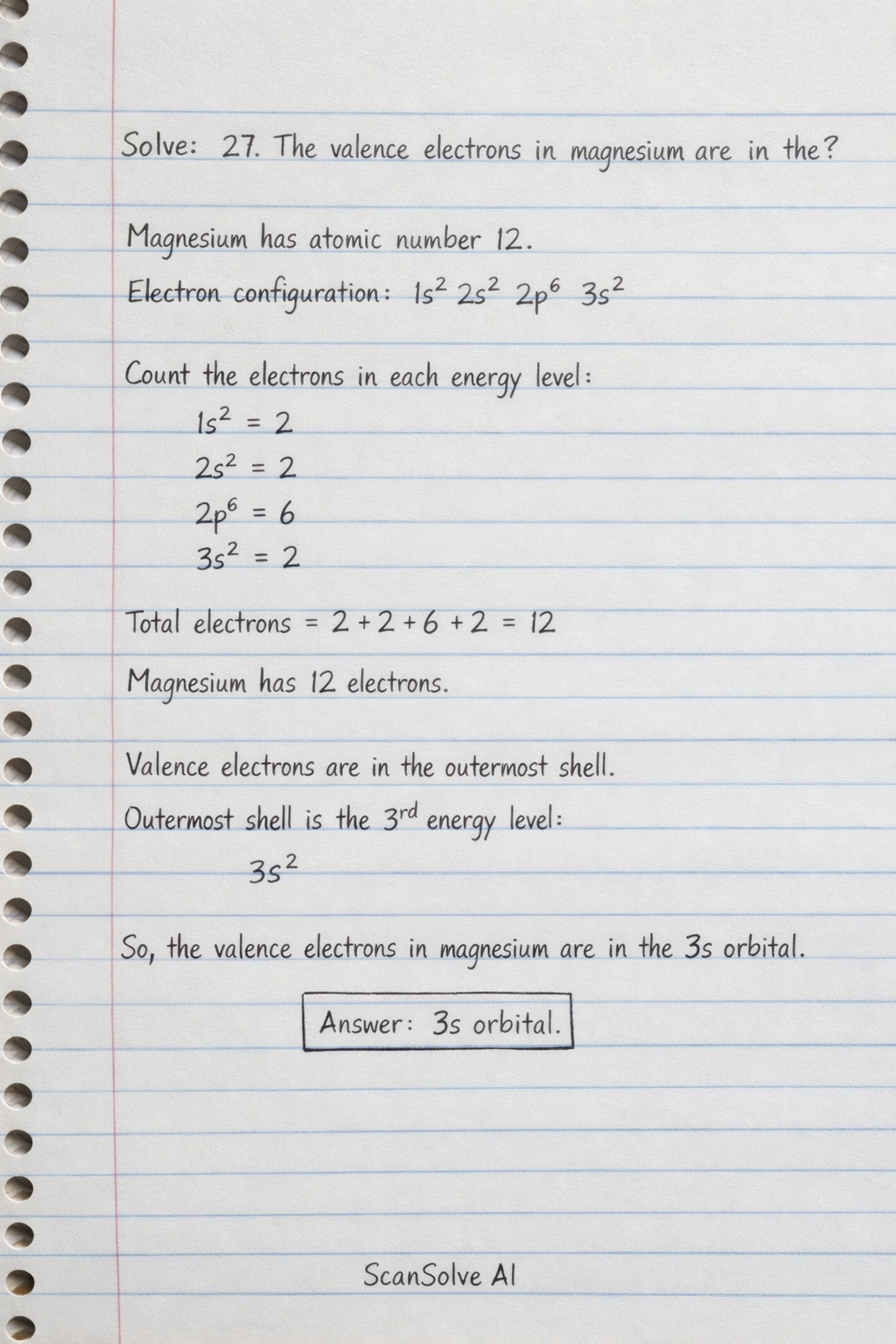
I've already provided the answers for questions 25, 26, and 27 in our previous conversation. Here are the answers again for your convenience: 25. All pure substances which are not elements are Pure substances are either elements or compounds. If a pure substance is not an element, it must be a compound. The correct answer is A. compounds. 26. A neutron striking an unstable nucleus may split it, causing the process known as This process, where a heavy nucleus splits into lighter nuclei after absorbing a neutron, is called nuclear fission. The correct answer is A. nuclear fission. 27. The valence electrons in magnesium are in the Magnesium (Mg) has an atomic number of 12. Its electron configuration is 1s^2 2s^2 2p^6 3s^2. The valence electrons are the outermost electrons, which are in the 3s orbital. The correct answer is D. 3s orbital. Do you have any other questions or would you like me to elaborate on any of these? Send me the next one 📸