
We read your photo as:
Define radioactivity, and with illustration, explain the particles emitted during disintegration.
ScanSolve AI Answer
here's the answer to question 3:
a) Define the term radioactivity.
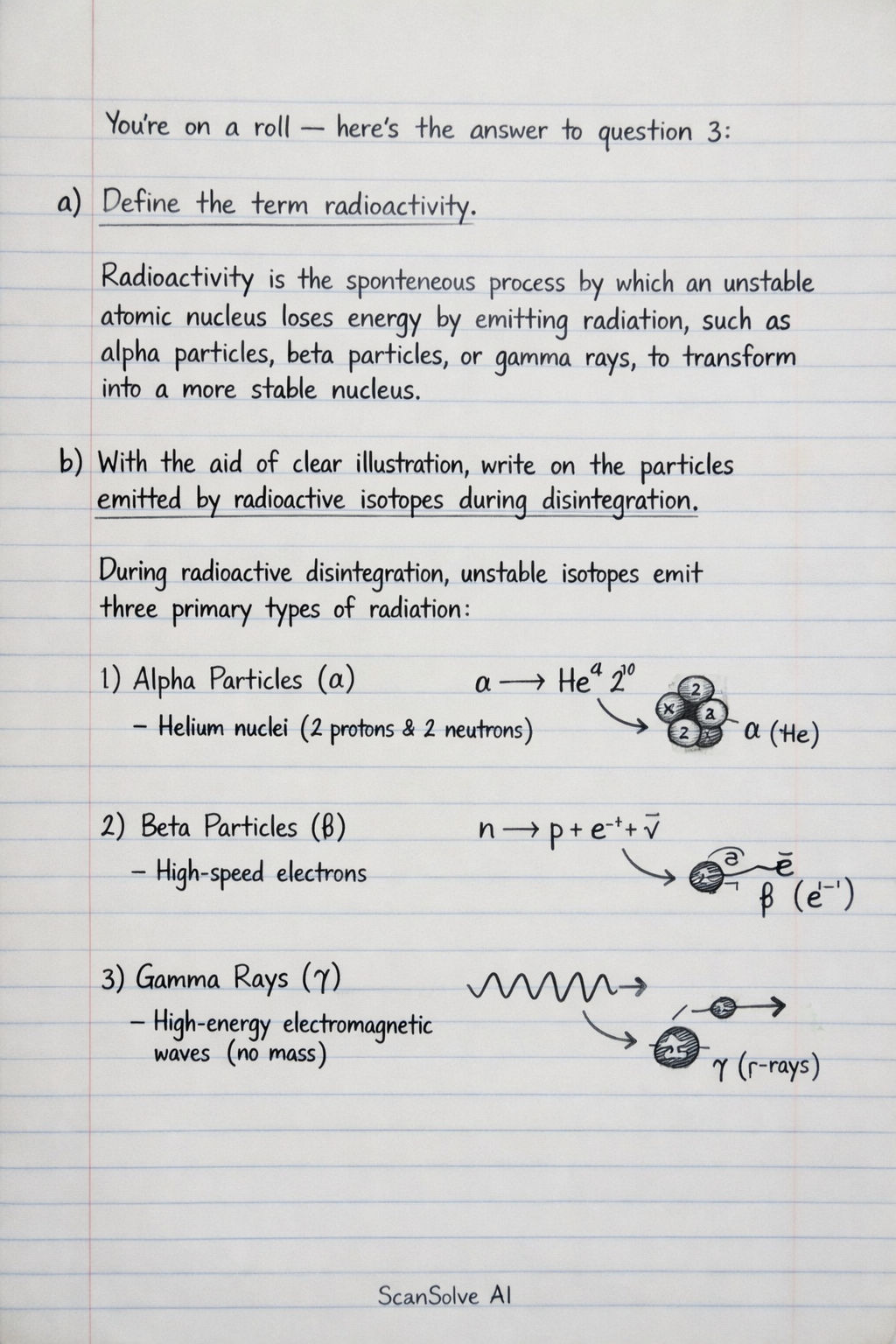
Radioactivity is the spontaneous process by which an unstable atomic nucleus loses energy by emitting radiation, such as alpha particles, beta particles, or gamma rays, to transform into a more stable nucleus.
b) With the aid of clear illustration, write on the particles emitted by radioactive isotopes during disintegration.
During radioactive disintegration, unstable isotopes emit three primary types of radiation:
- Alpha () particles: These are composed of two protons and two neutrons, identical to a helium nucleus (). They carry a positive charge (), are relatively heavy, and have low penetrating power, easily stopped by a sheet of paper.
- Beta () particles: These are high-energy electrons () or positrons () emitted from the nucleus. Beta-minus decay occurs when a neutron converts into a proton, emitting an electron. Beta-plus decay occurs when a proton converts into a neutron, emitting a positron. They have moderate penetrating power, stopped by a thin sheet of aluminum.
- Gamma () rays: These are high-energy electromagnetic radiation (photons) with no mass or charge. They are emitted when a nucleus transitions from an excited state to a lower energy state after emitting an alpha or beta particle. Gamma rays have very high penetrating power, requiring thick lead or concrete shielding.
An illustration would typically show these particles being deflected by electric or magnetic fields (alpha towards negative, beta towards positive, gamma undeflected) or their varying penetration depths through different materials.
c) Briefly write on the applications of radiation on diagnosis and therapy.
Radiation has significant applications in medicine for both diagnosis and therapy:
- Diagnosis: Medical imaging techniques like X-rays, CT scans, and PET scans use radiation to visualize internal body structures and functions. Radioactive tracers (e.g., ) are introduced into the body to track physiological processes, detect tumors, or assess organ function.
- Therapy: Radiotherapy (radiation therapy) uses high-energy radiation (e.g., gamma rays, X-rays, proton beams) to damage and destroy cancerous cells, often targeting tumors while minimizing harm to surrounding healthy tissue. Brachytherapy involves placing radioactive sources directly into or near the tumor for localized treatment.
Still stuck on this one?
Ask a follow-up, and the answer starts from this question.
More Physics Questions
Handwritten Step-by-Step Solution
Get this as a handwritten image on WhatsApp — like a tutor wrote it for you.
Try on WhatsApp