
We read your photo as:
Write nuclear equations for beta decay and radioactive decay, and discuss their effects and graphing.
ScanSolve AI Answer
Step-by-step solution
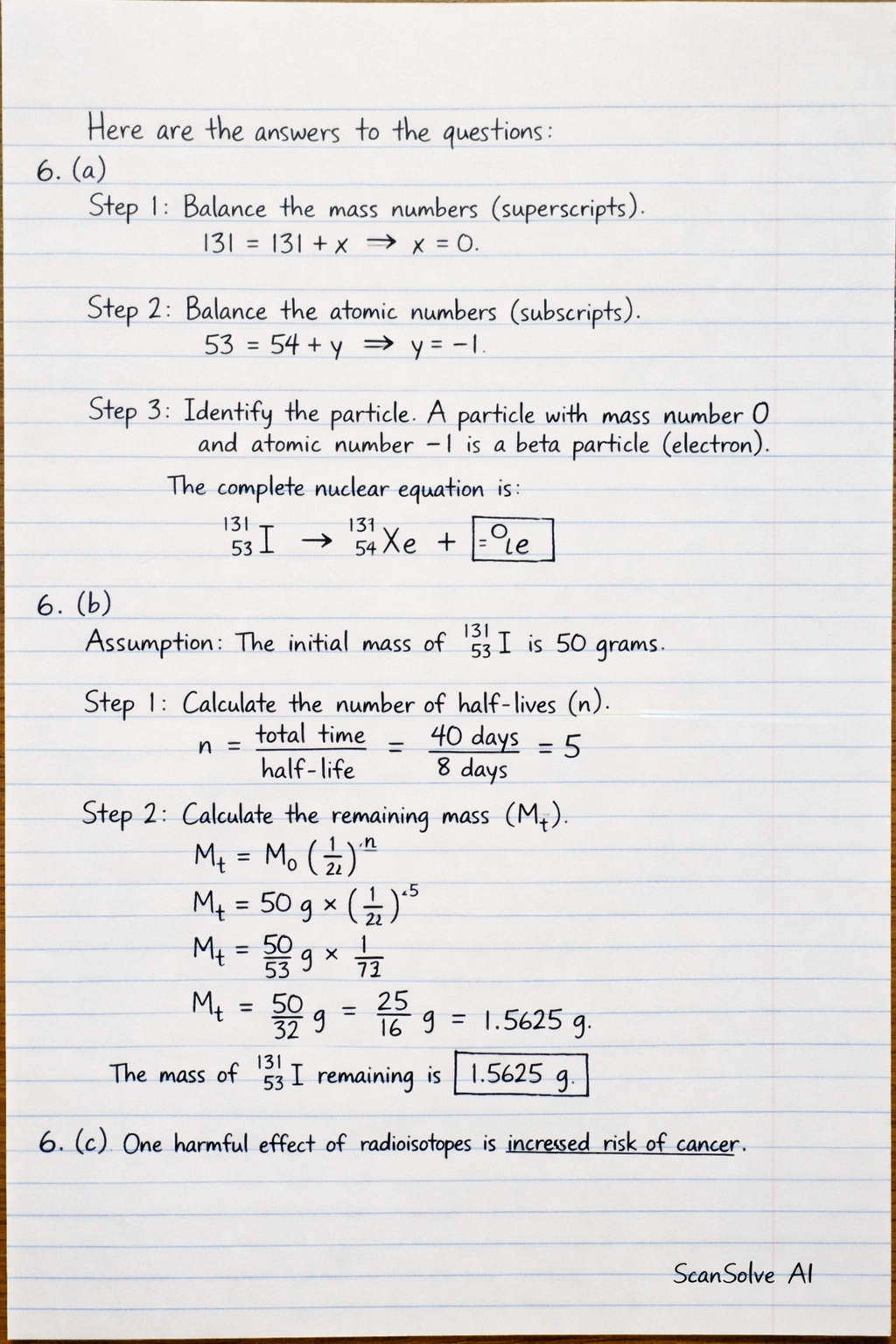
12 stepsHere are the answers to the questions:
6. (a)
Balance the mass numbers (superscripts).
Balance the atomic numbers (subscripts).
Identify the particle.
A particle with mass number 0 and atomic number -1 is a beta particle (electron).
The complete nuclear equation is:6. (b)
Assumption: The initial mass of is 50 grams.Calculate the number of half-lives ().
Calculate the remaining mass ().
The mass of remaining is .
6. (c)
One harmful effect of radioisotopes is increased risk of cancer.7.
To plot a graph of the mass of iodine-131 against time, you would use the following data points:- At time = 0 days, mass = 120 g
- At time = 8 days (1 half-life), mass =
- At time = 16 days (2 half-lives), mass =
- At time = 24 days (3 half-lives), mass =
- At time = 32 days (4 half-lives), mass = Plot these points on a graph with time on the x-axis and mass on the y-axis, then draw a smooth curve connecting them.
8.
Alpha, beta, and gamma radiations can be distinguished by their behavior in an electric or magnetic field:- Alpha () particles are positively charged and are deflected towards the negative plate in an electric field. They have the largest mass and least penetrating power.
- Beta () particles are negatively charged and are deflected towards the positive plate in an electric field. They have a much smaller mass than alpha particles and are more penetrating.
- Gamma () rays are electromagnetic radiation with no charge and no mass, so they are not deflected by electric or magnetic fields. They have the highest penetrating power.
9. (a)
- A neutron is a subatomic particle with no electric charge and a mass slightly greater than a proton.
- A proton is a subatomic particle with a positive electric charge (+1e) and a mass slightly less than a neutron.
9. (b)
A radioactive substance is a substance that undergoes spontaneous nuclear decay, emitting radiation (such as alpha, beta, or gamma particles/rays) to transform into a more stable nucleus.9. (c)
Two dangers associated with radioactive substances in the environment are:- Contamination of water and food sources, leading to internal exposure when ingested.
- Damage to living organisms and ecosystems, causing cell damage, genetic mutations, and increased risk of cancer in plants, animals, and humans.
9. (d) (i)
The nuclear equation is:
(I) Mass of Y:Balance the mass numbers (superscripts).
The mass of Y is .
(II) Number of Y:
Balance the atomic numbers (subscripts).
The atomic number of Y is .
9. (d) (ii)
The type of reaction undergone by the isotopes of hydrogen is nuclear fusion.9. (e) (i)
The half-life of a radioactive substance is the time taken for half of the radioactive nuclei in a given sample to decay.9. (e) (ii)
Determine the number of half-lives ().
Since , then .
Therefore, .Calculate the half-life ().
The half-life of the radioactive substance is .
10. (a)
Balance the mass numbers (superscripts).
Balance the atomic numbers (subscripts).
Identify the particle.
A particle with mass number 4 and atomic number 2 is an alpha particle.
The complete nuclear reaction is:10. (b)
Two uses of radioisotopes in health are:- Medical imaging for diagnosis (e.g., using technetium-99m for bone scans or iodine-131 for thyroid scans).
- Radiotherapy for cancer treatment (e.g., using cobalt-60 or iridium-192 to destroy cancerous cells).
Still stuck on this one?
Ask a follow-up, and the answer starts from this question.
More Physics Questions
Handwritten Step-by-Step Solution
Get this as a handwritten image on WhatsApp — like a tutor wrote it for you.
Try on WhatsApp