
We read your photo as:
The solutions provided cover nuclear equations for decay, defining half-life, and calculating remaining radioactive material after a certain time.
ScanSolve AI Answer
Step-by-step solution
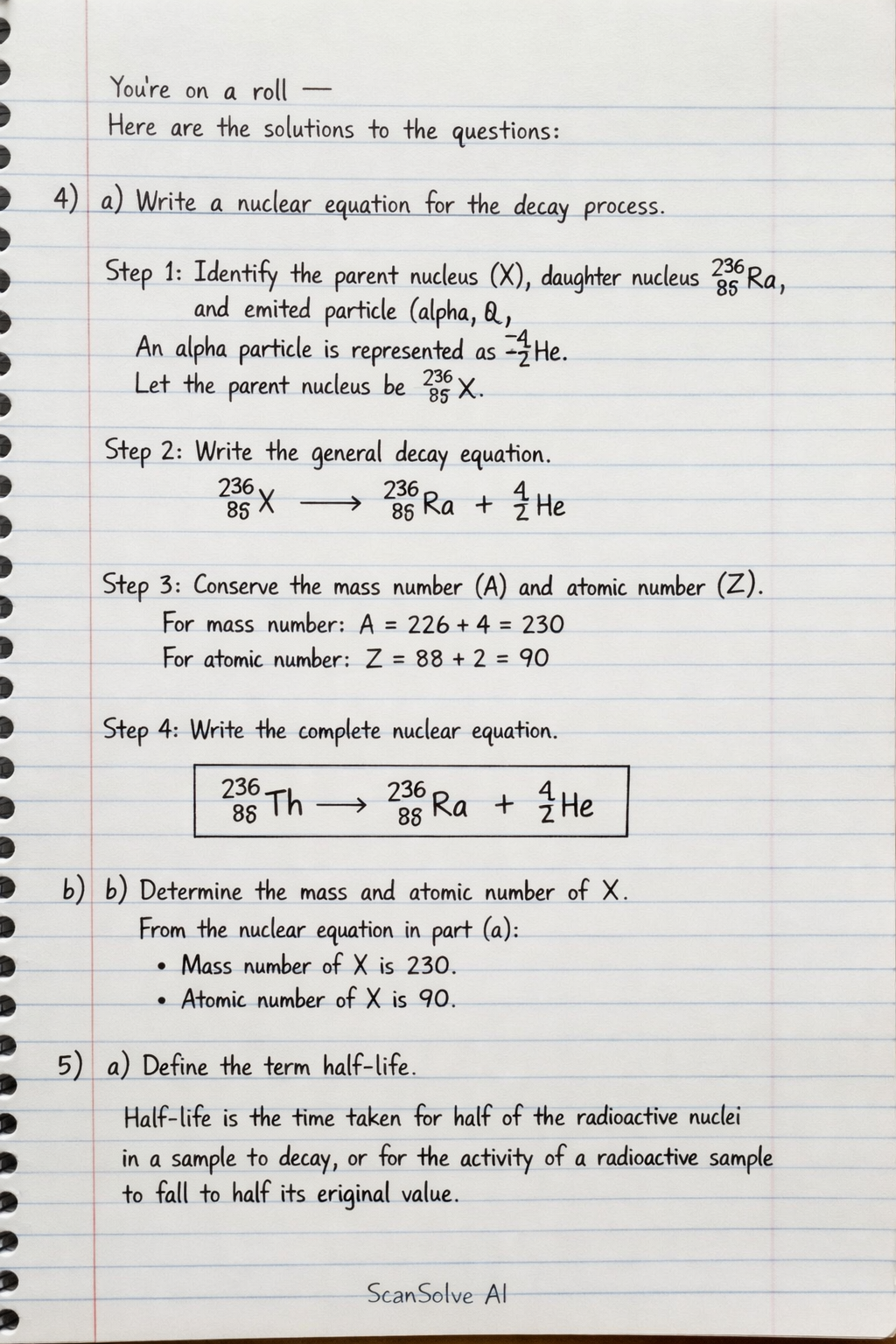
13 stepsHere are the solutions to the questions:
4.
a) Write a nuclear equation for the decay process.
Identify the parent nucleus (X), daughter nucleus (), and emitted particle (alpha, ).
An alpha particle is represented as .
Let the parent nucleus be .Write the general decay equation.
Conserve the mass number (A) and atomic number (Z).
For mass number:
For atomic number:Write the complete nuclear equation.
b) Determine the mass and atomic number of X.
From the nuclear equation in part (a):
- Mass number of X is 230.
- Atomic number of X is 90.
5.
a) Define the term half-life.
Half-life is the time taken for half of the radioactive nuclei in a sample to decay, or for the activity of a radioactive sample to fall to half its original value.
b) The half-life of is 4500 years. Work out the fraction of radioactive material that would be remaining after 18000 years.
Calculate the number of half-lives ().
The substance undergoes 4 half-lives.
Calculate the fraction remaining.
The fraction remaining is given by the formula .
The fraction of radioactive material remaining is .
6.
a) Determine the value of m and n in the nuclear equation:
Identify the particles.
An alpha particle () is .
A beta particle () is .Substitute the particles into the equation.
Conserve the mass number.
Conserve the atomic number.
Substitute the value of :
The values are .
b) The table below gives the rate of decay of radioactive element Y. Calculate the half-life of element Y.
Identify the initial mass () and final mass ().
At 0 days, .
At 270 days, .Use the decay formula to find the number of half-lives ().
Since , then .
Therefore, .Calculate the half-life ().
The half-life of element Y is .
7. Distinguish between nuclear fission and nuclear fusion.
- Nuclear fission is the process where a heavy atomic nucleus splits into two or more lighter nuclei, releasing a large amount of energy.
- Nuclear fusion is the process where two or more light atomic nuclei combine to form a heavier nucleus, also releasing a large amount of energy.
8.
a) State one use of radioisotopes in agriculture.
One use is pest control (e.g., sterile insect technique) or tracing nutrient uptake by plants.
b) State one danger associated with exposure of human beings to radioisotopes.
One danger is causing cancer (e.g., leukemia, thyroid cancer) or genetic mutations.
Still stuck on this one?
Ask a follow-up, and the answer starts from this question.
More Chemistry Questions
Handwritten Step-by-Step Solution
Get this as a handwritten image on WhatsApp — like a tutor wrote it for you.
Try on WhatsApp