
We read your photo as:
What is nuclear fission and how does it work?
ScanSolve AI Answer
Step-by-step solution
3 stepsNuclear fission is a nuclear reaction where the nucleus of a heavy atom, such as uranium or plutonium, splits into two or more smaller nuclei, along with a few neutrons and a large amount of energy.
Define nuclear fission.
Nuclear fission is the process by which a heavy atomic nucleus splits into two or more lighter nuclei, releasing a significant amount of energy.
Explain the process in detail.
This process is typically initiated when a heavy nucleus, like Uranium-235, absorbs a neutron, becoming unstable. The unstable nucleus then splits, producing two smaller nuclei (fission products), two or three additional neutrons, and gamma rays. The newly released neutrons can then go on to strike other heavy nuclei, causing further fission events and leading to a nuclear chain reaction. This chain reaction is the basis for nuclear power generation and atomic weapons.
Mention energy release.
The total mass of the products is slightly less than the original mass of the heavy nucleus and the initiating neutron. This mass defect is converted into a tremendous amount of energy according to Einstein's mass-energy equivalence principle, .
The final answer is
Still stuck on this one?
Ask a follow-up, and the answer starts from this question.
More Physics Questions
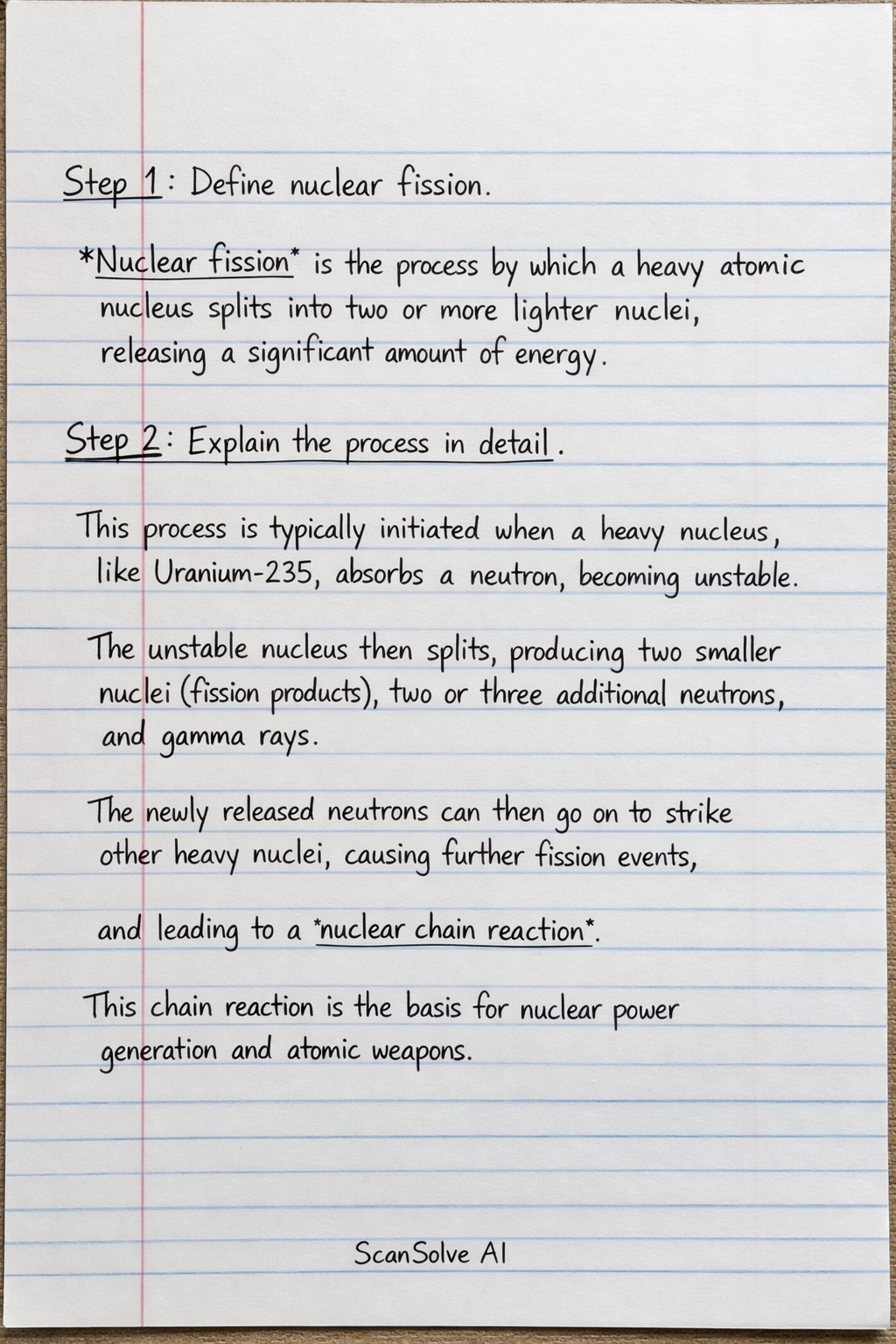
Handwritten Step-by-Step Solution
Get this as a handwritten image on WhatsApp — like a tutor wrote it for you.
Try on WhatsApp