
We read your photo as:
Distinguish between fission and nuclear fusion in a table form.
Physics
ScanSolve AI Answer
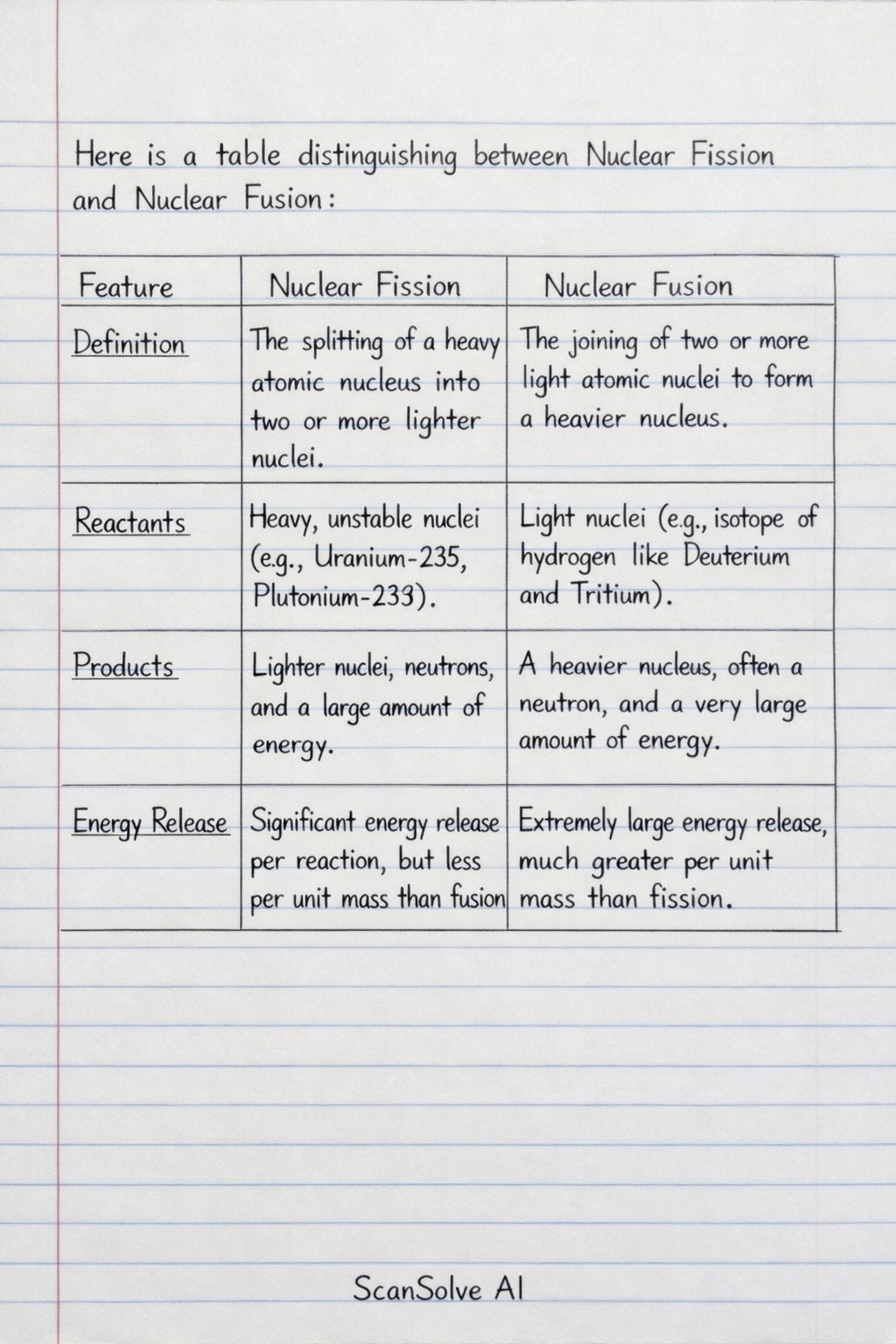
Here is a table distinguishing between Nuclear Fission and Nuclear Fusion:
| Feature | Nuclear Fission | Nuclear Fusion |
|---|---|---|
| Definition | The splitting of a heavy atomic nucleus into two or more lighter nuclei. | The joining of two or more light atomic nuclei to form a heavier nucleus. |
| Reactants | Heavy, unstable nuclei (e.g., Uranium-235, Plutonium-239). | Light nuclei (e.g., isotopes of hydrogen like Deuterium and Tritium). |
| Products | Lighter nuclei, neutrons, and a large amount of energy. | A heavier nucleus, often a neutron, and a very large amount of energy. |
| Energy Release | Significant energy release per reaction, but less per unit mass than fusion. | Extremely large energy release, much greater per unit mass than fission. |
| Conditions | Can occur at relatively lower temperatures and pressures. Often initiated by neutron bombardment. | Requires extremely high temperatures (millions of degrees Celsius) and pressures to overcome electrostatic repulsion. |
| Occurrence | Used in nuclear power plants and atomic bombs. | Occurs naturally in stars (like the Sun). Research is ongoing for controlled fusion on Earth. |
| Waste Products | Produces highly radioactive, long-lived nuclear waste. | Produces less radioactive waste, primarily helium, and potentially short-lived radioactive isotopes. |
| Chain Reaction | Can lead to a self-sustaining chain reaction if enough fissile material is present. | Does not involve a chain reaction in the same way; requires continuous input of energy to maintain conditions. |
Was this helpful?
Still stuck on this one?
Ask a follow-up, and the answer starts from this question.
Got a different question?Ask your own question
More Physics Questions
QDistinguish between Fission and Nuclear Fusion in a table form. June 2012 Q.9 a-b. June 2011 Q.9…QIdentify the particle in the nuclear equation and list uses and dangers of radioisotopes. Define…QWrite down the given nuclear reaction.QWhat is nuclear fission and how does it work?QA) In a tabular form, differentiate between mitosis and meiosis.
Handwritten Step-by-Step Solution
Get this as a handwritten image on WhatsApp — like a tutor wrote it for you.
Try on WhatsApp