
We read your photo as:
A particle starts from rest and moves with a constant acceleration of 0.5ms⁻². Calculate the time taken by the body to cover a distance of 25m (SSCE). A car slows down from 108 kmh⁻¹ with a uniform retardation of 5ms⁻² (i) How long will it take to reach 18kmh⁻¹ (ii) What is the distance covered?
ScanSolve AI Answer
Answers
2 partsStep-by-step solution
4 stepsHere are the solutions to the problems:
:
Given:
Initial velocity, (starts from rest)
Acceleration,
Distance,
Step 1: Identify the appropriate kinematic equation.
Since we have , , and need to find , we use the equation:
Step 2: Substitute the given values into the equation.
Step 3: Solve for .
The time taken is .
:
Given:
Initial velocity,
Final velocity,
Retardation (negative acceleration),
Step 1: Convert velocities from to .
To convert to , multiply by or .
Part i· 2 steps
How long will it take to reach ?
Use the kinematic equation to find time .
Solve for .
The time taken is .
Note: The provided answer in the image is 6.0s, but based on the calculation with the given values, the result is 5.0s.
Part ii
What is the distance covered?
Use the kinematic equation to find distance .
Solve for .
The distance covered is .
Try one yourself
A new problem that tests the same skill.
Still stuck on this one?
Ask a follow-up, and the answer starts from this question.
More Physics Questions
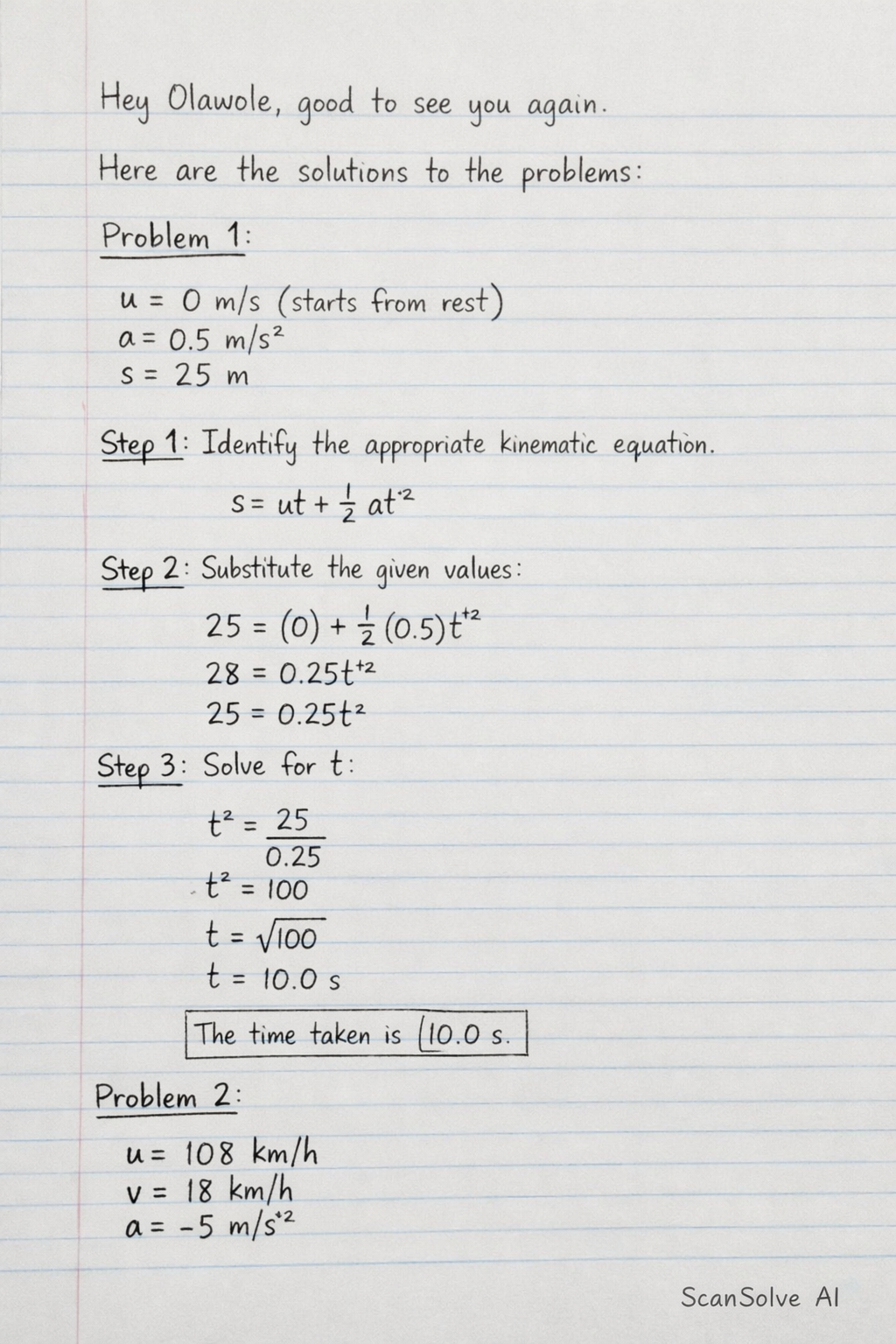
Handwritten Step-by-Step Solution
Get this as a handwritten image on WhatsApp — like a tutor wrote it for you.
Try on WhatsApp