
We read your photo as:
A radioactive nucleus with mass number A and atomic number Z undergoes decay by emitting 3 alpha particles and 2 positrons. Determine the mass number and atomic number of the final nucleus.
ScanSolve AI Answer
Answer
Step-by-step solution
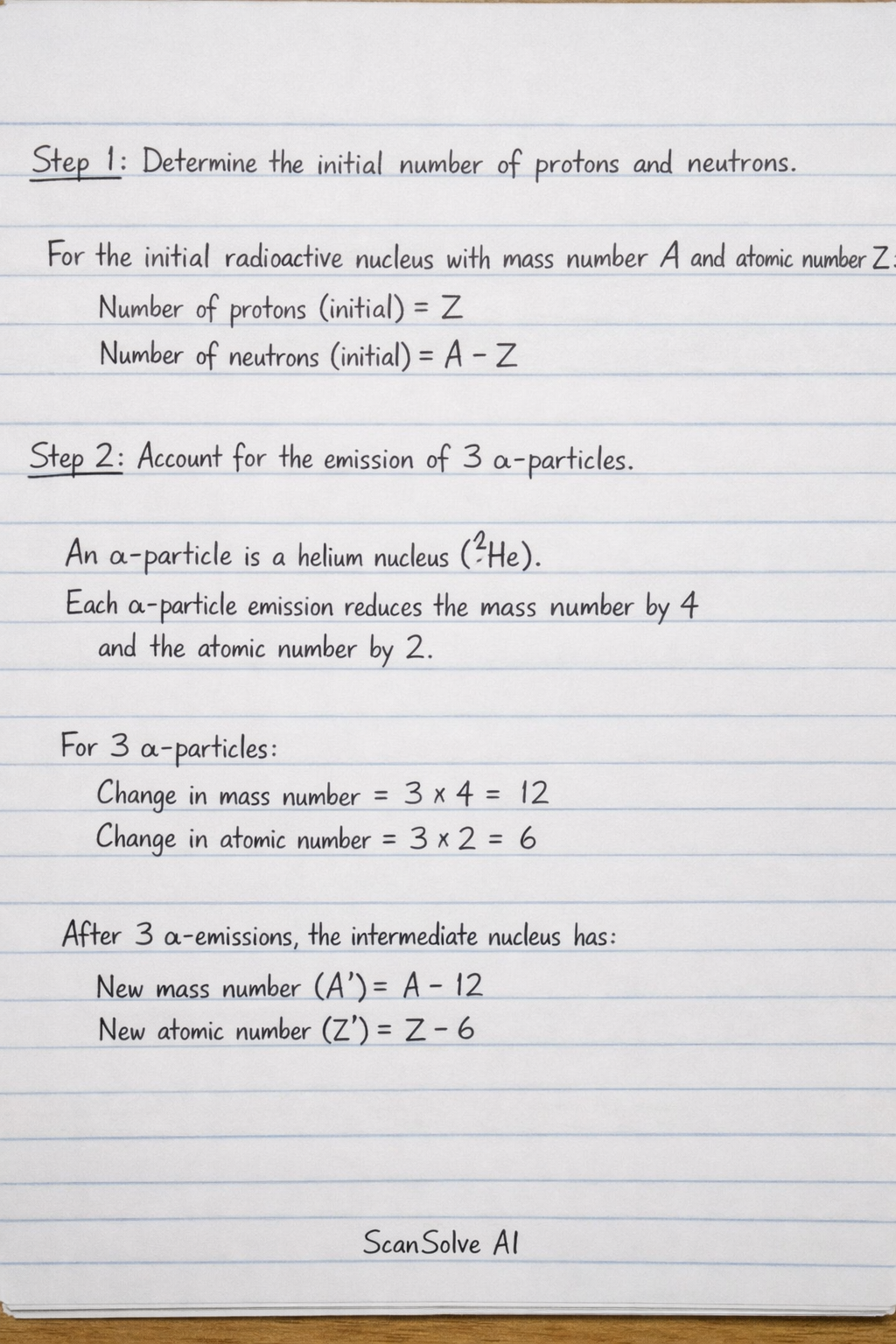
5 stepsDetermine the initial number of protons and neutrons.
For the initial radioactive nucleus with mass number and atomic number :
Number of protons (initial) =
Number of neutrons (initial) =Account for the emission of 3 -particles.
An -particle is a helium nucleus ().
Each -particle emission reduces the mass number by 4 and the atomic number by 2.
For 3 -particles:
Change in mass number =
Change in atomic number =
After 3 -emissions, the intermediate nucleus has:
New mass number () =
New atomic number () =Account for the emission of 2 positrons.
A positron ( particle) is represented as .
Each positron emission converts a proton into a neutron, so the mass number remains unchanged, but the atomic number decreases by 1.
For 2 positrons:
Change in mass number =
Change in atomic number = (atomic number decreases by 2)
After 2 positron emissions, the final nucleus has:
Final mass number () =
Final atomic number () =Calculate the number of protons and neutrons in the final nucleus.
Number of protons in the final nucleus =
Number of neutrons in the final nucleus =Determine the ratio of the number of neutrons to the number of protons in the final nucleus.
Ratio =
Comparing this result with the given options, it matches option (C).
The final answer is .
Try one yourself
A new problem that tests the same skill.
Still stuck on this one?
Ask a follow-up, and the answer starts from this question.
More Physics Questions
Handwritten Step-by-Step Solution
Get this as a handwritten image on WhatsApp — like a tutor wrote it for you.
Try on WhatsApp