
We read your photo as:
A radioactive sample contains 1020 atoms. Its half-life is 20 seconds. How many disintegrations occur in the first second?
ScanSolve AI Answer
Step-by-step solution
4 stepsTo find the number of disintegrations in the first second, we need to calculate the initial activity of the radioactive material. The activity is given by , where is the decay constant and is the number of radioactive atoms. The number of disintegrations in a short time interval is approximately .
Determine the initial number of atoms ().
The question states "1020 atoms". However, given the options are in powers of and , it is highly probable that "1020" is a typo and should be atoms. We will proceed with this assumption.
So, atoms.Calculate the decay constant ().
The half-life () is given as 20 seconds. The relationship between half-life and decay constant is:
Calculate the initial activity ().
The initial activity is the rate of disintegration at .
Calculate the number of disintegrations in the first second.
Since the time interval is very short (), we can approximate the number of disintegrations as .
Comparing this result with the given options:
A.
B.
C.
D.Our calculated value is approximately , which matches option B.
The final answer is .
Still stuck on this one?
Ask a follow-up, and the answer starts from this question.
More Physics Questions
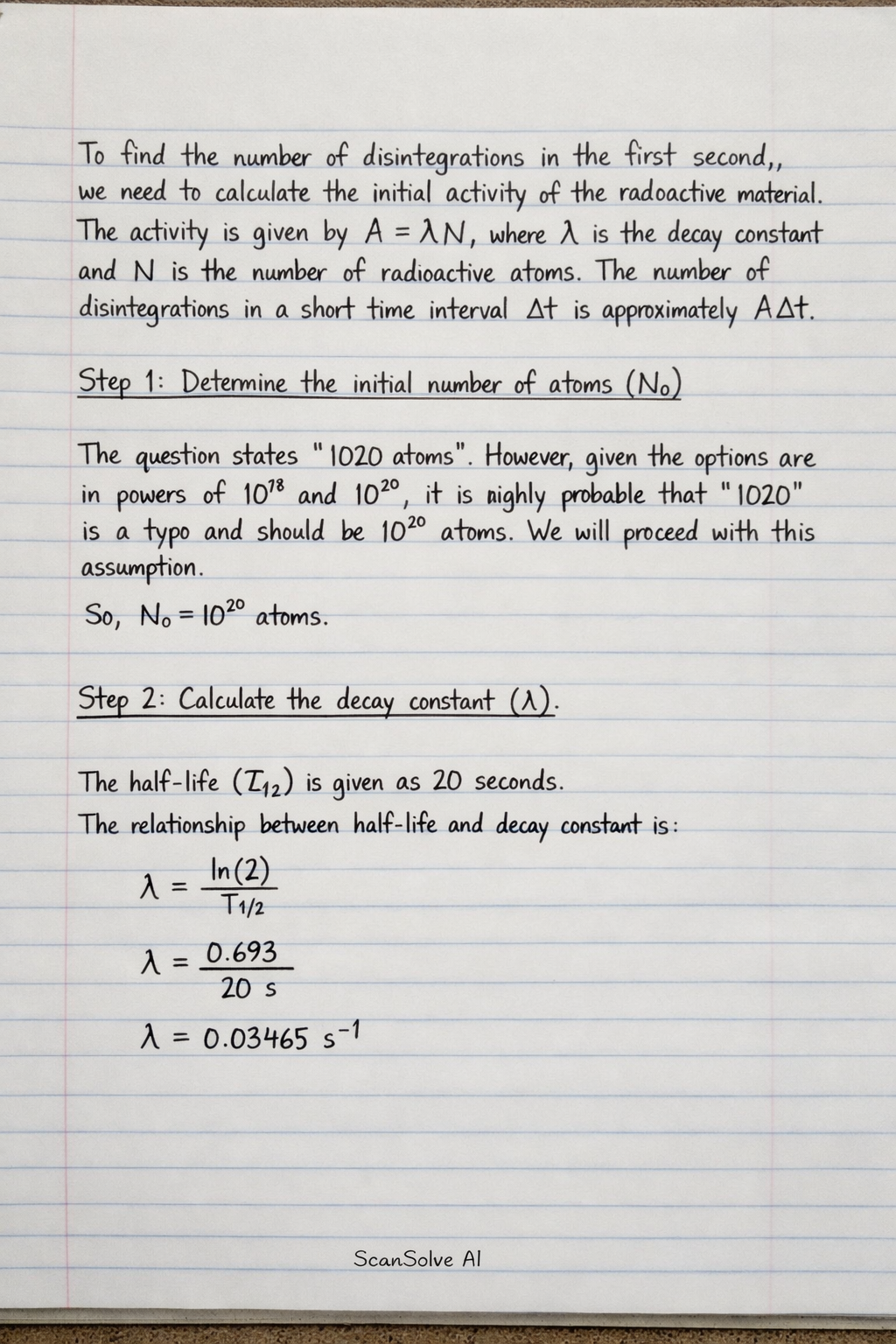
Handwritten Step-by-Step Solution
Get this as a handwritten image on WhatsApp — like a tutor wrote it for you.
Try on WhatsApp