
We read your photo as:
A radioactive substance has a half-life of 80 days. If you start with 6.0 x 10¹⁰ atoms, how many atoms will remain after 320 days?
Physics
ScanSolve AI Answer
Step-by-step solution
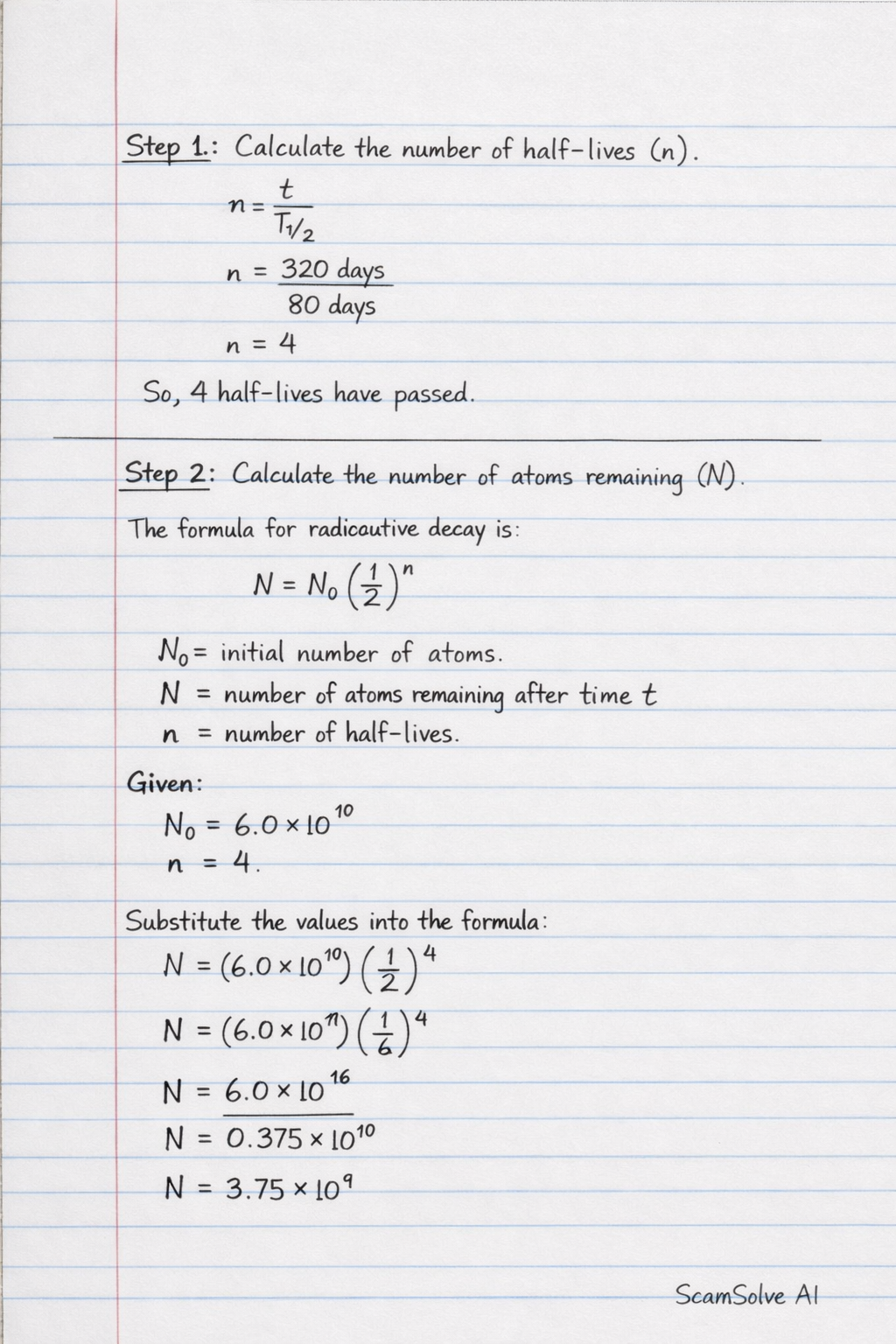
3 stepsCalculate the number of half-lives ().
The number of half-lives is the total time divided by the half-life period.
Given:- Half-life () = 80 days
- Total time () = 320 days
So, 4 half-lives have passed.
Calculate the number of atoms remaining ().
The formula for radioactive decay is:
Where:
- is the initial number of atoms
- is the number of atoms remaining after time
- is the number of half-lives
Given:
- Initial number of atoms () =
- Number of half-lives () = 4
Substitute the values into the formula:
To express this in standard scientific notation, we adjust the decimal:
Compare the result with the given options.
The calculated number of atoms remaining is .
This matches option A.The number of atoms that would remain at the end of 320 days is
\boxed{\text{3.75 \times 10^9}}.
Was this helpful?
Still stuck on this one?
Ask a follow-up, and the answer starts from this question.
Got a different question?Ask your own question
More Physics Questions
QA sample of a radioactive substance has an initial mass of 320 g. If its half-life is 2 minutes, how…QThe half-life of a radio-active element is 9 days, what fraction of atoms has decayed in 36 days?QA) What are the possible radiations emitted by radioactive nuclei? b) If a radioactive sample has a…QA sample contains 1010 atoms of a radioactive isotope with a half-life of 30 days. Calculate (i) the…QA radioactive sample contains 1020 atoms. Its half-life is 20 seconds. How many disintegrations…
Handwritten Step-by-Step Solution
Get this as a handwritten image on WhatsApp — like a tutor wrote it for you.
Try on WhatsApp