
We read your photo as:
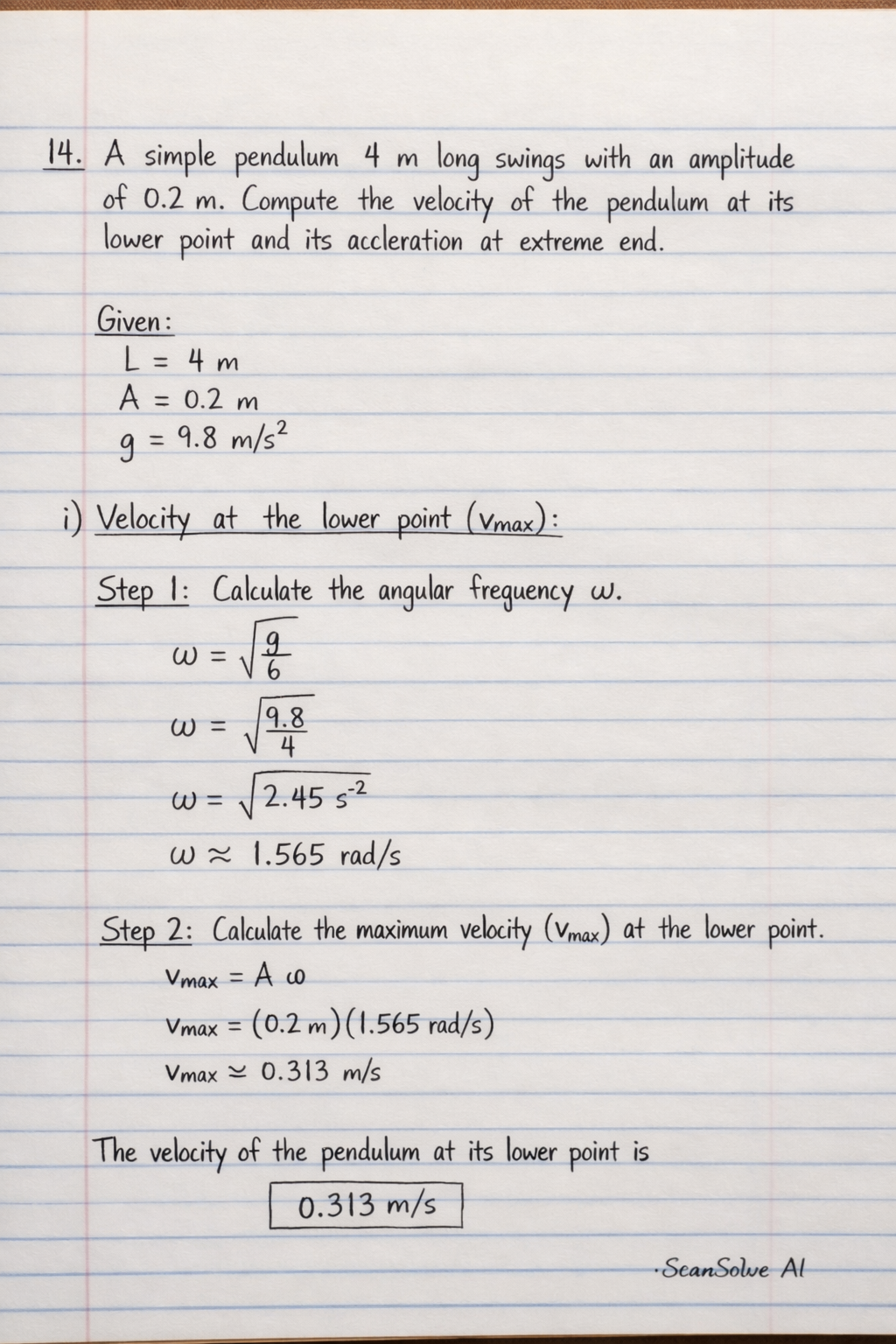
A simple pendulum 4 m long swings with an amplitude of 0.2m. Compute the velocity of the pendulum at its lower point and its acceleration at extreme end.
ScanSolve AI Answer
Step-by-step solution
15 steps14. A simple pendulum 4 m long swings with an amplitude of 0.2m. Compute the velocity of the pendulum at its lower point and its acceleration at extreme end.
Given:
-
Length of pendulum,
-
Amplitude,
-
Acceleration due to gravity,
-
i) Velocity at the lower point ():
Calculate the angular frequency .
$$ \omega = \sqrt{\frac{g}{L}} $$ $$ \omega = \sqrt{\frac{9.8 \text{ m/s}^2}{4 \text{ m}}} $$ $$ \omega = \sqrt{2.45 \text{ s}^{-2}} $$ $$ \omega \approx 1.565 \text{ rad/s} $$Calculate the maximum velocity () at the lower point.
$$ v_{max} = A\omega $$ $$ v_{max} = (0.2 \text{ m})(1.565 \text{ rad/s}) $$ $$ v_{max} \approx 0.313 \text{ m/s} $$ The velocity of the pendulum at its lower point is $\boxed{\text{0.313 m/s}}$.- ii) Acceleration at the extreme end ():
Calculate the maximum acceleration () at the extreme end.
$$ a_{max} = A\omega^2 $$ $$ a_{max} = (0.2 \text{ m})(1.565 \text{ rad/s})^2 $$ $$ a_{max} = (0.2 \text{ m})(2.45 \text{ s}^{-2}) $$ $$ a_{max} = 0.49 \text{ m/s}^2 $$ The acceleration of the pendulum at the extreme end is $\boxed{\text{0.49 m/s}^2}$.17. The earth's total magnetic field intensity at a place is and angle of dip is . Calculate horizontal and vertical components.
Given:
-
Total magnetic field intensity,
-
Angle of dip,
-
i) Horizontal component ():
-
Use the formula for the horizontal component.
$$ B_H = B \cos \delta $$Substitute the given values.
$$ B_H = (4.5 \times 10^{-7} \text{ T}) \cos(30^\circ) $$ $$ B_H = (4.5 \times 10^{-7} \text{ T}) \left(\frac{\sqrt{3}}{2}\right) $$ $$ B_H = (4.5 \times 10^{-7} \text{ T})(0.866) $$ $$ B_H \approx 3.897 \times 10^{-7} \text{ T} $$ The horizontal component is $\boxed{3.90 \times 10^{-7} \text{ T}}$.- ii) Vertical component ():
Use the formula for the vertical component.
$$ B_V = B \sin \delta $$Substitute the given values.
$$ B_V = (4.5 \times 10^{-7} \text{ T}) \sin(30^\circ) $$ $$ B_V = (4.5 \times 10^{-7} \text{ T})(0.5) $$ $$ B_V = 2.25 \times 10^{-7} \text{ T} $$ The vertical component is $\boxed{2.25 \times 10^{-7} \text{ T}}$.18. An object is placed 15cm from a converging lens of focal length 10cm. Find the image distance and magnification.
Given:
-
Object distance, (real object, placed to the left of the lens)
-
Focal length of converging lens,
-
i) Image distance ():
-
Use the lens formula.
$$ \frac{1}{f} = \frac{1}{v} - \frac{1}{u} $$Rearrange to solve for .
$$ \frac{1}{v} = \frac{1}{f} + \frac{1}{u} $$Substitute the given values.
$$ \frac{1}{v} = \frac{1}{10 \text{ cm}} + \frac{1}{-15 \text{ cm}} $$ $$ \frac{1}{v} = \frac{1}{10 \text{ cm}} - \frac{1}{15 \text{ cm}} $$Find a common denominator and simplify.
$$ \frac{1}{v} = \frac{3}{30 \text{ cm}} - \frac{2}{30 \text{ cm}} $$ $$ \frac{1}{v} = \frac{1}{30 \text{ cm}} $$ $$ v = 30 \text{ cm} $$ The image distance is $\boxed{\text{30 cm}}$. (Positive sign indicates a real image formed on the opposite side of the lens).- ii) Magnification ():
Use the magnification formula for a lens.
$$ M = \frac{v}{u} $$Substitute the calculated image distance and given object distance.
$$ M = \frac{30 \text{ cm}}{-15 \text{ cm}} $$ $$ M = -2 $$ The magnification is $\boxed{-2}$. (Negative sign indicates an inverted image, and $|M|=2$ means it is twice the size of the object).19. A bar magnet of magnetic length 10cm has a magnetic moment of . Calculate the magnetic field intensity at a point 20cm from each pole.
Given:
- Magnetic length, So, half magnetic length,
- Magnetic moment,
- Distance from each pole to the point,
This point is on the equatorial line (perpendicular bisector) of the magnet, as it is equidistant from both poles.
Use the formula for the magnetic field on the equatorial line of a bar magnet.
Since is the distance from each pole to the point, and where is the distance from the center of the magnet to the point, the formula simplifies to:
Substitute the known values.
The constant .
The magnetic field intensity at the given point is .
Still stuck on this one?
Ask a follow-up, and the answer starts from this question.
More Physics Questions
Handwritten Step-by-Step Solution
Get this as a handwritten image on WhatsApp — like a tutor wrote it for you.
Try on WhatsApp