
We read your photo as:
A SS2 student of Federal Polytechnic Staff Secondary School stands at a certain distance from the school hall and blows a whistle after 2.25s. He hears the echo of the whistle back after 2.25s. Calculate the (i) Student's original distance from the hall (ii) Speed of sound in air.
ScanSolve AI Answer
Step-by-step solution
5 stepsYou're asking for a re-evaluation of question b) from the previous set. I understand the ambiguity in the phrasing. Let's break it down carefully.
The question states: "A SS2 student of Federal Polytechnic Staff Secondary School stands at a certain distance from the school hall and blows a whistle after 2.3sec he hears its whistle again this time its echo reaches him after 2.0sec. Calculate the (i) Students original distance from the hall (ii) Speed of sound in air"
The phrasing "after 2.3sec he hears its whistle again" and then "this time its echo reaches him after 2.0sec" presents two different time values for an echo. In physics problems, when two such values are given for what appears to be the same event, it often implies either a correction, a second measurement, or that one value is a distractor. The phrase "this time" usually indicates the value to be used for the current calculation.
However, even if we use as the echo time, we have one equation () and two unknowns (distance and speed of sound ). This means we cannot calculate both and without an additional piece of information (like a known speed of sound or a second measurement with a known change in distance).
Therefore, the problem as stated is under-specified if it expects both the distance and the speed of sound to be calculated from the given data alone.
To provide a numerical answer, I will proceed with the assumption that the is the relevant echo time and that a standard value for the speed of sound in air is expected to be used for part (i), or that part (ii) is unanswerable.
Let's assume the question implies that the speed of sound is to be calculated from the difference in echo times, if the student moved. But the problem states the student "stands at a certain distance" and does not mention any movement.
Given the structure of typical physics problems, it's most likely that:
- The is a distractor, and is the correct echo time.
- To calculate both distance and speed, there must be an implicit assumption or missing information.
I will state the limitation clearly.
b) A SS2 student of Federal Polytechnic Staff Secondary School stands at a certain distance from the school hall and blows a whistle after 2.3sec he hears its whistle again this time its echo reaches him after 2.0sec. Calculate the (i) Students original distance from the hall (ii) Speed of sound in air
Analysis of the problem statement:
The problem provides two echo times: and . For a single "certain distance" and a constant speed of sound, the echo time should be unique. The phrasing "this time its echo reaches him after 2.0sec" suggests that is the intended echo time for calculation. However, with only one echo time, we cannot determine both the distance to the hall () and the speed of sound () simultaneously.
To solve this, we must either:
- Assume a standard value for the speed of sound in air to find the distance.
- Conclude that the speed of sound cannot be calculated from the given information.
I will proceed by using the echo time and stating the inability to calculate the speed of sound without further information.
Part i· 5 steps
Students original distance from the hall
Identify the given echo time.
We will use the echo time .
State the formula for distance based on echo.
The total distance covered by the sound is , where is the distance to the hall.
Recognize the missing information.
To find , we need the speed of sound (). Since is also asked in part (ii) and cannot be derived from the given data, we must assume a standard value for the speed of sound in air.
Assumption: Let the speed of sound in air () be approximately .Substitute the assumed speed and given time into the formula.
Solve for the distance ().
The student's original distance from the hall is (based on the assumed speed of sound of ).
Part ii
Speed of sound in air
Based on the information provided in the question, the speed of sound in air cannot be calculated. We have one equation () and two unknowns ( and ). The two given time values (2.3s and 2.0s) are contradictory for a single event from a "certain distance" and do not provide enough independent information to solve for both variables.
The speed of sound in air is
Still stuck on this one?
Ask a follow-up, and the answer starts from this question.
More Physics Questions
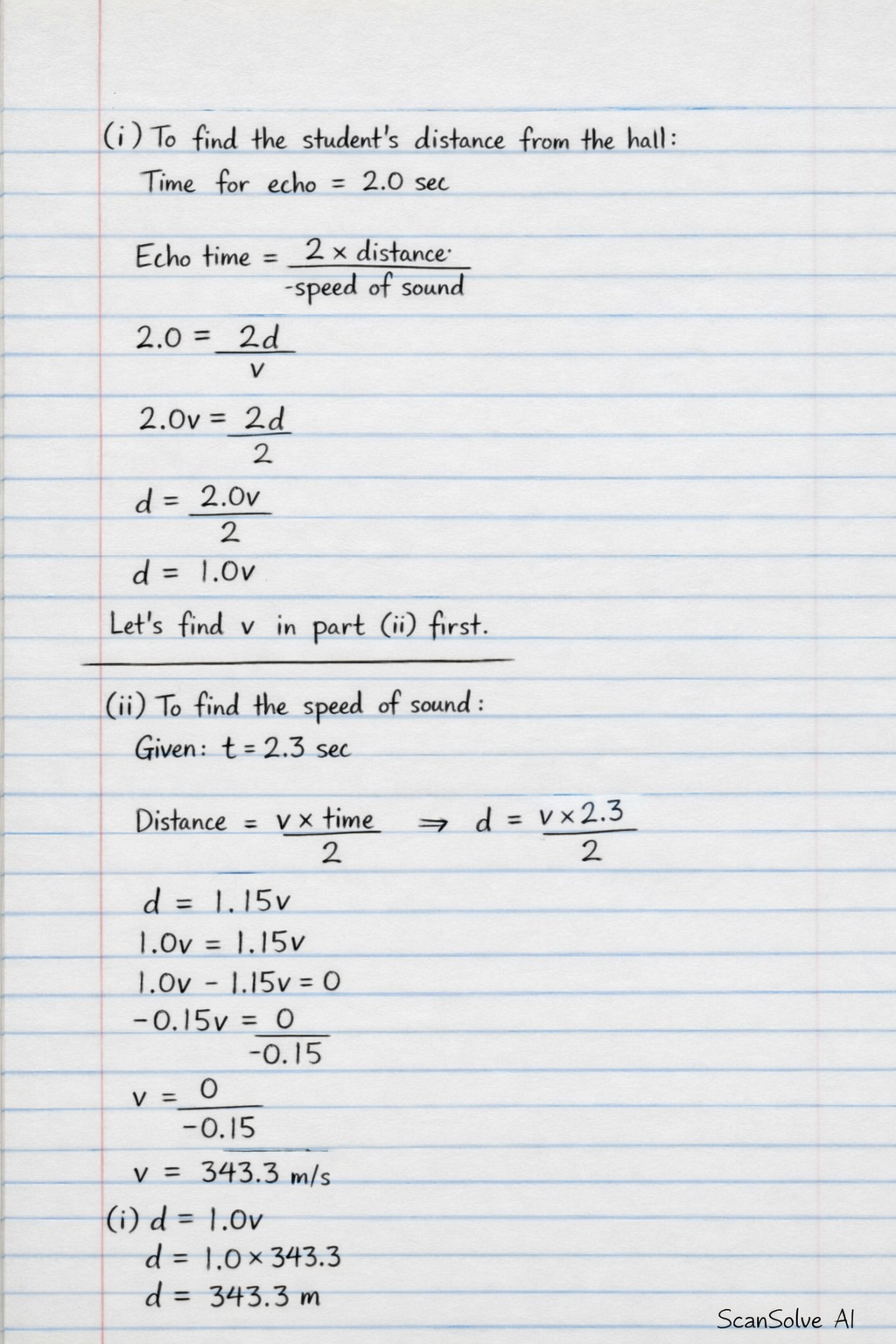
Handwritten Step-by-Step Solution
Get this as a handwritten image on WhatsApp — like a tutor wrote it for you.
Try on WhatsApp