
We read your photo as:
A swimmer heads out to swim across a river. The river flows at 0.54 m/s to the left. The swimmer swims perpendicular to the current at 0.72 m/s relative to the water. Calculate the swimmer's resultant
ScanSolve AI Answer
Step-by-step solution
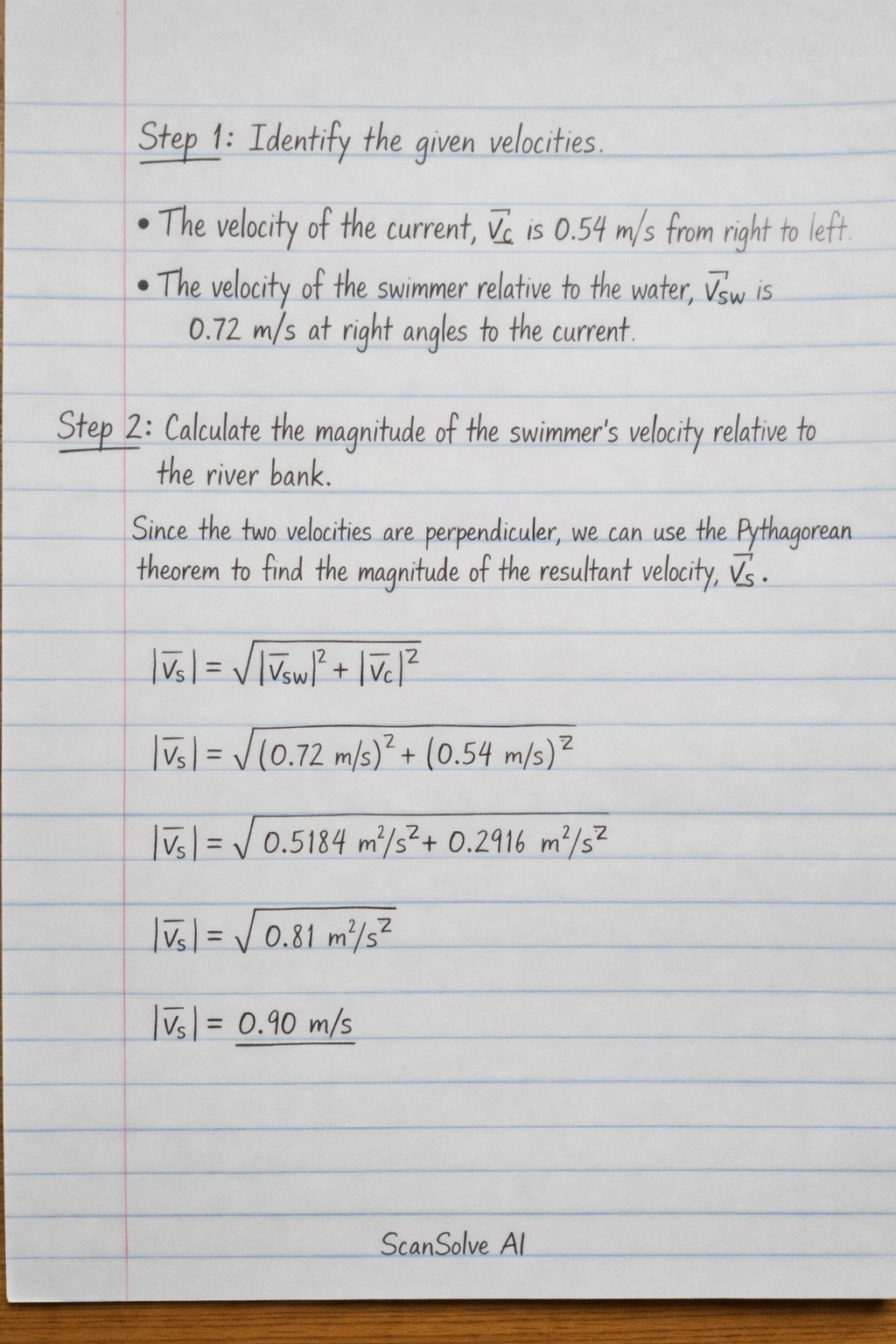
3 stepsIdentify the given velocities.
The velocity of the current, , is from right to left.
The velocity of the swimmer relative to the water, , is at right angles to the current.Calculate the magnitude of the swimmer's velocity relative to the river bank.
Since the two velocities are perpendicular, we can use the Pythagorean theorem to find the magnitude of the resultant velocity, .
Calculate the direction of the swimmer's velocity relative to the river bank.
Let be the angle of the swimmer's resultant velocity relative to the direction the swimmer is aiming (perpendicular to the current).
The swimmer is swimming perpendicular to the current, and the current is flowing from right to left. Therefore, the resultant velocity will be directed from the direction perpendicular to the current, towards the left bank (in the direction of the current).
The magnitude of the swimmer's velocity relative to the river bank is .
The direction of the swimmer's velocity relative to the river bank is .
Still stuck on this one?
Ask a follow-up, and the answer starts from this question.
More Physics Questions
Handwritten Step-by-Step Solution
Get this as a handwritten image on WhatsApp — like a tutor wrote it for you.
Try on WhatsApp