
We read your photo as:
A train approaching a detector emits a siren of frequency fs. The detector registers a frequency of 3148 Hz when the train is moving towards it, and 2073 Hz when it is moving away. If the speed of sou
ScanSolve AI Answer
Answer
Step-by-step solution
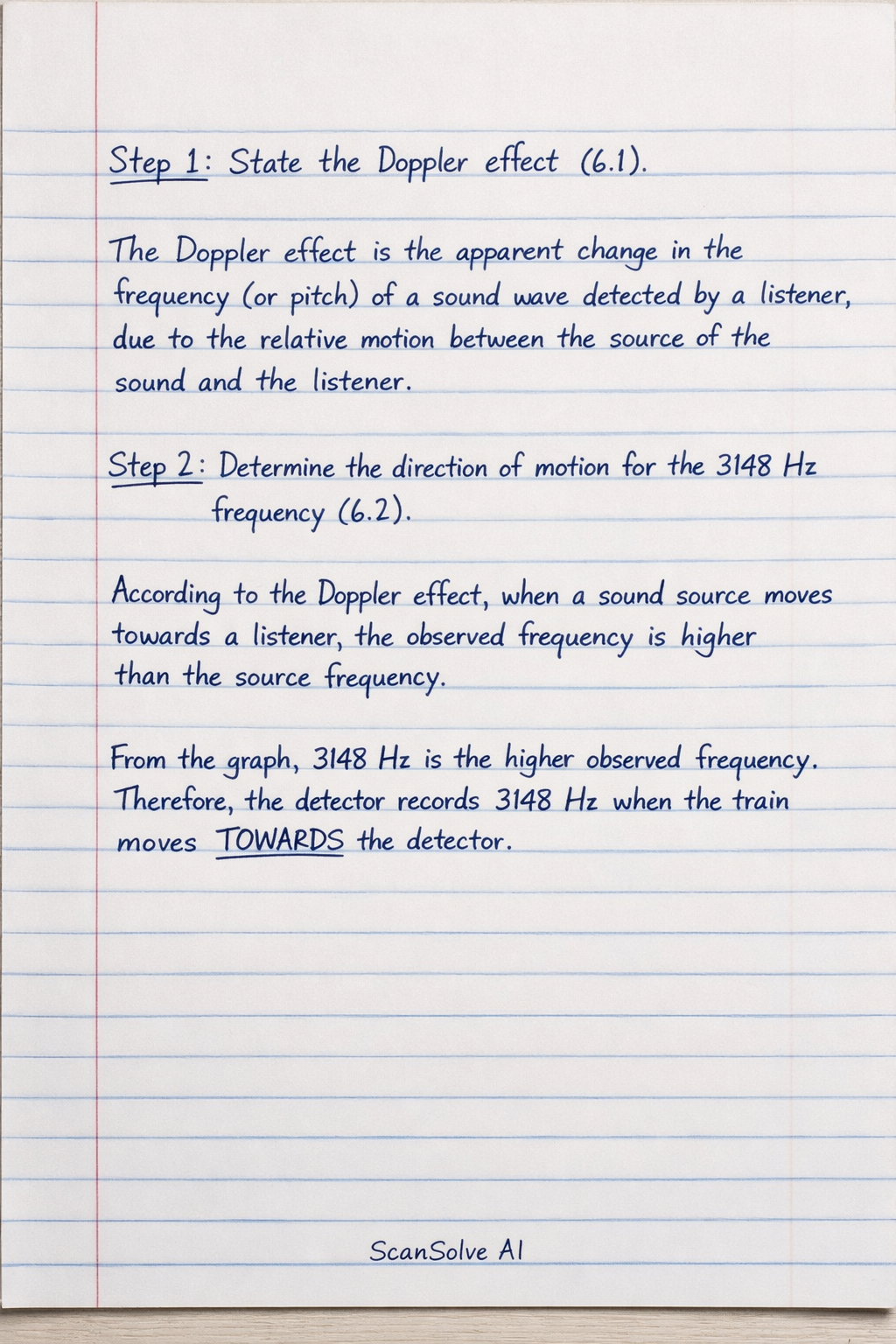
4 stepsState the Doppler effect (6.1).
The Doppler effect is the apparent change in the frequency (or pitch) of a sound wave detected by a listener, due to the relative motion between the source of the sound and the listener.
Determine the direction of motion for the 3148 Hz frequency (6.2).
According to the Doppler effect, when a sound source moves towards a listener, the observed frequency is higher than the source frequency. From the graph, 3148 Hz is the higher observed frequency. Therefore, the detector records 3148 Hz when the train moves TOWARDS the detector.
Calculate the speed of the train (6.3).
Let be the frequency of the siren emitted by the train, be the speed of sound in air (), and be the speed of the train.
When the train moves towards the detector, the observed frequency .When the train moves away from the detector, the observed frequency .
Divide equation (1) by equation (2):
The speed of the train is approximately .
Calculate time (6.4).
The detector started recording when the train was away. Time is when the train passes the detector, meaning it has covered the distance.
Using the formula for constant speed: distance = speed time.Time is approximately .
Try one yourself
A new problem that tests the same skill.
Still stuck on this one?
Ask a follow-up, and the answer starts from this question.
More Physics Questions
Handwritten Step-by-Step Solution
Get this as a handwritten image on WhatsApp — like a tutor wrote it for you.
Try on WhatsApp