
We read your photo as:
Calculate the wavelength of sound when the train is stationary and when it moves towards the observer using the Doppler effect.
ScanSolve AI Answer
Step-by-step solution
5 stepshere are the solutions to your questions:
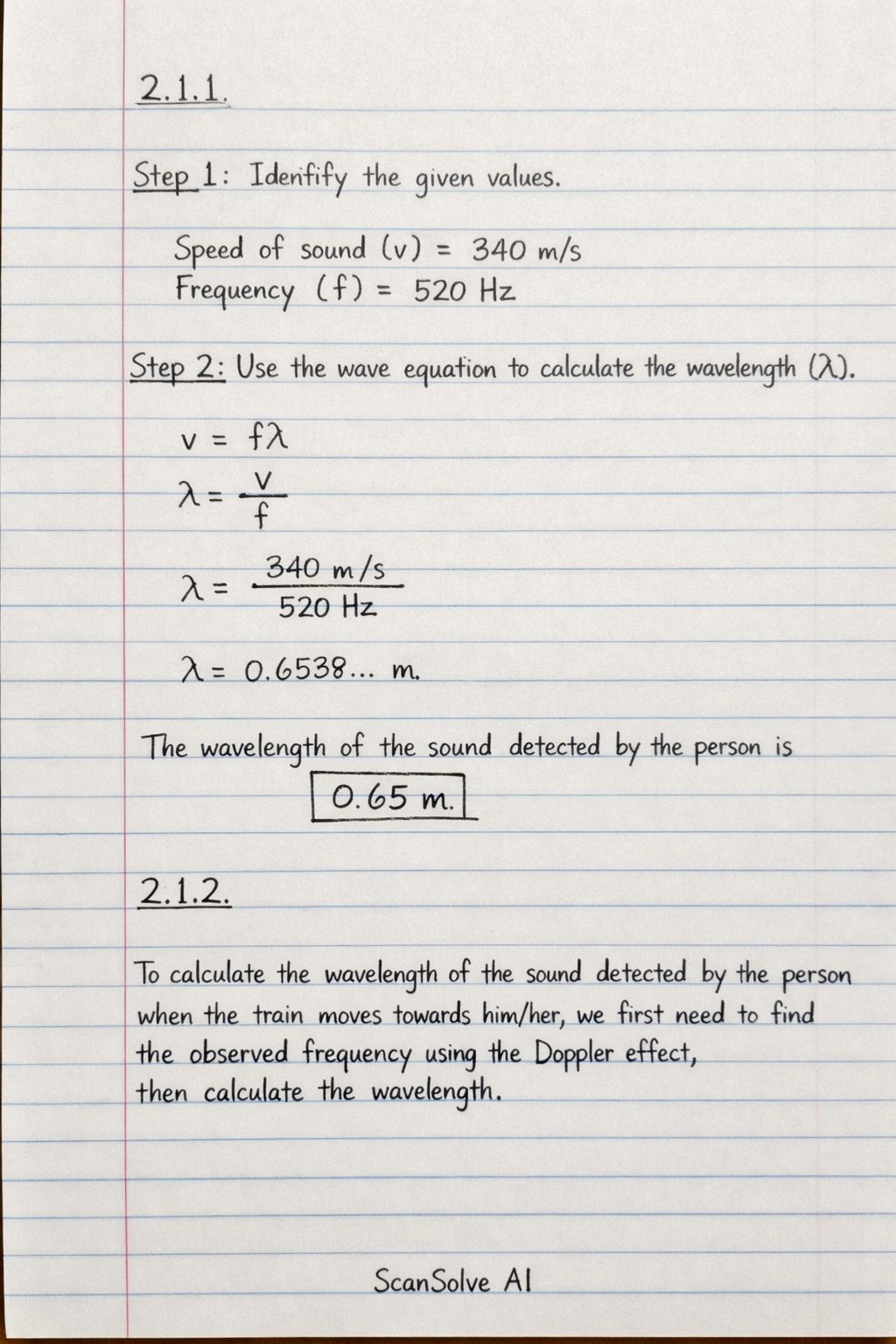
2.1.1
To calculate the wavelength of the sound detected by the person when the train is stationary, we use the wave equation.
Identify the given values.
The speed of sound () is .
The frequency of the sound () is .Use the wave equation to calculate the wavelength ().
The wavelength of the sound detected by the person is .
2.1.2
To calculate the wavelength of the sound detected by the person when the train moves towards him/her, we first need to find the observed frequency using the Doppler effect, then calculate the wavelength.
Identify the given values.
Speed of sound () =
Source frequency () =
Speed of source () = (moving towards the observer)
Speed of observer () = (stationary)Calculate the observed frequency () using the Doppler effect formula for a source moving towards a stationary observer.
Calculate the observed wavelength () using the wave equation with the observed frequency.
The wavelength of the sound detected by the person is .
2.2
The wavelength calculated in QUESTION 2.1.1 (0.65 m) is longer than that obtained in QUESTION 2.1.2 (0.63 m) because of the Doppler effect. When the train (source) moves towards the person (observer), the sound wavefronts are compressed in the direction of motion. This compression results in a shorter observed wavelength and a higher observed frequency for the sound reaching the person.
2.3
Red shift is an astronomical phenomenon where light from distant galaxies appears to have its wavelength shifted towards the red end of the electromagnetic spectrum. This is explained by the Doppler effect for light.
When a light source moves away from an observer, the observed wavelength of the light increases (shifts towards red), and its observed frequency decreases. Conversely, if a light source moves towards an observer, the observed wavelength decreases (shifts towards blue), and its observed frequency increases.
The observation of red shift in light from most distant galaxies indicates that these galaxies are moving away from Earth. The greater the red shift, the faster the galaxy is receding. This phenomenon provides strong evidence for the expansion of the universe.
Still stuck on this one?
Ask a follow-up, and the answer starts from this question.
More Physics Questions
Handwritten Step-by-Step Solution
Get this as a handwritten image on WhatsApp — like a tutor wrote it for you.
Try on WhatsApp