We read your photo as:

A uniform meter rule is pivoted at the 70 cm mark. Forces of 0.1 N and 0.4 N act downwards at the 60 cm and 85 cm marks respectively. Calculate the weight of the meter rule if it is in equilibrium.

Physics

ScanSolve AI Answer

Answers

4 parts
9

A. 0.25N\text{A. 0.25N}

10

C. 40cm from the heavier mass\text{C. 40cm from the heavier mass}

11

C. 70g\text{C. 70g}

12

D. 10 Nm\text{D. 10 Nm}

Step-by-step solution

14 steps

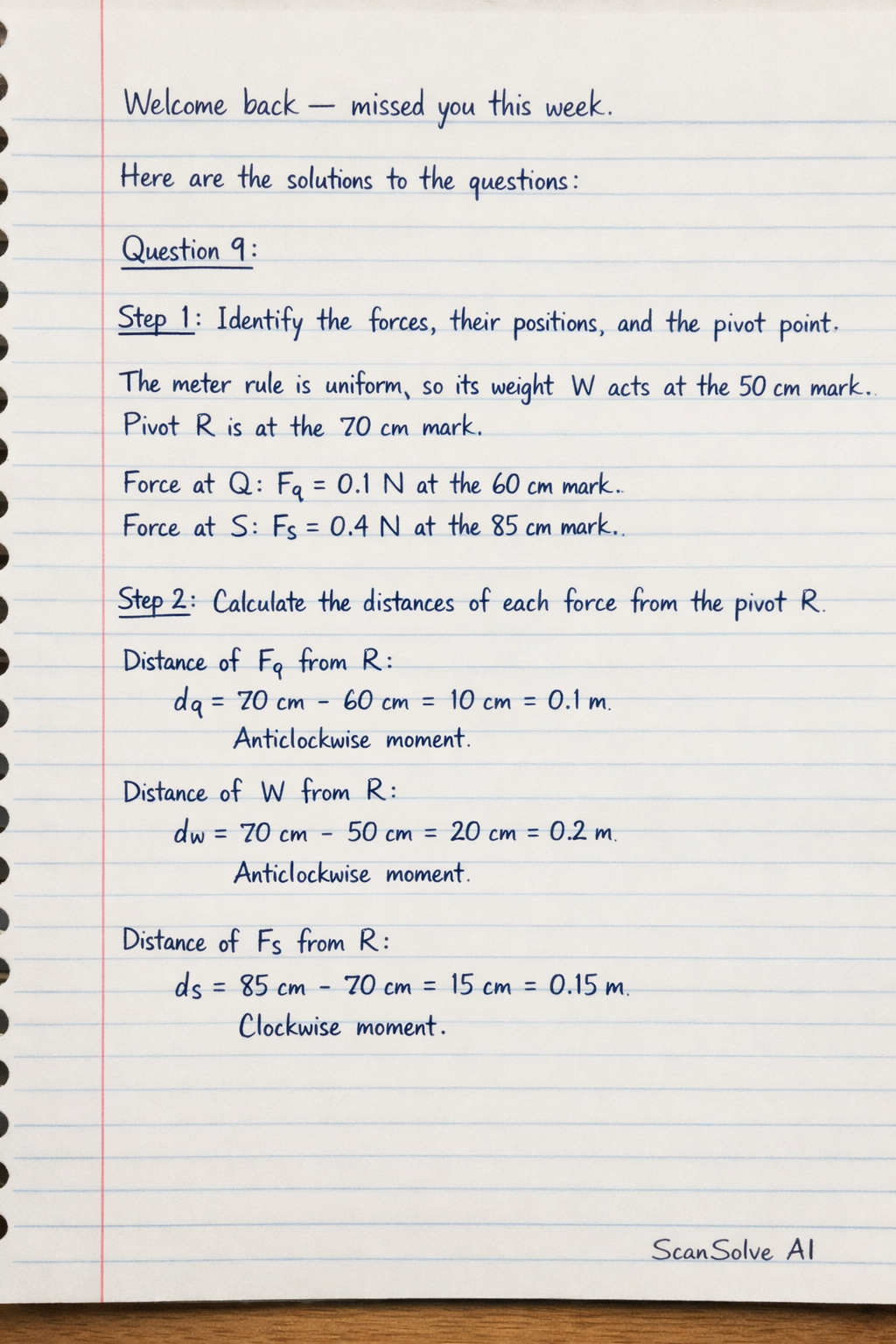
Here are the solutions to the questions:

Part 9· 4 steps

  1. Identify the forces, their positions, and the pivot point.

    The meter rule is uniform, so its weight WW acts at the 50 cm mark.
    The pivot R is at the 70 cm mark.
    Force at Q is FQ=0.1 NF_Q = 0.1 \, \text{N} at the 60 cm mark.
    Force at S is FS=0.4 NF_S = 0.4 \, \text{N} at the 85 cm mark.

  2. Calculate the distances of each force from the pivot R.

    Distance of FQF_Q from R: dQ=70 cm−60 cm=10 cm=0.1 md_Q = 70 \, \text{cm} - 60 \, \text{cm} = 10 \, \text{cm} = 0.1 \, \text{m}. This creates an anticlockwise moment.
    Distance of WW from R: dW=70 cm−50 cm=20 cm=0.2 md_W = 70 \, \text{cm} - 50 \, \text{cm} = 20 \, \text{cm} = 0.2 \, \text{m}. This creates an anticlockwise moment.
    Distance of FSF_S from R: dS=85 cm−70 cm=15 cm=0.15 md_S = 85 \, \text{cm} - 70 \, \text{cm} = 15 \, \text{cm} = 0.15 \, \text{m}. This creates a clockwise moment.

  3. Apply the principle of moments for equilibrium (sum of anticlockwise moments = sum of clockwise moments).

    (FQ×dQ)+(W×dW)=(FS×dS)(F_Q \times d_Q) + (W \times d_W) = (F_S \times d_S) (0.1 N×0.1 m)+(W×0.2 m)=(0.4 N×0.15 m)(0.1 \, \text{N} \times 0.1 \, \text{m}) + (W \times 0.2 \, \text{m}) = (0.4 \, \text{N} \times 0.15 \, \text{m}) 0.01 Nm+0.2W=0.06 Nm0.01 \, \text{Nm} + 0.2W = 0.06 \, \text{Nm}
  4. Solve for WW.

    0.2W=0.06−0.010.2W = 0.06 - 0.01 0.2W=0.050.2W = 0.05 W=0.050.2W = \frac{0.05}{0.2} W=0.25 NW = 0.25 \, \text{N}

    The weight of the meter rule is A. 0.25N\boxed{\text{A. 0.25N}}.

Part 10

C. 40cm from the heavier mass\text{C. 40cm from the heavier mass}

  1. Define the positions of the masses.

    Assume the meter rule extends from 0 cm to 100 cm.
    Lighter mass m1=40 gm_1 = 40 \, \text{g} is at x1=0 cmx_1 = 0 \, \text{cm}.
    Heavier mass m2=60 gm_2 = 60 \, \text{g} is at x2=100 cmx_2 = 100 \, \text{cm}.

  2. Calculate the center of gravity (XCGX_{CG}) using the formula XCG=∑mixi∑miX_{CG} = \frac{\sum m_i x_i}{\sum m_i}.

    XCG=(m1×x1)+(m2×x2)m1+m2X_{CG} = \frac{(m_1 \times x_1) + (m_2 \times x_2)}{m_1 + m_2} XCG=(40 g×0 cm)+(60 g×100 cm)40 g+60 gX_{CG} = \frac{(40 \, \text{g} \times 0 \, \text{cm}) + (60 \, \text{g} \times 100 \, \text{cm})}{40 \, \text{g} + 60 \, \text{g}} XCG=0+6000 g cm100 gX_{CG} = \frac{0 + 6000 \, \text{g cm}}{100 \, \text{g}} XCG=60 cmX_{CG} = 60 \, \text{cm}
  3. Interpret the result in relation to the options.

    The center of gravity is at the 60 cm mark.
    Option C states "40cm from the heavier mass". The heavier mass is at 100 cm. 100 cm−40 cm=60 cm100 \, \text{cm} - 40 \, \text{cm} = 60 \, \text{cm}. This matches our calculated position.
    The center of gravity of the system is C. 40cm from the heavier mass\boxed{\text{C. 40cm from the heavier mass}}.

Part 11

C. 70g\text{C. 70g}

  1. Identify the forces, their positions, and the pivot point.

    The meter rule QR is uniform, so its mass MM acts at the 50 cm mark (midpoint of QR, assuming Q is 0 cm and R is 100 cm).
    A mass of mP=10 gm_P = 10 \, \text{g} is hung at P, 10 cm from Q. So P is at the 10 cm mark.
    The knife edge (pivot) is 55 cm from R. This means the pivot is at 100 cm−55 cm=45 cm100 \, \text{cm} - 55 \, \text{cm} = 45 \, \text{cm} from Q.

  2. Calculate the distances of each mass from the pivot (45 cm mark).

    Distance of mPm_P from pivot: dP=45 cm−10 cm=35 cmd_P = 45 \, \text{cm} - 10 \, \text{cm} = 35 \, \text{cm}. This creates an anticlockwise moment.
    Distance of rule's mass MM from pivot: dM=50 cm−45 cm=5 cmd_M = 50 \, \text{cm} - 45 \, \text{cm} = 5 \, \text{cm}. This creates a clockwise moment.

  3. Apply the principle of moments for equilibrium.

    (mP×dP)=(M×dM)(m_P \times d_P) = (M \times d_M) (10 g×35 cm)=(M×5 cm)(10 \, \text{g} \times 35 \, \text{cm}) = (M \times 5 \, \text{cm}) 350 g cm=M×5 cm350 \, \text{g cm} = M \times 5 \, \text{cm}
  4. Solve for MM.

    M=350 g cm5 cmM = \frac{350 \, \text{g cm}}{5 \, \text{cm}} M=70 gM = 70 \, \text{g}

    The mass of the meter rule is C. 70g\boxed{\text{C. 70g}}.

Part 12

D. 10 Nm\text{D. 10 Nm}

  1. Identify the force and the pivot point.

    The force F=5 NF = 5 \, \text{N} acts at point Y.
    The pivot point is X.

  2. Identify the perpendicular distance from the pivot to the line of action of the force.

    The distance between X and Y is XY=2 mXY = 2 \, \text{m}. The diagram shows the force acting perpendicular to the rod at Y.

  3. Calculate the moment of the force about point X using the formula Moment = Force ×\times Perpendicular distance.

    Moment=F×XY\text{Moment} = F \times XY Moment=5 N×2 m\text{Moment} = 5 \, \text{N} \times 2 \, \text{m} Moment=10 Nm\text{Moment} = 10 \, \text{Nm}

    The moment of the force about point X is D. 10 Nm\boxed{\text{D. 10 Nm}}.

Was this helpful?

Try one yourself

A new problem that tests the same skill.

Still stuck on this one?

Ask a follow-up, and the answer starts from this question.

Got a different question?Ask your own question
Handwritten step-by-step solution preview

Handwritten Step-by-Step Solution

Get this as a handwritten image on WhatsApp — like a tutor wrote it for you.

Try on WhatsApp