We read your photo as:

A vertical frame of two legs shown below has a weight of 50kN hanging from point A. Determine the forces in legs 'AB' and 'AC' produced by the 50kN weight.

Physics

ScanSolve AI Answer

Answer

Force in leg AB

33.434 kN\text{33.434 kN}

Force in leg AC

25.979 kN\text{25.979 kN}

Step-by-step solution

4 steps
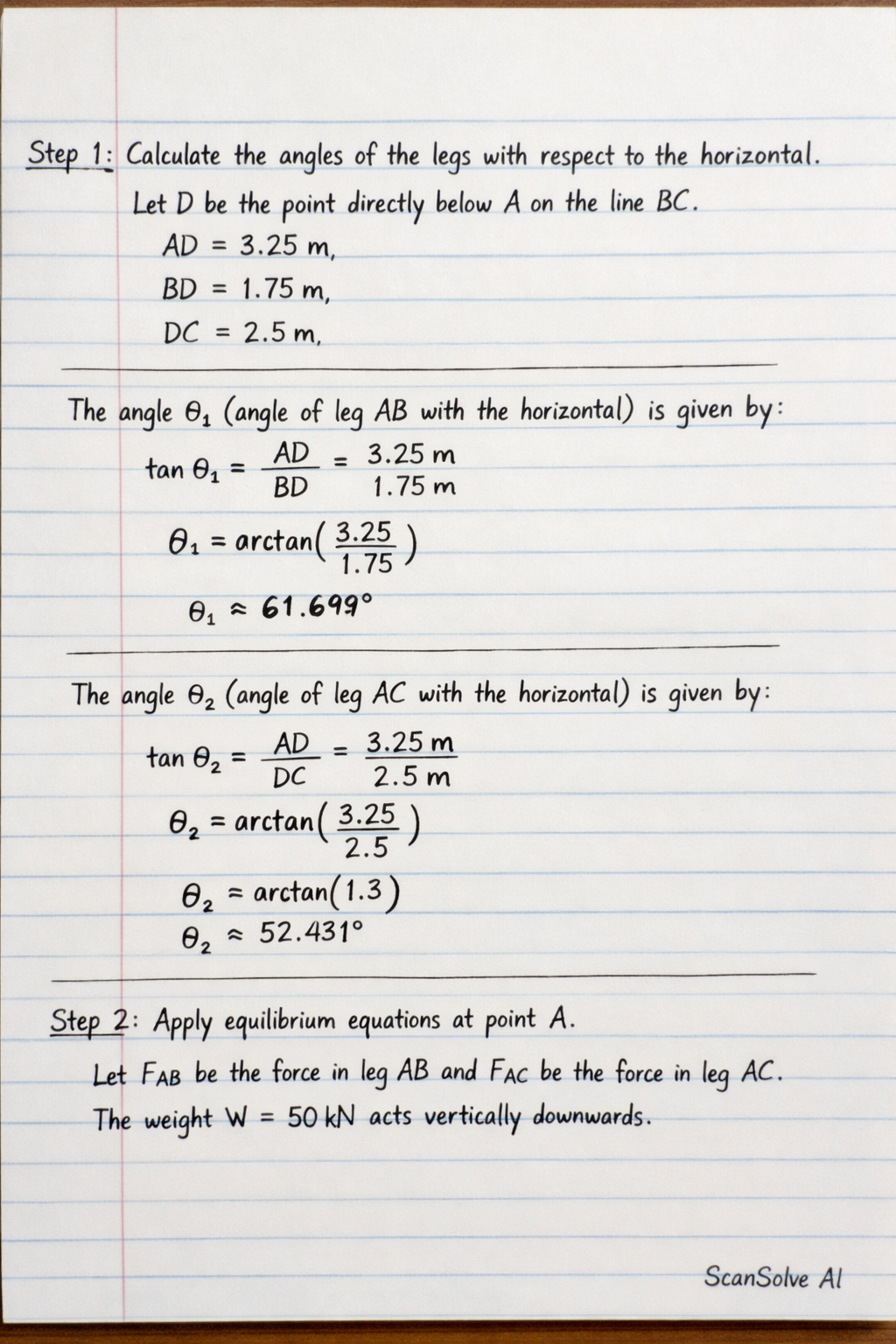
  1. Calculate the angles of the legs with respect to the horizontal.

    Let D be the point directly below A on the line BC.
    The height AD=3.25 mAD = 3.25 \, \text{m}.
    The horizontal distance BD=1.75 mBD = 1.75 \, \text{m}.
    The horizontal distance DC=2.5 mDC = 2.5 \, \text{m}.

    The angle θ1\theta_1 (angle of leg AB with the horizontal) is given by:

    tan⁡(θ1)=ADBD=3.25 m1.75 m\tan(\theta_1) = \frac{AD}{BD} = \frac{3.25 \, \text{m}}{1.75 \, \text{m}} θ1=arctan⁡(3.251.75)≈61.699∘\theta_1 = \arctan\left(\frac{3.25}{1.75}\right) \approx 61.699^\circ

    The angle θ2\theta_2 (angle of leg AC with the horizontal) is given by:

    tan⁡(θ2)=ADDC=3.25 m2.5 m\tan(\theta_2) = \frac{AD}{DC} = \frac{3.25 \, \text{m}}{2.5 \, \text{m}} θ2=arctan⁡(3.252.5)=arctan⁡(1.3)≈52.431∘\theta_2 = \arctan\left(\frac{3.25}{2.5}\right) = \arctan(1.3) \approx 52.431^\circ
  2. Apply equilibrium equations at point A.

    Let FABF_{AB} be the force in leg AB and FACF_{AC} be the force in leg AC. The weight W=50 kNW = 50 \, \text{kN} acts vertically downwards.

    Sum of forces in the horizontal direction (∑Fx=0\sum F_x = 0):

    FACcos⁡(θ2)−FABcos⁡(θ1)=0F_{AC} \cos(\theta_2) - F_{AB} \cos(\theta_1) = 0 FACcos⁡(θ2)=FABcos⁡(θ1)(Equation 1)F_{AC} \cos(\theta_2) = F_{AB} \cos(\theta_1) \quad (\text{Equation 1})

    Sum of forces in the vertical direction (∑Fy=0\sum F_y = 0):

    FABsin⁡(θ1)+FACsin⁡(θ2)−W=0F_{AB} \sin(\theta_1) + F_{AC} \sin(\theta_2) - W = 0 FABsin⁡(θ1)+FACsin⁡(θ2)=W(Equation 2)F_{AB} \sin(\theta_1) + F_{AC} \sin(\theta_2) = W \quad (\text{Equation 2})
  3. Substitute the calculated angles and trigonometric values into the equations.

    Using θ1≈61.699∘\theta_1 \approx 61.699^\circ and θ2≈52.431∘\theta_2 \approx 52.431^\circ:
    cos⁡(θ1)≈0.4740\cos(\theta_1) \approx 0.4740
    sin⁡(θ1)≈0.8805\sin(\theta_1) \approx 0.8805
    cos⁡(θ2)≈0.6100\cos(\theta_2) \approx 0.6100
    sin⁡(θ2)≈0.7926\sin(\theta_2) \approx 0.7926

    From Equation 1:

    FAC(0.6100)=FAB(0.4740)F_{AC} (0.6100) = F_{AB} (0.4740) FAC=FAB0.47400.6100≈0.7770FABF_{AC} = F_{AB} \frac{0.4740}{0.6100} \approx 0.7770 F_{AB}

    Substitute this expression for FACF_{AC} into Equation 2:

    FAB(0.8805)+(0.7770FAB)(0.7926)=50 kNF_{AB} (0.8805) + (0.7770 F_{AB}) (0.7926) = 50 \, \text{kN} FAB(0.8805)+FAB(0.6150)=50 kNF_{AB} (0.8805) + F_{AB} (0.6150) = 50 \, \text{kN} FAB(1.4955)=50 kNF_{AB} (1.4955) = 50 \, \text{kN}
  4. Solve for FABF_{AB} and FACF_{AC}.

    FAB=50 kN1.4955≈33.434 kNF_{AB} = \frac{50 \, \text{kN}}{1.4955} \approx 33.434 \, \text{kN}

    Now, calculate FACF_{AC}:

    FAC=0.7770×33.434 kN≈25.979 kNF_{AC} = 0.7770 \times 33.434 \, \text{kN} \approx 25.979 \, \text{kN}

    The forces in the legs are:

    • Force in leg AB: 33.434 kN\boxed{\text{33.434 kN}}
    • Force in leg AC: 25.979 kN\boxed{\text{25.979 kN}}
Was this helpful?

Try one yourself

A new problem that tests the same skill.

Still stuck on this one?

Ask a follow-up, and the answer starts from this question.

Got a different question?Ask your own question
Handwritten step-by-step solution preview

Handwritten Step-by-Step Solution

Get this as a handwritten image on WhatsApp — like a tutor wrote it for you.

Try on WhatsApp