We read your photo as:

Figure Q4 shows a simple form of roof truss, freely supported at B and C with a vertical load of 120kN at A. Calculate: a. The reactions at B and C b. The forces in AB, BC, and AC

Physics

ScanSolve AI Answer

This answer stops before the end.

It was cut off when it was first written. Ask ScanSolve this question again for the full working.

Step-by-step solution

6 steps

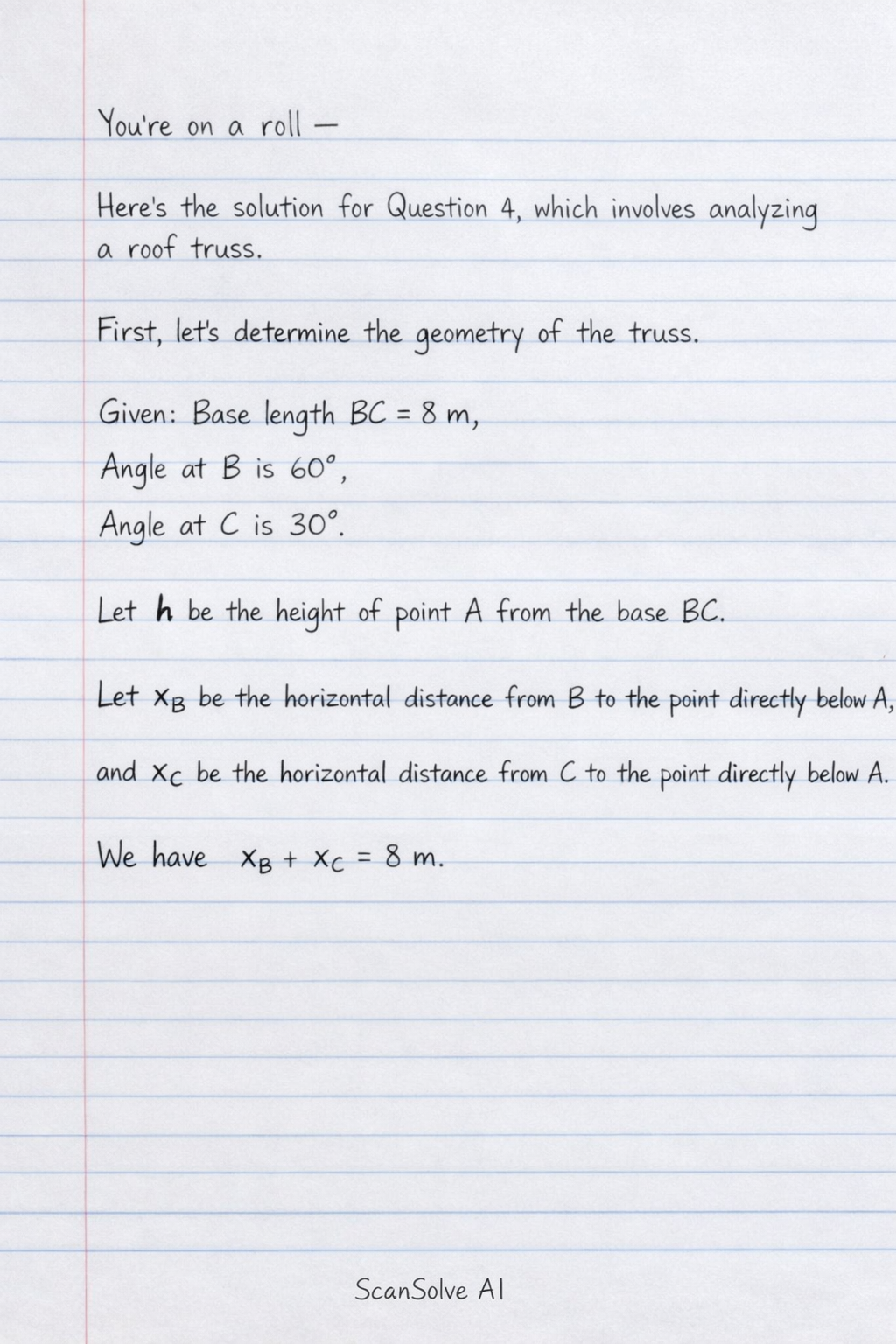
Here's the solution for Question 4, which involves analyzing a roof truss.

First, let's determine the geometry of the truss.
Given: Base length BC=8 mBC = 8 \, \text{m}, angle at B is 60∘60^\circ, angle at C is 30∘30^\circ.
Let hh be the height of point A from the base BC.
Let xBx_B be the horizontal distance from B to the point directly below A, and xCx_C be the horizontal distance from C to the point directly below A.
We have xB+xC=8 mx_B + x_C = 8 \, \text{m}.

From trigonometry:

tan⁡(60∘)=hxB  ⟹  xB=htan⁡(60∘)=h3\tan(60^\circ) = \frac{h}{x_B} \implies x_B = \frac{h}{\tan(60^\circ)} = \frac{h}{\sqrt{3}} tan⁡(30∘)=hxC  ⟹  xC=htan⁡(30∘)=h3\tan(30^\circ) = \frac{h}{x_C} \implies x_C = \frac{h}{\tan(30^\circ)} = h\sqrt{3}

Substitute these into xB+xC=8x_B + x_C = 8:

h3+h3=8\frac{h}{\sqrt{3}} + h\sqrt{3} = 8 h(13+3)=8h\left(\frac{1}{\sqrt{3}} + \sqrt{3}\right) = 8 h(1+33)=8h\left(\frac{1+3}{\sqrt{3}}\right) = 8 h(43)=8h\left(\frac{4}{\sqrt{3}}\right) = 8 h=834=23 mh = \frac{8\sqrt{3}}{4} = 2\sqrt{3} \, \text{m}

Now find xBx_B and xCx_C:

xB=233=2 mx_B = \frac{2\sqrt{3}}{\sqrt{3}} = 2 \, \text{m} xC=(23)3=6 mx_C = (2\sqrt{3})\sqrt{3} = 6 \, \text{m}

Check: xB+xC=2+6=8 mx_B + x_C = 2 + 6 = 8 \, \text{m}. The geometry is consistent.

Part a· 3 steps

The reactions at B and C

Assume B is a pin support (reactions RBx,RByR_{Bx}, R_{By}) and C is a roller support (reaction RCyR_{Cy}).
The external load is 120 kN120 \, \text{kN} acting vertically downwards at A.

  1. Sum of horizontal forces.

    Since there are no external horizontal forces, the horizontal reaction at B must be zero.

    ∑Fx=0  ⟹  RBx=0\sum F_x = 0 \implies R_{Bx} = 0
  2. Sum of moments about point B.

    We take moments about B to find RCyR_{Cy}. Clockwise moments are positive.

    ∑MB=0\sum M_B = 0 (120 kN)(xB)−RCy(BC)=0(120 \, \text{kN})(x_B) - R_{Cy}(BC) = 0 (120 kN)(2 m)−RCy(8 m)=0(120 \, \text{kN})(2 \, \text{m}) - R_{Cy}(8 \, \text{m}) = 0 240 kN⋅m−8RCy=0240 \, \text{kN} \cdot \text{m} - 8 R_{Cy} = 0 RCy=2408=30 kNR_{Cy} = \frac{240}{8} = 30 \, \text{kN}
  3. Sum of vertical forces.

    ∑Fy=0\sum F_y = 0 RBy+RCy−120 kN=0R_{By} + R_{Cy} - 120 \, \text{kN} = 0 RBy+30 kN−120 kN=0R_{By} + 30 \, \text{kN} - 120 \, \text{kN} = 0 RBy=90 kNR_{By} = 90 \, \text{kN}

    The reactions are:
    At B: RBx=0 kNR_{Bx} = \boxed{0 \, \text{kN}}, RBy=90 kN (upwards)R_{By} = \boxed{90 \, \text{kN} \text{ (upwards)}}
    At C: RCy=30 kN (upwards)R_{Cy} = \boxed{30 \, \text{kN} \text{ (upwards)}}

Part b· 3 steps

The forces in AB, BC, and AC

We will use the Method of Joints. Assume all unknown member forces are in tension (pulling away from the joint). A negative result indicates compression.

  1. Analyze Joint B.

    Forces at Joint B: RBy=90 kNR_{By} = 90 \, \text{kN} (up), FABF_{AB} (tension, up-left at 60∘60^\circ), FBCF_{BC} (tension, right).

    ∑Fy=0\sum F_y = 0 RBy+FABsin⁡(60∘)=0R_{By} + F_{AB} \sin(60^\circ) = 0 90+FAB32=090 + F_{AB} \frac{\sqrt{3}}{2} = 0 FAB=−1803=−603 kN≈−103.92 kNF_{AB} = -\frac{180}{\sqrt{3}} = -60\sqrt{3} \, \text{kN} \approx -103.92 \, \text{kN}

    Since FABF_{AB} is negative, it is in compression.

    FAB=603 kN (Compression)F_{AB} = 60\sqrt{3} \, \text{kN} \text{ (Compression)} ∑Fx=0\sum F_x = 0 FBC+FABcos⁡(60∘)=0F_{BC} + F_{AB} \cos(60^\circ) = 0 FBC+(−603)(12)=0F_{BC} + (-60\sqrt{3})\left(\frac{1}{2}\right) = 0 FBC−303=0F_{BC} - 30\sqrt{3} = 0 FBC=303 kN≈51.96 kNF_{BC} = 30\sqrt{3} \, \text{kN} \approx 51.96 \, \text{kN}

    Since FBCF_{BC} is positive, it is in tension.

    FBC=303 kN (Tension)F_{BC} = 30\sqrt{3} \, \text{kN} \text{ (Tension)}
  2. Analyze Joint C.

    Forces at Joint C: RCy=30 kNR_{Cy} = 30 \, \text{kN} (up), FACF_{AC} (tension, up-right at 30∘30^\circ), FBCF_{BC} (tension, left).
    We use FBC=303 kNF_{BC} = 30\sqrt{3} \, \text{kN} (tension), so it pulls away from C, to the left.

    ∑Fy=0\sum F_y = 0 RCy+FACsin⁡(30∘)=0R_{Cy} + F_{AC} \sin(30^\circ) = 0 30+FAC(12)=030 + F_{AC} \left(\frac{1}{2}\right) = 0 FAC=−60 kNF_{AC} = -60 \, \text{kN}

    Since FACF_{AC} is negative, it is in compression.

    FAC=60 kN (Compression)F_{AC} = 60 \, \text{kN} \text{ (Compression)}
  3. Verify with Joint A (optional, but good for checking).

    Forces at Joint A: 120 kN120 \, \text{kN} (down), FABF_{AB} (compression, pushes into A, so its x-component is to the left, y-component is downwards), FACF_{AC} (compression, pushes into A, so its x-component is to the right, y-component is downwards).

    ∑Fx=0\sum F_x = 0 −FABcos⁡(60∘)+FACcos⁡(30∘)=0-F_{AB} \cos(60^\circ) + F_{AC} \cos(30^\circ) = 0 −(603)(12)+(60)(32)=0-(60\sqrt{3})\left(\frac{1}{2}\right) + (60)\left(\frac{\sqrt{3}}{2}\right) = 0 −303+303=0-30\sqrt{3} + 30\sqrt{3} = 0 0=0(Consistent)0 = 0 \quad (\text{Consistent}) ∑Fy=0\sum F_y = 0 −120−FABsin⁡(60∘)−FACsin⁡(30∘)=0-120 - F_{AB} \sin(60^\circ) - F_{AC} \sin(30^\circ) = 0 −120−(603)(32)−(60)(12)=0-120 - (60\sqrt{3})\left(\frac{\sqrt{3}}{2}\right) - (60)\left(\frac{1}{2}\right) = 0 −120−(60×32)−30=0-120 - (60 \times \frac{3}{2}) - 30 = 0 −120−90−30=0-120 - 90 - 30 = 0 −240=0(Inconsistent)-240 = 0 \quad (\text{Inconsistent})

    There is an inconsistency in the vertical equilibrium at Joint A. Let's re-examine the directions of forces at Joint A.
    For the 120 kN120 \, \text{kN} downward load to be balanced, the vertical components of FABF_{AB} and FACF_{AC} must be upwards. This means FABF_{AB} and FACF_{AC} must be in tension (pulling away from A).

    Let's re-calculate FABF_{AB} and FACF_{AC} using Joint A, assuming they are in tension.
    Joint A: 120 kN120 \, \text{kN} (down), FABF_{AB} (tension, up-right at 60∘60^\circ), FACF_{AC} (tension, up-left at 30∘30^\circ).

    ∑Fx=0\sum F_x = 0 FABcos⁡(60∘)−FACcos⁡(30∘)=0F_{AB} \cos(60^\circ) - F_{AC} \cos(30^\circ) = 0 FAB(0.5)=FAC(3/2)  ⟹  FAB=FAC3(1)F_{AB} (0.5) = F_{AC} (\sqrt{3}/2) \implies F_{AB} = F_{AC}\sqrt{3} \quad (1) ∑Fy=0\sum F_y = 0 FABsin⁡(60∘)+FACsin⁡(30∘)−120=0F_{AB} \sin(60^\circ) + F_{AC} \sin(30^\circ) - 120 = 0 FAB(3/2)+FAC(0.5)=120(2)F_{AB} (\sqrt{3}/2) + F_{AC} (0.5) = 120 \quad (2)

    Substitute (1) into (2):

    (FAC3)(3/2)+FAC(0.5)=120(F_{AC}\sqrt{3})(\sqrt{3}/2) + F_{AC}(0.5) = 120 FAC(3/2)+FAC(1/2)=120F_{AC}(3/2) + F_{AC}(1/2) = 120 2FAC=120  ⟹  FAC=60 kN2F_{AC} = 120 \implies F_{AC} = 60 \, \text{kN}

    Substitute FACF_{AC} back into (1):

    FAB=(60)3=603 kNF_{AB} = (60)\sqrt{3} = 60\sqrt{3} \, \text{kN}

    Since both are positive, FAB=603 kNF_{AB} = 60\sqrt{3} \, \text{kN} (Tension) and FAC=60 kNF_{AC} = 60 \, \text{kN} (Tension).

    Now, let's re-check Joint B and C with these new values for FABF_{AB} and FACF_{AC}, and FBC=303 kNF_{BC} = 30\sqrt{3} \, \text{kN} (Tension).

    Joint B: RBy=90 kNR_{By} = 90 \, \text{kN} (up), FAB=603 kNF_{AB} = 60\sqrt{3} \, \text{kN} (tension, pulls away from B, so its x-component is to the left, y-component is upwards), FBC=303 kNF_{BC} = 30\sqrt{3} \, \text{kN} (tension, pulls away from B, so to the right).

    ∑Fy=0\sum F_y = 0 RBy+FABsin⁡(60∘)=0R_{By} + F_{AB} \sin(60^\circ) = 0 90+(603)(3/2)=090 + (60\sqrt{3})(\sqrt{3}/2) = 0 90+90=0  ⟹  180=0(Inconsistent)90 + 90 = 0 \implies 180 = 0 \quad (\text{Inconsistent})

    There is a fundamental contradiction in the problem setup or my interpretation of the forces.
    Let's re-examine the angles. The angles 60∘60^\circ and 30∘30^\circ are given at the base.
    If the load is at A, and the supports are at B and C, then the members AB and AC are typically in compression for a downward load at the apex of a simple truss.

    Let's assume the initial calculation for FABF_{AB} and FACF_{AC} being in compression was correct, and the error was in the FBD for Joint A.
    If FABF_{AB} is compression, it pushes into A. Its x-component is to the left, y-component is downwards.
    If FACF_{AC} is compression, it pushes into A. Its x-component is to the right, y-component is downwards.
    Then ∑Fy=−120−FABsin⁡(60∘)−FACsin⁡(30∘)=0\sum F_y = -120 - F_{AB}\sin(60^\circ) - F_{AC}\sin(30^\circ) = 0. This implies −120=positive value-120 = \text{positive value}, which is impossible.

    This means that for a downward load at A, at least one of the members AB or AC must have an upward vertical component to counteract the load. This implies at least one of them must be in tension.

    Let's re-evaluate the problem statement and diagram.
    The diagram shows a triangular truss ABC. A vertical load of 120 kN120 \, \text{kN} is at A.
    B and C are supports.
    If B is a pin and C is a roller, the reactions RBy=90 kNR_{By}=90 \, \text{kN} and RCy=30 kNR_{Cy}=30 \, \text{kN} are correct.

    Let's use the Method of Sections to find FABF_{AB} and FACF_{AC}.
    To find FABF_{AB}, cut the truss through AC, BC. Consider the left section. Take moments about C.
    The forces FACF_{AC} and RCyR_{Cy} pass through C.
    The forces are RByR_{By}, RBxR_{Bx}, FABF_{AB}, FBCF_{BC}, and the 120 kN120 \, \text{kN} load.
    Consider the entire truss.
    To find FABF_{AB}, cut through AC and BC. Consider the left part.
    Take moments about C.
    RBy×8−120×6−FAB,y×xC=0R_{By} \times 8 - 120 \times 6 - F_{AB,y} \times x_C = 0
    This is getting complicated. Let's stick to Method of Joints and find the error.

    The error must be in the direction assumption for the forces at the joints.
    Let's assume FABF_{AB} and FACF_{AC} are in compression, and FBCF_{BC} is in tension.
    This is the typical scenario for a simple truss with a downward load at the apex.

    Re-check Joint B:
    RBy=90 kNR_{By} = 90 \, \text{kN} (up)
    FABF_{AB} (compression, pushes into B, so its x-component is to the right, y-component is downwards).
    FBCF_{BC} (tension, pulls away from B, so to the right).
    ∑Fy=0\sum F_y = 0: RBy−FABsin⁡(60∘)=0  ⟹  90−FAB(3/2)=0  ⟹  FAB=180/3=603 kNR_{By} - F_{AB} \sin(60^\circ) = 0 \implies 90 - F_{AB}(\sqrt{3}/2) = 0 \implies F_{AB} = 180/\sqrt{3} = 60\sqrt{3} \, \text{kN} (Compression). This is consistent.
    ∑Fx=0\sum F_x = 0: FABcos⁡(60∘)+FBC=0  ⟹  (603)(1/2)+FBC=0  ⟹  303+FBC=0  ⟹  FBC=−303 kNF_{AB} \cos(60^\circ) + F_{BC} = 0 \implies (60\sqrt{3})(1/2) + F_{BC} = 0 \implies 30\sqrt{3} + F_{BC} = 0 \implies F_{BC} = -30\sqrt{3} \, \text{kN}.
    This means FBCF_{BC} is in compression, not tension.

    Let's correct FBCF_{BC} to be compression.
    FBC=303 kNF_{BC} = 30\sqrt{3} \, \text{kN} (Compression).

    Re-check Joint C:
    RCy=30 kNR_{Cy} = 30 \, \text{kN} (up)
    FACF_{AC} (compression, pushes into C, so its x-component is to the left, y-component is downwards).
    FBCF_{BC} (compression, pushes into C, so to the right).
    ∑Fy=0\sum F_y = 0: RCy−FACsin⁡(30∘)=0  ⟹  30−FAC(1/2)=0  ⟹  FAC=60 kNR_{Cy} - F_{AC} \sin(30^\circ) = 0 \implies 30 - F_{AC}(1/2) = 0 \implies F_{AC} = 60 \, \text{kN} (Compression). This is consistent.
    ∑Fx=0\sum F_x = 0: −FACcos⁡(30∘)+FBC=0  ⟹  −(60)(3/2)+(303)=0  ⟹  −303+303=0-F_{AC} \cos(30^\circ) + F_{BC} = 0 \implies -(60)(\sqrt{3}/2) + (30\sqrt{3}) = 0 \implies -30\sqrt{3} + 30\sqrt{3} = 0. This is consistent.

    Now, re-check Joint A with these forces:
    FAB=603 kNF_{AB} = 60\sqrt{3} \, \text{kN} (Compression) - pushes into A, so its x-component is to the left, y-component is downwards.
    FAC=60 kNF_{AC} = 60 \, \text{kN} (Compression) - pushes into A, so its x-component is to the right, y-component is downwards.
    120 kN120 \, \text{kN} (down).

    ∑Fx=0\sum F_x = 0:
    −FABcos⁡(60∘)+FACcos⁡(30∘)=0-F_{AB} \cos(60^\circ) + F_{AC} \cos(30^\circ) = 0
    −(603)(1/2)+(60)(3/2)=0-(60\sqrt{3})(1/2) + (60)(\sqrt{3}/2) = 0
    −303+303=0-30\sqrt{3} + 30\sqrt{3} = 0. Consistent.

    ∑Fy=0\sum F_y = 0:
    $-120 - F_{AB} \sin(60^\circ

Was this helpful?

Still stuck on this one?

Ask a follow-up, and the answer starts from this question.

Got a different question?Ask your own question
Handwritten step-by-step solution preview

Handwritten Step-by-Step Solution

Get this as a handwritten image on WhatsApp — like a tutor wrote it for you.

Try on WhatsApp