
We read your photo as:
Identify the number of zero force members present in the truss shown
ScanSolve AI Answer
Answer
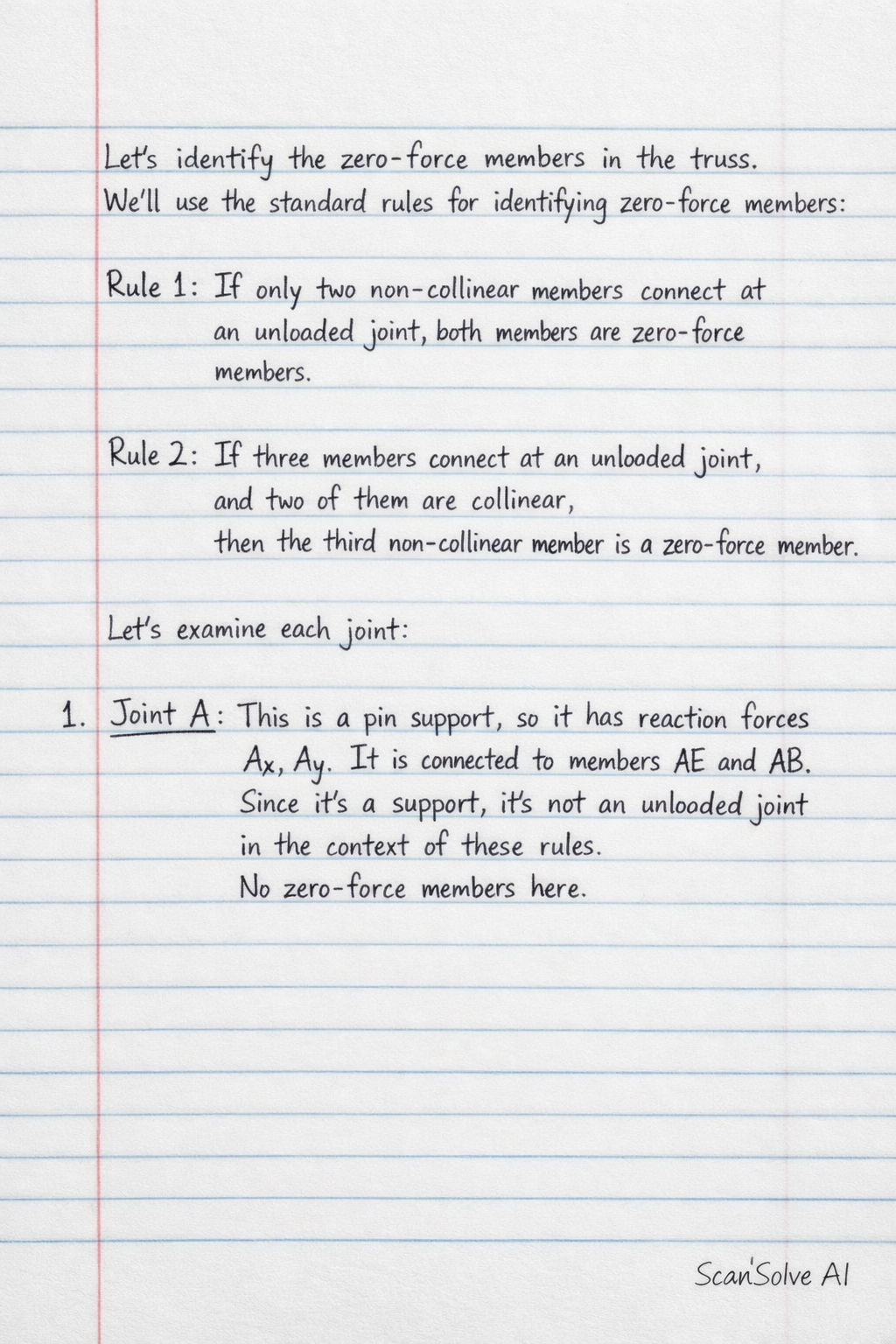
Let's identify the zero-force members in the truss. We'll use the standard rules for identifying zero-force members:
- Rule 1: If only two non-collinear members connect at an unloaded joint, both members are zero-force members.
- Rule 2: If three members connect at an unloaded joint, and two of them are collinear, then the third non-collinear member is a zero-force member.
Let's examine each joint:
-
Joint A: This is a pin support, so it has reaction forces (). It is connected to members AE and AB. Since it's a support, it's not an unloaded joint in the context of these rules. No zero-force members here.
-
Joint B: This joint is unloaded. It connects four members: AB, BC, BE, and BD.
- Members AB and BC are collinear (horizontal).
- Member BE is vertical.
- Member BD is diagonal. Since there are four members, Rule 2 (for three members) does not directly apply. If we sum forces in the vertical direction at joint B: . This means the vertical component of must be balanced by . Since is likely non-zero due to the loads at E, will also be non-zero. Thus, BE is not a zero-force member. No zero-force members here.
-
Joint C: This is a roller support. The 30-degree angle indicates the direction of the reaction force, or the angle of member CD with the horizontal. Assuming the ground is horizontal, the roller reaction is typically vertical. However, the 30-degree angle is explicitly shown for member CD with the horizontal. This joint is a support, so it's not an unloaded joint. No zero-force members here.
-
Joint E: This joint has external loads (450 lb horizontally and 600 lb vertically). Therefore, it is not an unloaded joint. No zero-force members here.
-
Joint D: This joint is unloaded. It connects three members: BD, DE, and DC.
- Visually, none of these three members appear to be collinear with each other.
- Member DC makes an angle of with the horizontal (as indicated in the diagram).
- Members BD and DE are also diagonal. Since no two members are collinear at this unloaded joint, Rule 2 does not apply.
Based on a direct application of the standard rules for zero-force members, and assuming the visual representation of the truss geometry is accurate, there are no zero-force members in this truss.
However, in some contexts, a member might be considered zero-force if it's redundant or if its force is zero under specific loading conditions that are not immediately obvious from the rules. Given the common patterns for zero-force members, and the explicit question asking to "identify the number", it's possible there's a subtle interpretation.
Let's re-examine joint D. If we consider the forces at joint D, and assume the members are not collinear, then for equilibrium, all three members must carry a force to balance each other's components.
Therefore, based on the standard rules and visual inspection:
The number of zero-force members is 0.
Try one yourself
A new problem that tests the same skill.
Still stuck on this one?
Ask a follow-up, and the answer starts from this question.
More Physics Questions
Handwritten Step-by-Step Solution
Get this as a handwritten image on WhatsApp — like a tutor wrote it for you.
Try on WhatsApp