
We read your photo as:
A worker pulls a crate with a mass of 30kg from rest along a horizontal floor, by applying a constant force of magnitude 50 N at an angle of 30° to the horizontal. A frictional force of magnitude 20 N acts on the crate whilst it is moving along the floor.
ScanSolve AI Answer
Step-by-step solution
6 steps6.1 Define the term work.
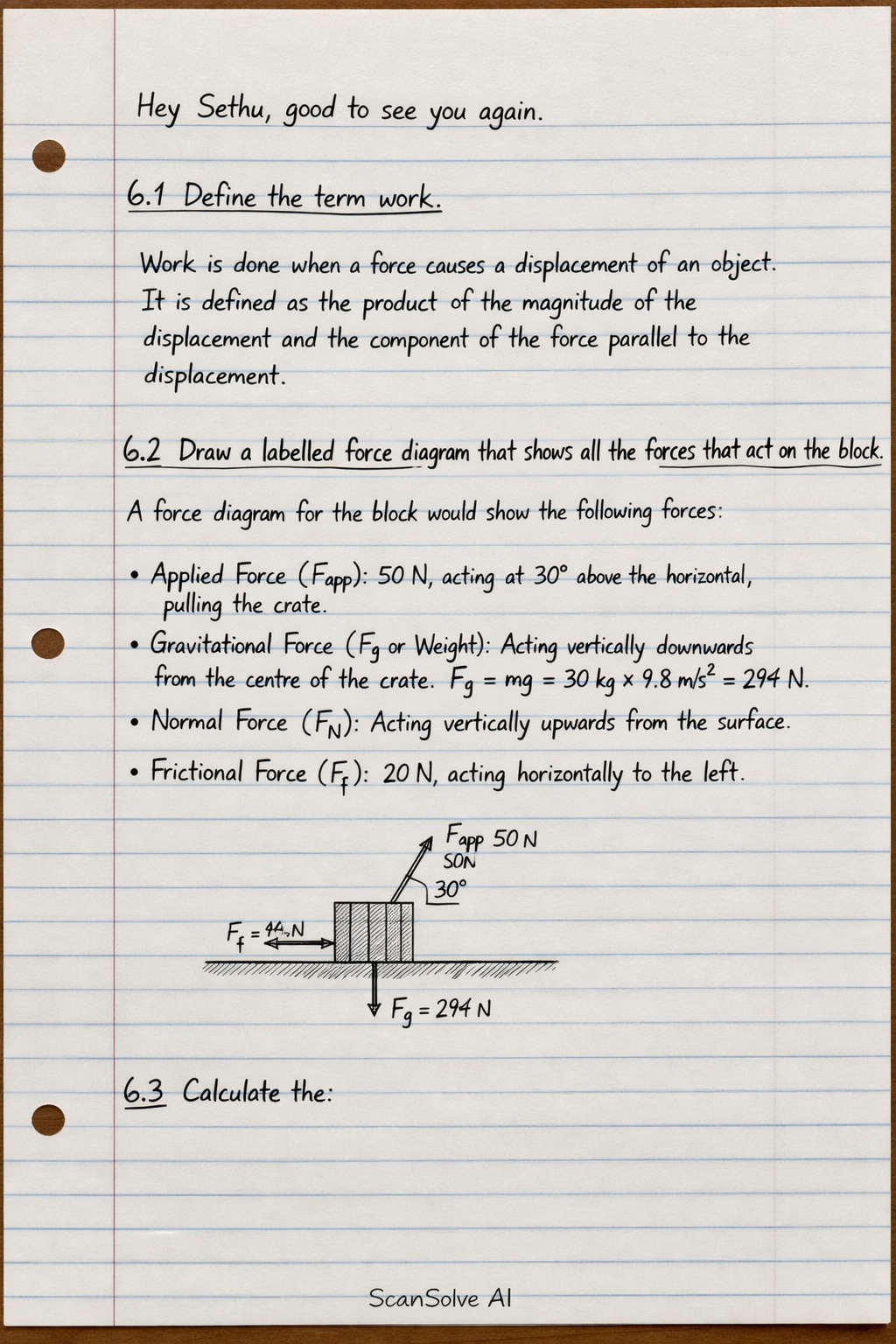
Work is done when a force causes a displacement of an object. It is defined as the product of the magnitude of the displacement and the component of the force parallel to the displacement.
6.2 Draw a labelled force diagram that shows all the forces that act on the block.
A force diagram for the block would show the following forces:
- Applied Force (): 50 N, acting at an angle of above the horizontal, pulling the crate.
- Gravitational Force ( or Weight): Acting vertically downwards from the center of the crate. .
- Normal Force (): Acting vertically upwards from the surface, perpendicular to the floor.
- Frictional Force (): 20 N, acting horizontally opposite to the direction of motion (to the left).
6.3 Calculate the:
6.3.1 magnitude of the horizontal component of the applied force.
Identify the applied force and angle.
The applied force is at an angle to the horizontal.
Calculate the horizontal component.
The magnitude of the horizontal component of the applied force is .
6.3.2 work done by the horizontal component of the applied force.
Identify the horizontal force and displacement.
The horizontal component of the applied force is (from 6.3.1).
The displacement is .Calculate the work done.
Work done () is given by . Since the force is horizontal and the displacement is horizontal, and .
The work done by the horizontal component of the applied force is .
6.3.3 work done due to the frictional force acting on the box.
Identify the frictional force and displacement.
The frictional force is .
The displacement is .Calculate the work done.
The frictional force acts opposite to the direction of motion, so the angle between the force and displacement is .
The work done due to the frictional force is .
Still stuck on this one?
Ask a follow-up, and the answer starts from this question.
More Physics Questions
Handwritten Step-by-Step Solution
Get this as a handwritten image on WhatsApp — like a tutor wrote it for you.
Try on WhatsApp