
About temperature and thermal equilibrium
ScanSolve AI Answer
Temperature is a fundamental thermodynamic property that quantifies the average translational kinetic energy of the microscopic particles (atoms or molecules) within a substance. At a university level, it's crucial to understand that temperature is an intensive property, meaning it does not depend on the amount of substance. The absolute temperature scale, Kelvin (K), is particularly important as it directly relates to the kinetic energy, with 0 K representing the theoretical point of zero kinetic energy (absolute zero). Temperature dictates the direction of spontaneous heat transfer: heat always flows from a region of higher temperature to a region of lower temperature.
Thermal equilibrium is a state where two or more systems in thermal contact have reached a uniform temperature throughout, and there is no net exchange of heat energy between them. This concept is formalized by the Zeroth Law of Thermodynamics, which states: "If two systems are each in thermal equilibrium with a third system, then they are in thermal equilibrium with each other." This law is foundational because it allows for the consistent definition and measurement of temperature. When systems are in thermal equilibrium, their macroscopic properties, such as pressure and volume, also stabilize, indicating a stable thermodynamic state. The process of reaching thermal equilibrium involves heat transfer mechanisms like conduction, convection, and radiation, which work to equalize temperature differences.
Still stuck on this one?
Ask a follow-up, and the answer starts from this question.
More Physics Questions
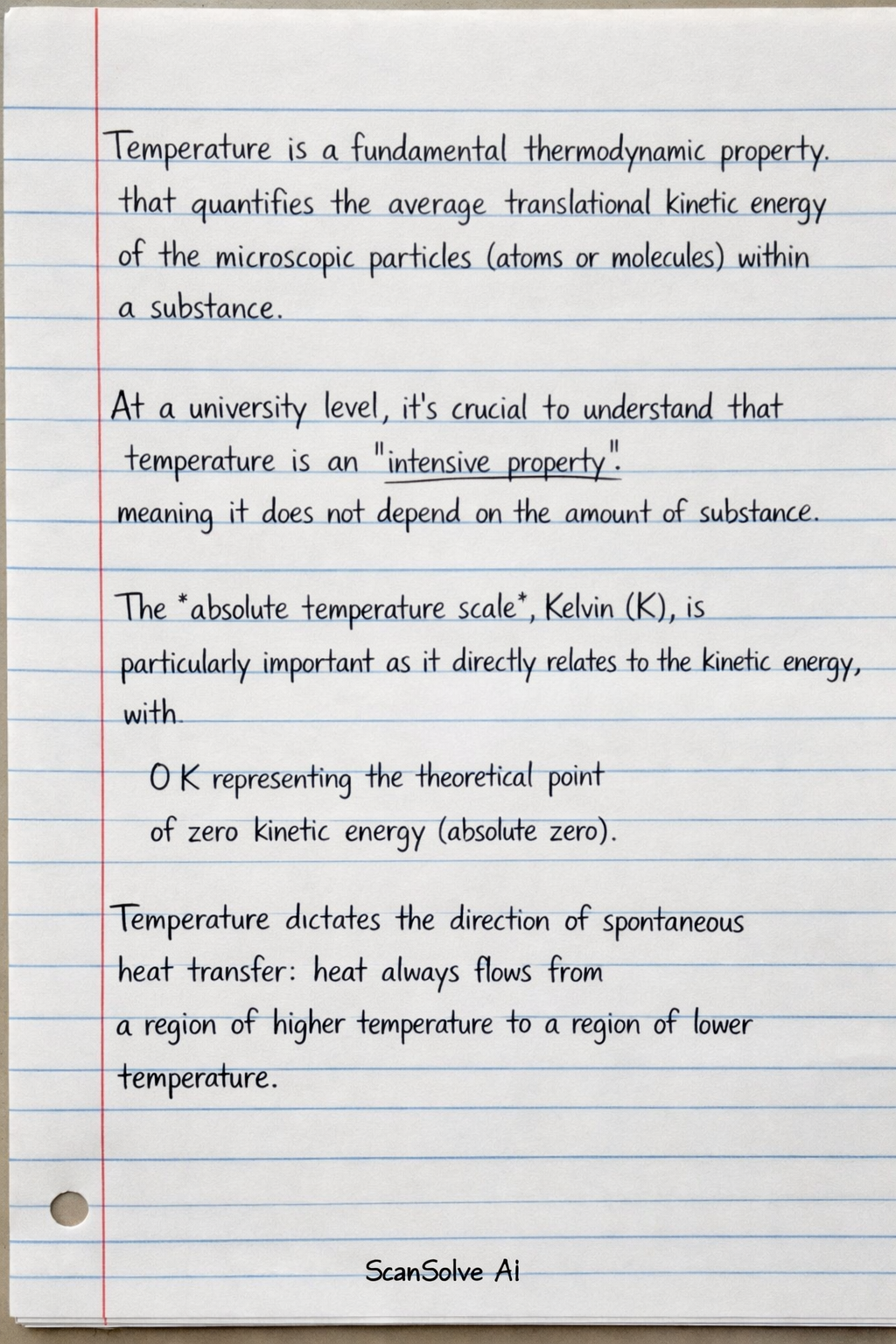
Handwritten Step-by-Step Solution
Get this as a handwritten image on WhatsApp — like a tutor wrote it for you.
Try on WhatsApp