
We read your photo as:
An object of mass 24 kg is on a frictionless inclined plane at an angle of 37 degrees. If it starts from rest and covers 18 m in 3.0 s, what is the applied force?
ScanSolve AI Answer
Answers
2 partsStep-by-step solution
4 stepsHere's a step-by-step solution to the problem:
Given Information:
- Mass of the object,
- Angle of inclination,
- Initial velocity, (starts from rest)
- Distance covered,
- Time taken,
- Acceleration due to gravity,
- The plane is frictionless.
Step 1: Calculate the acceleration () of the object.
Since the object starts from rest and moves a certain distance in a given time, we can use the kinematic equation:
Given :
Step 2: Calculate the applied force () acting on the object.
The forces acting along the incline are the applied force () upwards and the component of gravity () downwards. According to Newton's second law, the net force is .
Using :
Part a· 2 steps
What is the average power required to accomplish the process?
Calculate the total work done () by the applied force.
Work done is the product of force and displacement in the direction of the force:
Calculate the average power ().
Average power is the total work done divided by the time taken:
Rounding to three significant figures:
The average power required is .
Part b
What is the instantaneous power required at the end of the 3.0 second interval?
Calculate the final velocity () at .
Using the kinematic equation:
Calculate the instantaneous power () at .
Instantaneous power is the product of the applied force and the instantaneous velocity:
Rounding to three significant figures:
The instantaneous power required at the end of the 3.0 second interval is .
Try one yourself
A new problem that tests the same skill.
Still stuck on this one?
Ask a follow-up, and the answer starts from this question.
More Physics Questions
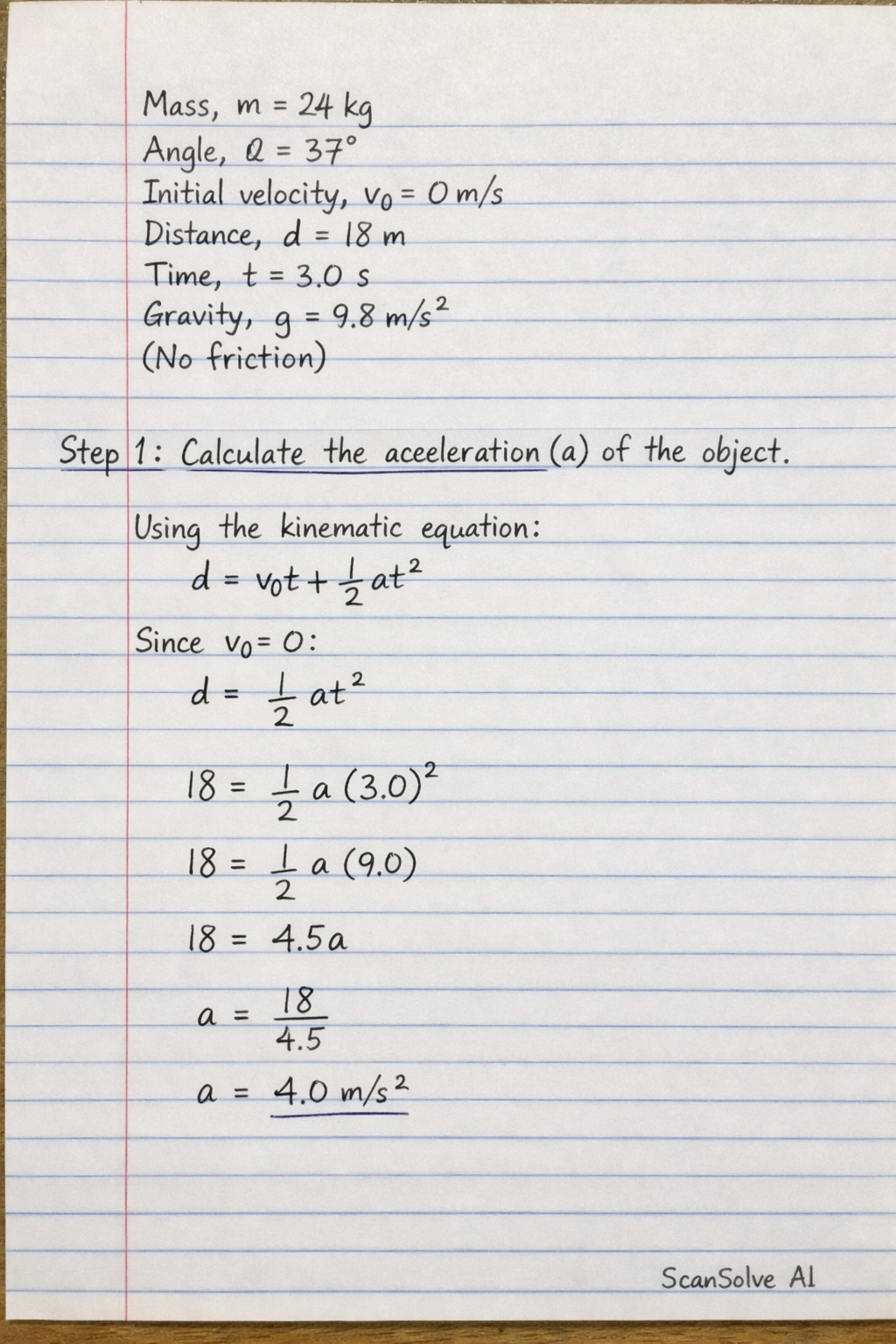
Handwritten Step-by-Step Solution
Get this as a handwritten image on WhatsApp — like a tutor wrote it for you.
Try on WhatsApp